
Pales weevil (Root pine weevil)
Hylobius aliradicis
Description
How to identify
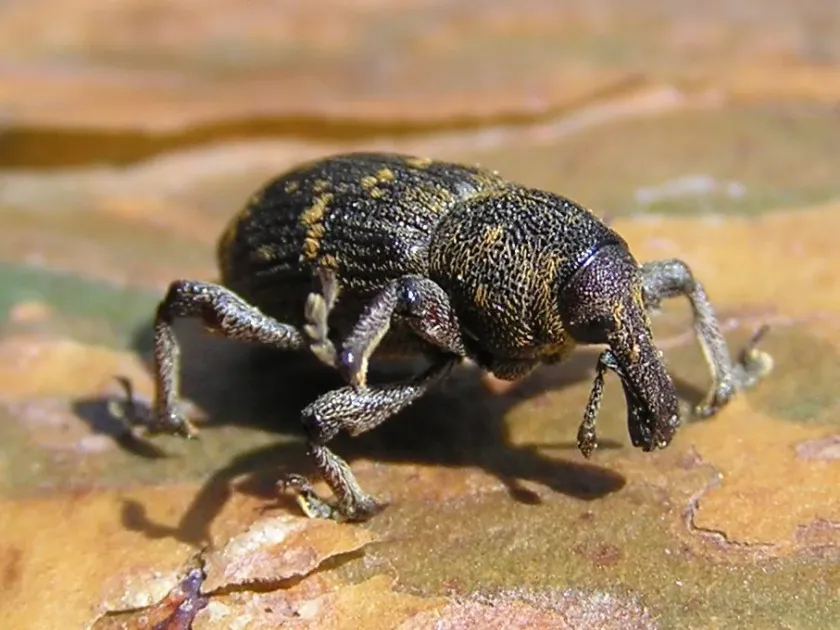
The root pine weevil (Hylobius aliradicis) is a member of the Curculionidae family, belonging to the order Coleoptera. Adult beetles typically measure 10–12 mm in length and exhibit a dark brown to black coloration.
These weevils possess a characteristic long snout or rostrum, which they use to feed on the bark of young seedlings. Their bodies are covered in fine scales that provide excellent camouflage against pine bark and forest debris.
The larval stage consists of legless, creamy-white larvae with distinct brown head capsules. These larvae are responsible for the most significant damage as they feed internally on the root systems.
The life cycle of this species is primarily focused on weakened or dying trees and stumps. Unlike some of its relatives, this species specifically targets the underground portions of the host plant.
Due to their nocturnal nature, identifying these beetles requires night surveys. During the day, they remain well-hidden within the organic matter of the forest floor or deep within bark crevices.
What it damages
The primary hosts of the root pine weevil are various species of pines, especially in reforestation areas. Young seedlings and saplings are most vulnerable, often suffering high mortality rates.
Larval feeding destroys the cambium layer in the root collar and main roots. This disruption of the phloem and xylem prevents the flow of nutrients, leading to the yellowing of needles and eventual tree death.
Damage by this pest significantly weakens the host, making it susceptible to secondary infestations by bark beetles or wood-boring insects. This compounding effect often kills trees faster than the weevil would alone.
In large-scale forestry operations, the presence of these weevils can cause substantial economic losses, forcing replanting efforts and increased management costs to protect young stands.
Infestations are often localized initially but can spread rapidly if forest hygiene is neglected, particularly in areas where old stumps are left to rot, providing perfect breeding grounds.
When it appears
Adult weevils typically emerge in the spring as temperatures rise, signaling the start of their feeding and reproductive cycle. They migrate to fresh host material to mate and lay eggs.
The larval stage is long and often lasts for one or even two full seasons, depending on local environmental conditions and the quality of the host root system.
Summer is the period of most intense larval activity, as the warmer temperatures accelerate their development within the wood. The root systems of the host trees are actively consumed during this time.
Winter is spent in hibernation. Adults typically overwinter in the soil or under debris, while larvae remain sheltered inside the roots of their host tree, surviving the cold weather.
Regional variations play a major role in the timing of the life cycle. Warmer climates may allow for more rapid development and potentially overlapping generations, increasing the pressure on forest stands.
Signs of infestation
Early symptoms of an infestation include foliage discoloration, specifically yellowing or browning of the needles, which indicates that the tree is no longer receiving adequate water and nutrients.
Inspection of the root collar often reveals pitch flow, where the tree is attempting to seal wounds created by the larvae. The bark may show small, irregular entry or exit holes.
The presence of fine wood shavings, or frass, around the base of the tree is a strong indicator of larval activity inside the root tissues. This debris is pushed out by the feeding larvae.
In cases of severe infestation, a light tug on the top of a young seedling may result in it pulling out of the ground easily because the root system has been largely consumed or girdled.
Adult weevils may be spotted at night near the base of the stems. If disturbed, they often exhibit a defensive behavior called thanatosis, or playing dead, by dropping to the ground.
Control measures
The most effective strategy is the removal of pine stumps shortly after harvest. Stumps act as the primary breeding reservoir, and their elimination drastically reduces the local pest population.
Fallow periods are recommended between harvesting and replanting. Leaving an area vacant for a season can starve the developing larvae and break the pest's reproductive cycle.
Chemical control involving systemic insecticides applied to the base of the trees or as a soil drench can protect seedlings during their most vulnerable early growth stage.
Biological controls, such as the use of entomopathogenic nematodes, are becoming a preferred method. These organisms seek out the larvae within the root systems without leaving toxic residues in the soil.
- Monitor adult populations using bait logs or pheromone traps.
- Promote mixed-species forest stands to reduce host density.
- Ensure high-quality silvicultural practices to maximize tree vigor.
- Routinely scout plantations for the earliest signs of needle yellowing.
Taxonomy
- Latin name
- Hylobius aliradicis
- Order
- Coleoptera (beetles)
- Family
- Curculionidae
- EPPO code
- HYLOAL
Discussion
No discussions yet — be the first.