
Large pine weevil
Hylobius
Description
How to identify
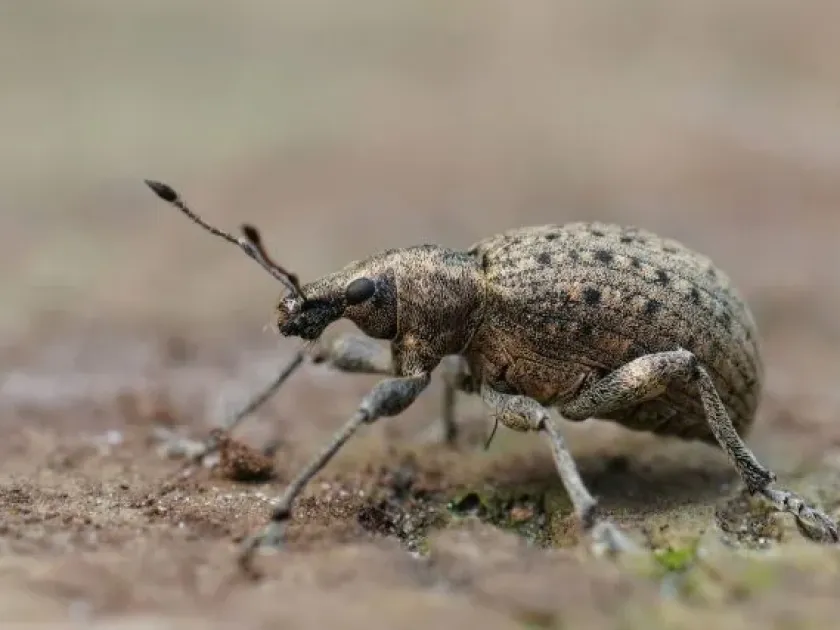
The large pine weevil (Hylobius abietis) is a member of the Curculionidae family in the Coleoptera order. The adult beetle is between 7 and 14 mm long, with a robust, oval-shaped body.
The coloration of the insect ranges from reddish-brown to almost black. It is distinguished by patches of yellow or grey hairs on its wing covers, which form distinct transverse bands.
The snout is of medium length, with antennae attached near the middle. The larvae are legless, white, with a well-developed brown head, reaching up to 15 mm in length.
The life cycle of the weevil usually spans from one to three years, depending on environmental factors such as temperature, humidity, and the availability of host material.
Adults typically overwinter in the forest floor litter, while larvae remain protected within the roots and stumps of host trees, ensuring survival through harsh winters.
What it damages
This pest is highly destructive to coniferous species, including pine, spruce, fir, and larch, particularly threatening young saplings in reforestation areas.
Adult beetles pose the greatest threat to young trees aged 1 to 5 years. They feed on the bark of the stem and root collar, disrupting nutrient flow and causing the saplings to wither and die.
Larvae develop within the roots of stumps and dying trees, creating extensive galleries. This feeding weakens the root system and contributes to the spread of secondary pests like bark beetles.
The risk of infestation is exceptionally high in areas where clear-felling has occurred recently, as the abundant stump supply provides ideal breeding conditions.
Economic losses in forestry can be severe, often resulting in the total failure of new plantations if prophylactic measures are not implemented during the first years of growth.
When it appears
Adult weevils emerge in the spring, typically from April to May, as soon as soil temperatures reach approximately 10–12 degrees Celsius, signaling the start of their feeding activity.
The most intense feeding period occurs during late spring and early summer. Although activity may drop during the peak heat of midsummer, it often increases again in late summer.
Feeding continues until the onset of late autumn frosts, after which the adults migrate to the soil or debris layer for the winter dormancy period.
Saplings are most vulnerable during the first three years following planting, which corresponds with the period of high adult beetle activity.
Effective monitoring and population assessment are generally conducted in early spring, just as the insects become active after overwintering.
Signs of infestation
The most reliable sign of an infestation is the presence of irregular, chewed patches on the bark of young saplings, often extending down to the woody tissue.
Severe attacks lead to girdling of the stem, which prevents the transport of water and nutrients, causing the young tree to yellow and die relatively quickly.
The presence of brown frass (wood dust) near the base of stumps or saplings is a clear indication of ongoing larval or adult feeding activity beneath the bark.
Excessive resin flow from wounds on the stem is a common defense response by the tree, although it is often insufficient to stop a large-scale beetle attack.
- Characteristic bark-chewing wounds;
- Stem girdling at the root collar;
- Yellowing and premature death of saplings;
- Visible presence of adult beetles during inspections.
Control measures
The primary control strategy is silvicultural: delaying the planting of new conifer stands for 2–3 years after harvest allows stumps to decay, reducing food availability.
The use of trap logs (freshly cut pine wood) is an effective method to aggregate beetles for later collection and destruction, serving as both a monitoring and control tool.
Chemical control involving the application of insecticides to saplings can protect them during the vulnerable stage, particularly in high-risk plantation areas.
Sanitation practices, such as the removal or stump treatment of logging residue, minimize the habitat suitability for the weevil's larval development.
Encouraging natural predators, including insectivorous birds and parasitic insects, is recommended to help maintain weevil populations below the economic injury threshold.
Taxonomy
- Latin name
- Hylobius
- Order
- Coleoptera (beetles)
- Family
- Curculionidae
- EPPO code
- HYLOSP
Discussion
No discussions yet — be the first.