
Ash bark beetle
Hylesinus crenatus
Description
How to identify
The Ash bark beetle (Hylesinus crenatus) is a member of the Curculionidae family, subfamily Scolytinae, known for its destructive impact on trees.
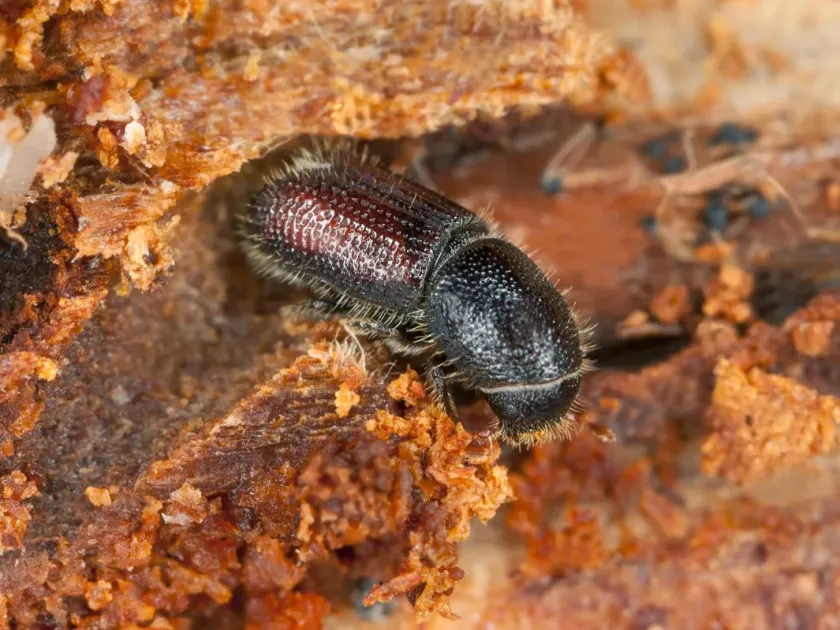
The adult beetle is relatively large, measuring between 3.5 and 5 mm in length, with a robust, cylindrical body shape.
It is characterized by a dark, often brownish-black color and a surface covered with dense, short scales that provide a dull appearance.
The larvae are legless, white in color, and have a distinct, slightly darker head, usually maintaining a curved, C-shape posture.
Pupation occurs within small chambers, or cradles, excavated by the larvae in the layer of bark or sapwood before they emerge as adults.
What it damages
The primary host for this beetle is the European ash (Fraxinus excelsior), though it can also infest other species within the Fraxinus genus.
These insects bore into the bark, constructing intricate galleries in the inner bark and cambium, which disrupts the transport of water and nutrients.
While they prefer stressed or dying trees, large populations can easily attack and overcome healthy ash trees in urban and forest settings.
The physical damage caused by these galleries severely weakens the tree's vascular system, eventually leading to branch dieback and overall tree death.
Beyond ecological damage, infested wood loses its commercial and aesthetic value, making it a major concern for both forestry and landscaping.
When it appears
The flight period for the Ash bark beetle generally begins in spring, typically in April or May, when temperatures are consistently warm.
Upon emerging, adults undergo a period of maturation feeding on young twigs before moving to the main trunk for breeding purposes.
The life cycle typically takes one year to complete, but in cooler climates or under specific environmental conditions, it may span two years.
Larval development takes place throughout the summer months, during which time they continuously expand their galleries.
The species overwinters primarily as adults, staying within their maternal galleries or in protected niches at the base of the tree trunk.
Signs of infestation
A classic sign of infestation is the appearance of "frass"—a mixture of wood dust and excrement—that accumulates near entrance holes on the bark.
Careful inspection of the trunk reveals numerous small, circular entry holes where the beetles have penetrated the outer bark.
Underneath the bark, one can observe the characteristic gallery patterns, which often form complex labyrinths that damage the cambium.
Crown symptoms include foliage thinning, premature yellowing, and the eventual wilting and drying of the upper branches.
In advanced stages of infestation, large patches of bark may begin to slough off the tree, exposing the galleries underneath.
Control measures
Sanitation is the cornerstone of control: promptly identifying and removing infested, dying, or wind-thrown trees is crucial to preventing population spikes.
Avoid leaving freshly cut ash timber or debris near healthy stands, as these provide optimal breeding material for the beetles.
Implementing trap trees or pheromone-based monitoring systems can help manage and reduce local populations in parks and residential areas.
For high-value specimen trees, targeted insecticide treatments applied to the bark can provide effective protection during the beetle's flight season.
Encouraging the presence of natural predators, such as woodpeckers and predatory wasps, can contribute to the long-term management of beetle populations.
Taxonomy
- Latin name
- Hylesinus crenatus
- Order
- Coleoptera (beetles)
- Family
- Curculionidae
- EPPO code
- HYESCR
Discussion
No discussions yet — be the first.