
Clover root borer
Hylastinus obscurus
Description
How to identify
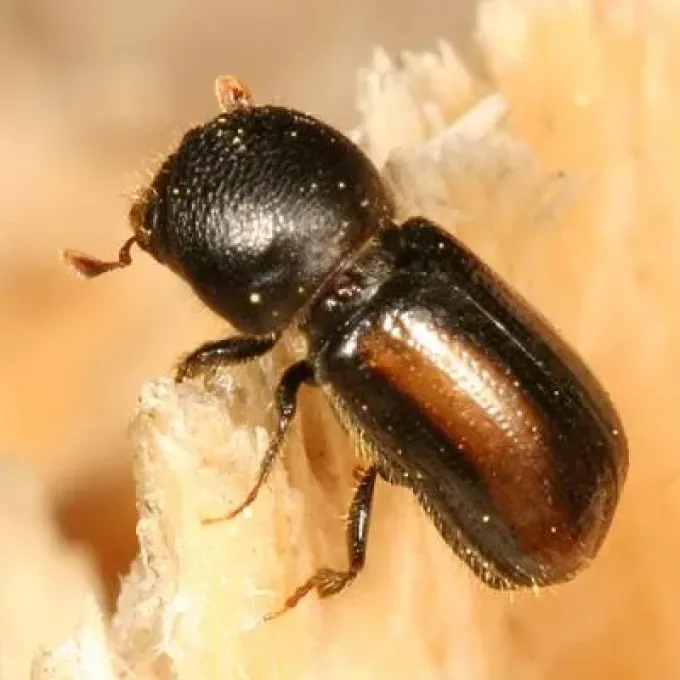
The clover root borer (Hylastinus obscurus) is a beetle belonging to the Curculionidae family and the Scolytinae subfamily. Adults are small, measuring about 2.0–2.5 mm in length, with an elongated, dark brown body.
The body is covered with fine, dense hairs, giving it a dull appearance. The pronotum is cylindrical and narrows toward the front, which is a key diagnostic feature for species identification.
The larvae are legless, white, and C-shaped. They develop entirely within the host plant's root system, making them invisible until significant damage has already occurred.
Pupae are white and free-living, developing within specific chambers constructed inside the root tissues by the larvae before pupation.
Adult beetles are capable of flight, allowing them to migrate efficiently between fields, especially during the spring dispersal period when seeking new clover stands.
What it damages
The primary hosts of the clover root borer are perennial legumes, most notably red, white, and alsike clover. Alfalfa may also serve as a host under certain conditions.
Both adults and larvae contribute to crop damage. Adults feed on the crown of the plant, creating small holes that serve as entry points for feeding and egg-laying.
Larvae feed by boring tunnels inside the taproot, which disrupts the vascular system and impairs the plant's ability to transport water and nutrients to the foliage.
Heavily infested plants show stunted growth and decreased vigor. In dry conditions, the damage often leads to plant death, significantly reducing the density of the clover stand.
The loss of plant health and stand density over several years shortens the economic life of clover fields, leading to decreased yields in subsequent harvests.
When it appears
Adults and late-stage larvae overwinter inside the roots of infested plants. In the spring, usually around April or May, adults emerge from the roots.
Emergence and migration to new fields coincide with rising temperatures. Adults feed on the crown tissues, which is a critical period for monitoring their presence.
Egg-laying typically occurs in May and June. Females create tunnels within the root crown to deposit eggs, which hatch into larvae that remain active throughout the summer.
The larval stage lasts through the summer months. Pupation occurs within the root structure by late summer or autumn, leading to the development of the new generation.
The species generally produces one generation per year, although the exact timing of the life cycle can vary based on regional climate and weather conditions.
Signs of infestation
The first indicator of an infestation is the premature wilting and yellowing of individual plants, which is often misdiagnosed as drought stress or root rot disease.
Close inspection of the taproot reveals entry holes and internal tunneling packed with brown frass, which is a mixture of excrement and chewed plant material.
Heavily damaged plants have weakened root systems and can be easily pulled from the soil, as the taproot structure is significantly compromised by larval galleries.
Scattered patches of dying plants appear throughout the field. These patches tend to expand over time as the population of the borer increases in the stand.
Excavating the root crown and slicing the taproot longitudinally will often expose the larvae, pupae, or adult beetles inhabiting the internal galleries.
Control measures
The most effective management strategy is crop rotation. Avoiding clover cultivation on the same field for more than two consecutive years helps to break the pest cycle.
Plowing under older clover fields immediately after the last cutting can significantly reduce pest populations by destroying their habitat and larval development sites.
Maintaining high plant vigor through proper fertilization and sound agronomic practices enables clover to withstand moderate levels of feeding damage.
Regular field monitoring is essential. Early detection of patches allows for targeted management and preventing the spread of the infestation to adjacent areas.
Chemical control is rarely practiced due to the borer's concealed lifestyle. However, in extreme cases, insecticidal treatments during adult migration may be considered.
Taxonomy
- Latin name
- Hylastinus obscurus
- Order
- Coleoptera (beetles)
- Family
- Curculionidae
- EPPO code
- HYATOB
Discussion
No discussions yet — be the first.