
Black pine beetle
Hylastes porculus
Description
How to identify
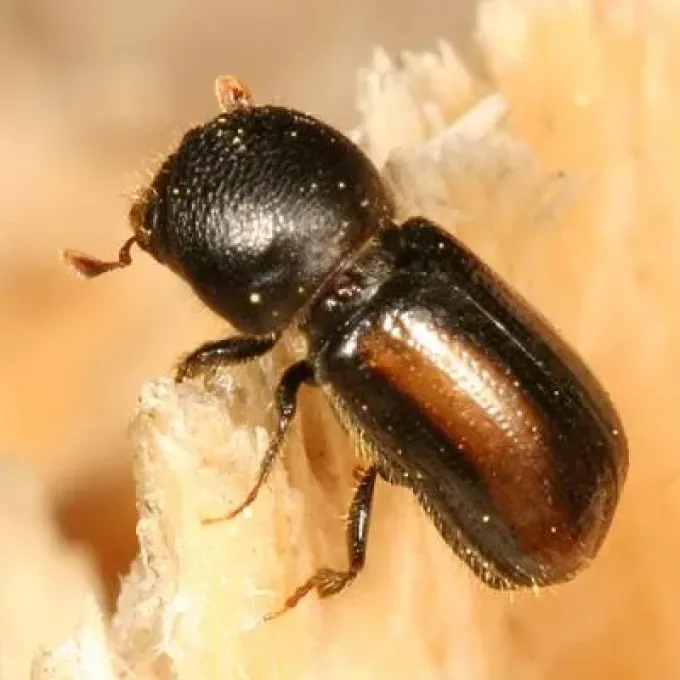
The black pine beetle (Hylastes porculus) belongs to the family Curculionidae, subfamily Scolytinae. This small beetle measures between 3.5 and 4.5 mm in length and possesses an elongated, cylindrical body with a dull black appearance.
The pronotum is densely covered with deep punctures, giving it a granular texture. The elytra exhibit distinct longitudinal grooves, and the base is often slightly depressed, which assists entomologists in distinguishing this species from other closely related bark beetles.
The larvae are legless, whitish organisms with a distinct brown head capsule. They lead a secretive lifestyle, boring galleries directly under the bark of the lower stem or within the thick roots of coniferous trees.
Development occurs primarily in weakened or freshly felled trees, as well as in stumps. The beetles actively utilize olfactory receptors to locate food sources, responding to specific terpenes emitted by distressed pine trees.
The life cycle of this species is closely tied to the condition of the root system and the root collar of pine trees. Unlike some other bark beetle species, the black pine beetle prefers humid environments, often infesting the lower sections of the tree.
What it damages
The primary hosts for Hylastes porculus are species of the genus Pinus, with spruce being less frequently infested. Damage occurs as beetles colonize the root collars and large roots of weakened trees, leading to metabolic disruption.
This species poses a significant threat to young forest plantations and nurseries. Adult beetles frequently feed on the bark at the base of young seedlings, which leads to rapid desiccation and mass mortality.
In natural forests, this pest contributes to the decline of stands, leaving them susceptible to secondary pests and fungal pathogens. The galleries bored by larvae disrupt the transport of nutrients from the roots to the canopy.
Infestation of healthy trees typically occurs when the pest population reaches a high density, leading to mass attacks. During such outbreaks, even robust trees may perish due to loss of turgor and blockage of the vascular system.
Economic losses are manifested in reduced wood increment, loss of nursery stock, and the necessity for costly sanitary logging operations within forest management areas.
When it appears
The emergence of overwintered beetles typically begins in early spring as soon as the soil temperature reaches 8–10 degrees Celsius. Mass flight usually occurs in April and May, depending on regional climatic conditions.
During the summer months, active reproduction takes place. Females lay eggs in specially excavated egg galleries within the thick bark of roots or the root collar. Larvae develop throughout the summer, feeding on the inner bark.
Pupation occurs in chambers under the bark, most often in the latter half of summer or early autumn. New adults emerge from these chambers and may begin supplemental feeding before the onset of cold weather.
Adults overwinter in feeding sites or within the forest litter near host trees. Some larvae may remain in a developmental stage until the following season if autumn temperatures are insufficient for completion.
Clearly defined seasonality allows for effective planning of protection measures: monitoring and trapping activities are prioritized during the spring flight period.
Signs of infestation
The first visual sign of the pest's presence is the occurrence of "boring dust" — fine wood particles that accumulate near the base of the trunk or in bark crevices near the root collar.
When inspecting the root collar, one can discover entrance holes made by the beetles. These are often masked by soil or plant debris, necessitating the clearing of the root zone for thorough examination.
In young trees, signs include sudden yellowing and wilting of the needles, often accompanied by "girdling" of the seedling stem by the beetles. Such plants are easily pulled from the ground due to severe root system damage.
Internal signs include the presence of typical egg and larval galleries under the bark of the lower stem. These galleries are usually oriented randomly, distinguishing them from those of many other bark beetle species.
- Yellowing of needles in young seedlings
- Accumulation of boring dust at the root collar
- Damage to the bark integrity in the lower trunk
- Exit holes of new adults in the bark
Control measures
Prevention is the primary method for managing the black pine beetle. It is essential to promptly remove freshly infested trees, logging residues, and stumps, which serve as ideal breeding grounds for the pest.
In forest nurseries, the use of trap trenches and trap trees is highly effective. These are deployed in spring to attract beetles, after which the infested material is removed and destroyed before the next generation emerges.
Chemical protection involves the application of systemic insecticides. Treating the root collar area of seedlings during peak flight periods helps prevent the beetles from burrowing into the bark.
Agrotechnical measures include the creation of mixed-species forest stands, which are less prone to mass pest colonization. Maintaining high tree vigor through proper silvicultural care also reduces the risk of infestation.
In cases of large-scale outbreaks, the use of biological agents based on entomopathogenic fungi is recommended to reduce the beetle population density within the forest floor.
Taxonomy
- Latin name
- Hylastes porculus
- Order
- Coleoptera (beetles)
- Family
- Curculionidae
- EPPO code
- HYASPO
Discussion
No discussions yet — be the first.