
Dark pine beetle
Hylastes opacus
Description
How to identify
The dark pine beetle (Hylastes opacus) is a small bark beetle belonging to the Curculionidae family, which causes significant damage to coniferous forests.
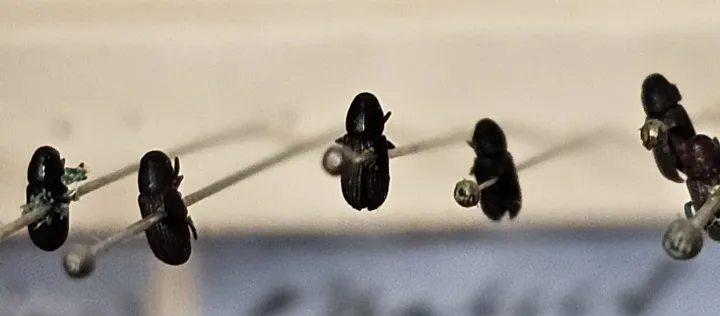
The adult beetle is typically 3.0 to 4.0 mm long, with a dark brown or black, cylindrical body that blends in with bark crevices.
The species is distinguished by its specific elytral striae and its tendency to focus its activity on the root collar and subterranean parts of the host tree.
Larvae are legless, white, and inhabit the phloem tissue of roots and the base of tree trunks, where they feed and develop.
Due to their nocturnal and subterranean nature, these beetles are rarely observed by forest managers during daylight hours.
What it damages
Hylastes opacus primarily attacks young pine plantations, causing severe economic losses by killing seedlings shortly after planting.
The beetles bore into the bark of the root collar and main roots, disrupting the tree's vascular system and nutrient transport.
Fresh stumps and logging residues serve as primary breeding grounds, allowing populations to thrive before spreading to healthy trees.
While mature trees can sometimes withstand minor attacks, young plants are highly susceptible and often die rapidly once infested.
The cumulative damage often results in patchy stands and necessitates expensive replanting efforts in affected forestry areas.
When it appears
Adult beetles typically emerge in spring, with activity peaking as temperatures rise and the soil warms up sufficiently.
A second period of activity often occurs during mid-summer, characterized by the migration of adult beetles seeking new host materials.
The life cycle is generally completed in one year, but climate variability can sometimes lead to overlapping generations or delayed development.
Winter is spent in the adult stage, sheltered within the soil around the roots or beneath the bark of stumps and fallen logs.
Proper timing of forestry operations is crucial, as fresh harvest debris left during the peak flight season encourages massive population growth.
Signs of infestation
Initial signs include needle chlorosis, which eventually progresses to yellowing and browning as the tree loses its water-conducting capabilities.
Careful inspection of the root collar region usually reveals small entry holes bored by the adult beetles into the bark.
Excavating the soil around the base of the tree reveals extensive larval galleries and feeding damage concentrated on the root system.
In cases of heavy infestation, seedlings may lean or become easily uprooted due to the destruction of root tissue.
- Needle yellowing and browning
- Small boreholes on the root collar
- Larval galleries under the root bark
- Seedling mortality in young plantations
Control measures
The primary control strategy involves rigorous sanitation, specifically the removal of stumps and debris from logged areas to eliminate breeding sites.
Delaying the replanting of young pines in clear-cut areas helps ensure that local beetle populations decrease before new trees are introduced.
Trapping techniques using fresh pine billets can effectively attract and concentrate the beetle population for subsequent destruction.
In high-value areas such as nurseries, chemical treatments applied to the soil and stem base can provide temporary protection against beetle attacks.
Promoting forest diversity and maintaining healthy stand conditions are long-term preventative measures against Hylastes opacus outbreaks.
Taxonomy
- Latin name
- Hylastes opacus
- Order
- Coleoptera (beetles)
- Family
- Curculionidae
- EPPO code
- HYASOP
Discussion
No discussions yet — be the first.