
Black pine beetle
Hylastes nigrinus
Description
How to identify
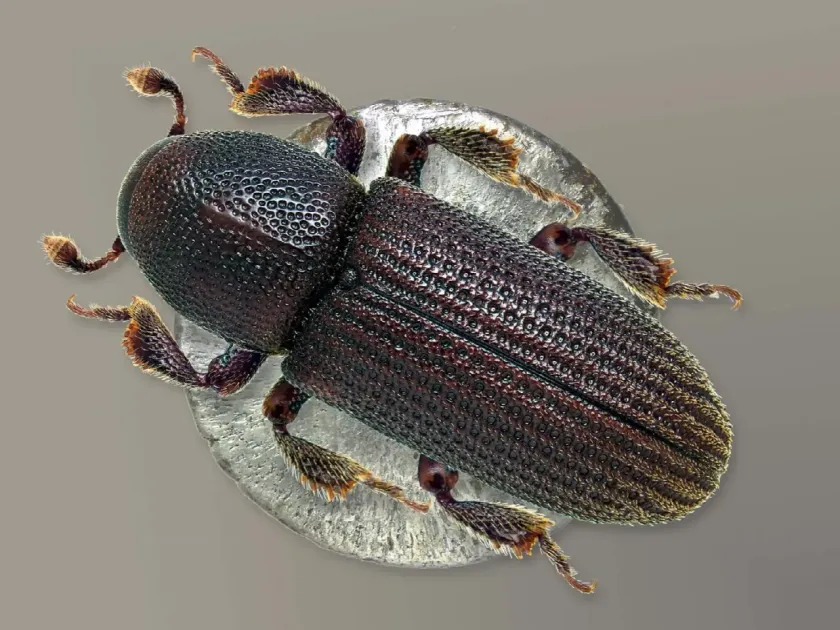
The black pine beetle (Hylastes nigrinus) is a small bark beetle belonging to the family Curculionidae, subfamily Scolytinae. Adult beetles measure approximately 3.5 to 4.5 mm in length.
The body is dark black or brown with a slightly elongated shape. The elytra are marked with fine, longitudinal grooves and sparse, short hairs, which helps distinguish it from similar species.
The head of this species is distinctly elongated, and the antennae possess a compact club structure. These morphological features are essential for identification under a magnifying glass.
Larvae are legless, C-shaped, and creamy white with a brownish head capsule. They primarily develop underneath the bark of roots and the root collar of host trees.
Because they spend most of their life cycle hidden under the soil surface or beneath the bark of roots, they are often difficult to detect until significant damage has occurred.
What it damages
This beetle primarily affects conifers, including species of pine (Pinus), spruce (Picea), and fir (Abies). It is a significant threat in nurseries and young plantations.
Adult beetles and larvae feed on the inner bark and cambium layer of roots. This feeding activity disrupts the transport of nutrients and water, often causing rapid chlorosis and tree death.
Damage to the root collar is particularly destructive, as it compromises the structural integrity of the root system and facilitates the entry of pathogenic fungi.
In forest stands, the black pine beetle often attacks weakened trees or fresh stumps, but it can shift to healthy young saplings when populations are high or environmental stress is present.
Cumulative damage by this pest reduces the resilience of plantations, making them more susceptible to subsequent infestations by other secondary bark beetles and wood-boring insects.
When it appears
Adult flight usually begins in early spring when soil temperatures reach about 10-12°C. The peak activity period typically occurs during May and June.
Females bore into the bark of roots or stumps to deposit eggs. The development of the brood is highly dependent on sufficient moisture within the bark tissues.
The life cycle can take between one to two years to complete, depending on regional climatic conditions and the availability of suitable host material.
New adults emerge from the pupal chambers in late summer or autumn. Some individuals may overwinter in the soil or under the root bark until the following growing season.
Warmer temperatures accelerate the maturation process, allowing for more intensive breeding cycles and increasing the risk of infestation in nursery settings.
Signs of infestation
Initial signs of infestation include the gradual yellowing of needles, which eventually fade to a dull brown as the tree dries out due to root system failure.
Small entry holes, approximately 2 mm in diameter, can be found near the root collar or on exposed major roots. Resin flow around these holes is a common defensive response.
Careful removal of the soil around the base of the tree may reveal tunnels filled with frass, a mixture of bark fragments and larval excrement, under the bark.
If a tree is excavated, larval galleries may be observed running throughout the cambium. The bark in these areas often separates easily from the wood due to the feeding damage.
The presence of adults emerging from the ground near the base of the trunk during the spring is a definitive indicator of an active infestation within the root zone.
Control measures
Effective control requires the removal and destruction of stumps in nurseries, as these are primary breeding sites for the black pine beetle population.
Using bait traps, such as fresh coniferous logs placed in affected areas, can help aggregate adults during the flight season, allowing for systematic destruction.
Chemical control involving the application of insecticides to the root collar of young trees can protect them during the critical spring flight period.
Maintaining high forest health standards through proper thinning and sanitation helps minimize the amount of suitable breeding material available to the beetles.
- Regular monitoring of young plantations for signs of decline.
- Prompt sanitation logging and stump removal.
- Use of pheromone lures for population monitoring.
- Ensuring proper soil moisture to keep trees vigorous.
Taxonomy
- Latin name
- Hylastes nigrinus
- Order
- Coleoptera (beetles)
- Family
- Curculionidae
- EPPO code
- HYASNI
Discussion
No discussions yet — be the first.