
Large pine bark beetle
Hylastes macer
Description
How to identify
The large pine bark beetle (Hylastes macer) is a member of the Curculionidae family, specifically recognized as a serious pest of coniferous trees.
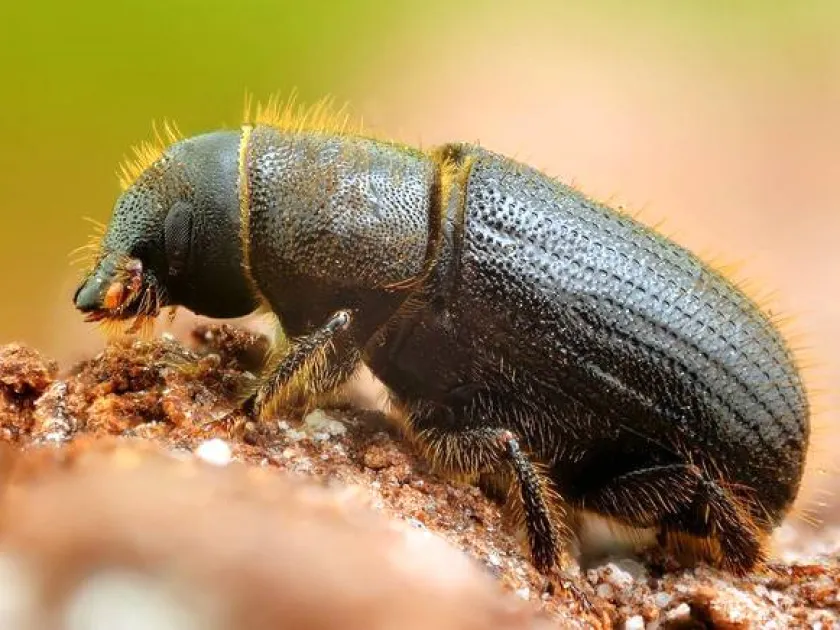
Adult beetles are elongated, measuring approximately 3.5 to 5 mm in length, and possess a dark brown to black matte cuticle.
The head is distinctly visible, and the pronotum is slightly longer than it is wide, tapering towards the front, which helps distinguish it from similar species.
The elytra (wing covers) display deep grooves with small punctures, giving the beetle a rugged appearance essential for moving through bark.
Larvae are typical bark beetle grubs: legless, C-shaped, and creamy white with a hardened, yellowish-brown head capsule.
What it damages
This beetle primarily attacks various pine species, with a strong preference for Scots pine (Pinus sylvestris) in forest environments.
It causes significant damage by feeding on the phloem of the root collar and main roots of trees, which often leads to rapid decline.
Young plantations and nurseries are particularly vulnerable, as the beetle's feeding can ring-bark small stems, causing death.
The pest is attracted to recently cut timber, stumps, and stressed trees, making forest management and cleaning operations critical.
By disrupting nutrient flow from the roots, Hylastes macer can cause widespread mortality within a stand in a relatively short time.
When it appears
The adult beetles emerge from their wintering sites in early spring as soon as soil temperatures reach favorable levels for flight.
Peak flight and mating activity typically occur during late spring and early summer when the beetles search for suitable host material.
The developmental cycle is highly dependent on ambient temperatures, with generation times varying significantly across different latitudes.
As temperatures begin to drop in autumn, the beetles seek shelter in the soil or under the bark near the base of the tree to overwinter.
Regular monitoring during the growth season is essential, especially in stands where logging activities have recently taken place.
Signs of infestation
The first indicator of an infestation is the presence of small, circular entry holes located on the bark near the root collar.
Frass (boring dust) can often be found near the base of the trunk or caught in the bark fissures, indicating active tunneling by the beetles.
Crown symptoms include a progressive change in needle color from healthy green to yellow and finally to a dull reddish-brown.
Under the bark, one can observe distinct, longitudinal maternal galleries that extend downwards into the root system.
General wilting and loss of tree stability, where the tree can be easily pushed over due to root damage, are signs of a severe infestation.
Control measures
The most effective management strategy is strict forest hygiene, involving the rapid removal of fresh slash and timber from the forest site.
Reducing the availability of breeding material is key to preventing population outbreaks and minimizing tree losses.
Felling and debarking infested trees promptly can prevent the next generation of beetles from emerging and spreading to healthy trees.
- Prompt removal of logging residues.
- Use of pheromone lures for systematic population monitoring.
- Protective insecticide treatments for young seedlings in nurseries.
Biological control, such as encouraging natural predators or using entomopathogenic agents, represents an important component of integrated pest management.
Taxonomy
- Latin name
- Hylastes macer
- Order
- Coleoptera (beetles)
- Family
- Curculionidae
- EPPO code
- HYASMA
Discussion
No discussions yet — be the first.