
Hylastes fulgidus
Hylastes fulgidus
Description
How to identify
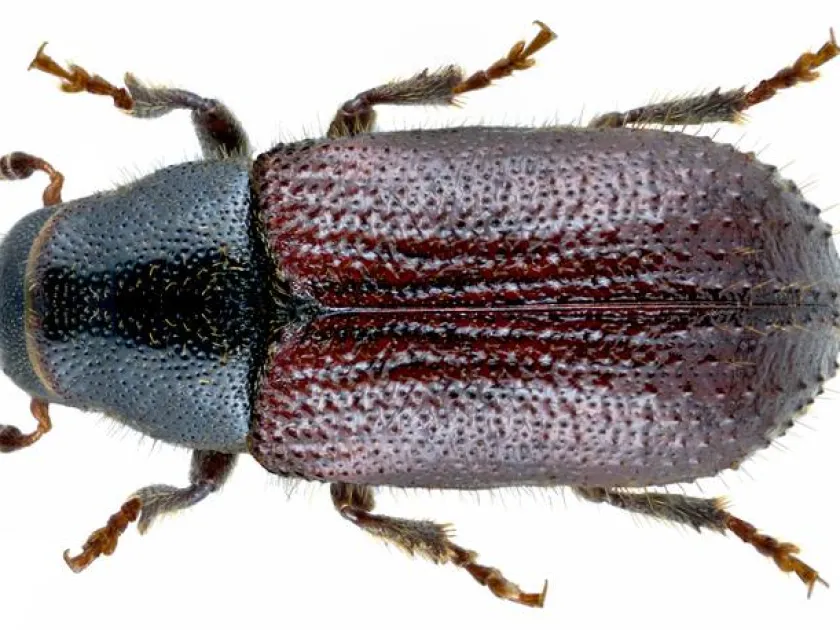
Hylastes fulgidus is a small beetle belonging to the Curculionidae family, specifically the Scolytinae subfamily. These insects are typically 3–4 mm long, with a cylindrical, shiny, dark brown or black body.
The pronotum is covered with dense punctures, while the elytra feature distinct longitudinal striae. Larvae are white, legless, and have a brownish head, specialized for feeding beneath the bark of roots.
As hidden dwellers, these beetles primarily infest the underground portion of stems and the root collars of coniferous trees, making them difficult to detect during standard canopy surveys.
Correct identification requires examination under magnification, as the species shares structural similarities with other Hylastes genus representatives.
Their life cycle is closely tied to the soil environment, where they spend most of their time excavating galleries in the bark of root collars and woody roots.
What it damages
Hylastes fulgidus is a significant pest of coniferous species, particularly affecting young pines in forest plantations and nurseries where seedlings are vulnerable.
The pest targets weakened or stressed trees, especially those suffering from environmental factors like drought or recent transplant shock.
Larvae feed under the bark of the root collar and main roots, creating tunnels that disrupt the vascular tissue, effectively stopping the flow of water and nutrients to the canopy.
This damage leads to rapid weakening, yellowing of needles, and eventual mortality of young trees, which is a major concern for forestry operations.
In cases of high population density, the pest can cause significant economic loss by decimating young plantations in a relatively short period of time.
When it appears
The flight activity of adult beetles begins in early spring as soil temperatures rise, triggering their emergence from overwintering sites to find suitable host material.
The primary period for mating and infestation generally occurs between April and May, depending heavily on the regional climate and spring temperature progression.
Development usually completes within a single growing season, though warmer southern climates may occasionally support a partial second generation within the same year.
Beetles typically overwinter in the forest floor, soil, or within the bark of root collars of infested trees, where they remain dormant until the following spring.
Outbreaks are most often correlated with years following environmental stressors, such as major storms or long droughts, which provide the beetles with ideal conditions to breed.
Signs of infestation
The most immediate symptom of infestation is the sudden chlorosis and wilting of needles on young pines, often without visible damage to the above-ground trunk.
Careful excavation around the root collar reveals entrance holes in the bark, which the adult beetles drill to initiate the construction of their egg galleries.
Presence of frass—a mixture of wood dust and larval excrement—in the soil surrounding the root collar is a definitive sign of active infestation.
Peeling away the bark in the infested area exposes the intricate gallery system, which may completely girdle the root collar and prevent sap flow.
Infestations are often localized in patches, leading to characteristic groups of dead or dying seedlings within a larger plantation area.
Control measures
Effective management relies heavily on silvicultural practices, including the removal of potential breeding grounds such as fresh stumps and logging slash.
Maintaining high sanitary standards in forest nurseries is essential to prevent the spread of the beetle to healthy planting stock.
- Regular health inspections of plantations throughout the spring season.
- Prompt extraction and disposal of infested trees to stop the lifecycle.
- Application of approved insecticides to seedlings before planting in high-risk zones.
- Promoting rapid growth and tree vigor to enhance natural resistance.
- Monitoring populations using pheromone traps to anticipate outbreaks.
Chemical control is rarely feasible for large forest areas but can be effective in nursery settings where young trees are highly valuable and reachable.
Strategic management of site conditions to minimize tree stress is the most sustainable approach to long-term prevention against Hylastes species.
Taxonomy
- Latin name
- Hylastes fulgidus
- Order
- Coleoptera (beetles)
- Family
- Curculionidae
- EPPO code
- HYASFU
Discussion
No discussions yet — be the first.