
Large pine shoot beetle
Hylastes cunicularius
Description
How to identify
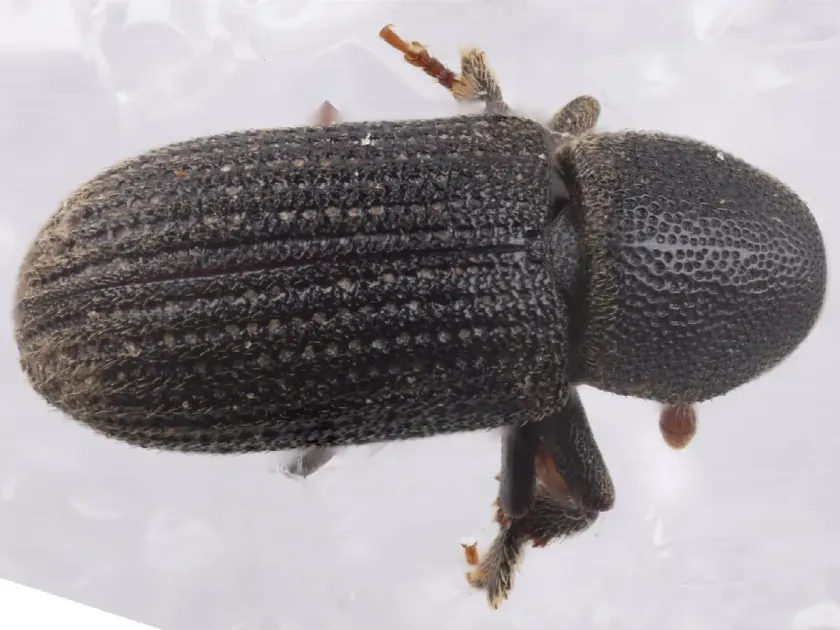
The Black pine beetle (Hylastes cunicularius) is a species of bark beetle belonging to the Curculionidae family. It is a small, dark-colored insect that thrives in coniferous forests.
Adult beetles have a cylindrical body shape, reaching about 4 to 5 millimeters in length. Their coloration ranges from dark brown to pure black, often with a dull appearance due to fine setae.
The larvae are typically legless, white grubs with a distinct brownish head capsule. They are exclusively found under the bark of roots or the root collar of host trees.
Pupation occurs within small, oval chambers constructed by the larvae in the inner bark or the surface of the sapwood of the host plant.
Because they spend most of their life cycle in subterranean environments, these beetles are often overlooked until significant tree damage becomes apparent.
What it damages
The primary hosts for Hylastes cunicularius are spruce (Picea) and pine (Pinus) species. They are particularly devastating to young seedlings in forest nurseries and plantations.
Adult beetles feed on the bark of the root collar and main roots. By girdling these areas, they disrupt the transport of nutrients and water, causing the seedling to wilt and die.
In mature stands, the beetles colonize weakened or stressed trees, often focusing on the roots that are exposed at the soil surface or are close to the root zone.
Large-scale infestations can cause severe mortality in young forests, leading to significant economic losses and requiring extensive replanting efforts.
Stumps left behind after logging serve as primary breeding grounds, allowing the beetle population to multiply rapidly before attacking nearby healthy saplings.
When it appears
Emergence from overwintering sites typically begins in early spring as soil temperatures rise, usually triggered by the first warm days of the season.
Peak flight and mating activity generally occur between May and June, depending on local climate conditions and forest elevation.
The life cycle typically takes one year to complete, although cool summer temperatures or northern latitudes may extend the development time.
Adults overwinter in the soil or in the root tissues of host trees, protected from extreme cold and desiccation during the winter months.
Activity decreases as temperatures drop in autumn, at which point the beetles seek out their overwintering locations to survive until the following spring.
Signs of infestation
The most reliable sign of infection is the sudden wilting and yellowing of young conifer seedlings, even when other environmental factors appear optimal.
Closer inspection of the root collar often reveals small, circular entrance holes in the bark, sometimes accompanied by small piles of sawdust-like frass.
Under the bark of the root system, one can find characteristic galleries—tunnels carved by adults for feeding and by larvae during their development.
In cases of heavy infestation, the bark around the root collar may become loose or brittle, showing visible signs of extensive mining beneath the surface.
- Wilted needles on young seedlings.
- Presence of boring dust around the stem base.
- Gallery patterns under the bark of the roots.
- Evidence of girdling on the root collar.
Control measures
Effective management begins with strict sanitation practices, including the removal of stumps and logging residues that serve as breeding sites.
In nurseries, it is recommended to maintain an appropriate waiting period before replanting conifers on land that was recently cleared of spruce or pine.
Chemical control, applied as a prophylactic treatment to the root collars of seedlings before planting, can significantly reduce the risk of beetle damage.
Monitoring programs using pheromone-baited traps or trap logs help forest managers assess beetle populations and time control interventions appropriately.
Maintaining forest health through proper stand density management and removing stressed trees helps minimize the attractiveness of the site to colonizing beetles.
Taxonomy
- Latin name
- Hylastes cunicularius
- Order
- Coleoptera (beetles)
- Family
- Curculionidae
- EPPO code
- HYASCU
Discussion
No discussions yet — be the first.