
Narrow-headed pine bark beetle
Hylastes attenuatus
Description
How to identify
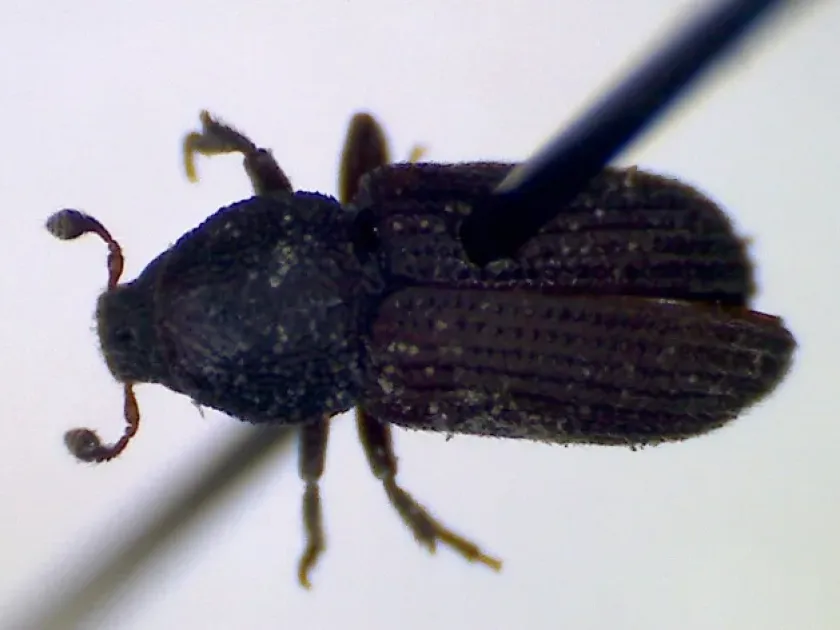
The narrow-headed pine bark beetle (Hylastes attenuatus) is a small coleopteran insect belonging to the family Curculionidae, subfamily Scolytinae. It typically measures between 3.5 and 4.5 mm in length.
The beetle is characterized by its slender, elongated body and a pronotum that is noticeably narrower than the elytra. The dark-brown or black color provides camouflage against the pine bark.
The larvae are small, legless, and white with a distinct brown head capsule. They develop exclusively in the inner bark and phloem of conifer trees, where they create intricate feeding galleries.
The life cycle involves complete metamorphosis, including the egg, larval, pupal, and adult stages. Under standard environmental conditions, the beetle completes one generation per year.
This species is highly host-specific, primarily targeting Pinus species, preferring weakened trees or fresh slash where conditions for larval development are optimal.
What it damages
The beetle primarily impacts young pine stands, nurseries, and weakened mature trees. It causes the most significant damage by attacking the root collar and lower stem sections.
Adults engage in maturation feeding by boring into the bark of young saplings, which frequently results in girdling and the subsequent death of the young trees.
Larval galleries interrupt the flow of nutrients in the phloem, causing a decline in tree vigor. In dense populations, this leads to rapid desiccation and mortality of the host plant.
Beyond physical damage, the beetle acts as a vector for various wood-staining fungi and root pathogens that further weaken the tree's immune system and accelerate decline.
The pest is a major concern in reforestation projects, as it can devastate new plantings by attacking the root system immediately after seedlings are transplanted.
When it appears
Adults typically emerge in early spring once soil temperatures reach 10–12 degrees Celsius. This primary flight period initiates the colonization of susceptible trees.
A second, minor flight period may occur during the summer, involving newly emerged adults that feed on the bark of healthy or stressed seedlings to reach maturity.
Winter is spent in hibernation, with beetles seeking shelter deep in the soil or under the bark of logs and stumps to survive freezing conditions.
Activity levels are highly correlated with the tree's sap flow cycle, as beetles are attracted to the moisture and nutrient content of the phloem during the spring.
Extended, mild autumn weather can delay hibernation, potentially leading to increased damage in areas where new planting activities continue into the late season.
Signs of infestation
The earliest symptom of infestation is the appearance of fine, brown bore dust («frass») located around the base of the stem, often hidden by leaf litter or soil.
Trees may exhibit signs of wilting, with the foliage fading from green to yellowish-brown. This indicates that the vascular system has been compromised at the root level.
Inspecting the bark of the root collar often reveals vertical or irregular feeding galleries packed with boring dust, which prevents normal sap circulation.
In advanced stages of attack, the bark may loosen or slough off. If the tree is still resistant, small resin drops may appear at the entry holes as a defense mechanism.
The presence of adult beetles in the soil surrounding the root zone is a definitive sign of colonization, especially in newly planted reforestation areas.
Control measures
Forest hygiene is the cornerstone of management; this involves the rapid removal of infested trees and the clearing of logging slash that attracts the beetles.
In nursery settings, systemic or contact insecticides are often applied to the root collar of seedlings before planting to prevent initial colonization by adult beetles.
Monitoring using pheromone-baited traps allows foresters to track beetle population trends and time control measures, such as the removal of traps or localized chemical treatment.
Promoting diverse, mixed-species forest stands reduces the concentration of host pines, making it more difficult for the beetle to find suitable breeding grounds.
- Maintain high standards of forest sanitation.
- Apply preventive insecticides in nurseries.
- Use pheromone traps for population tracking.
- Diversify plantation species to break pest cycles.
Taxonomy
- Latin name
- Hylastes attenuatus
- Order
- Coleoptera (beetles)
- Family
- Curculionidae
- EPPO code
- HYASAT
Discussion
No discussions yet — be the first.