
Black pine beetle
Hylastes ater
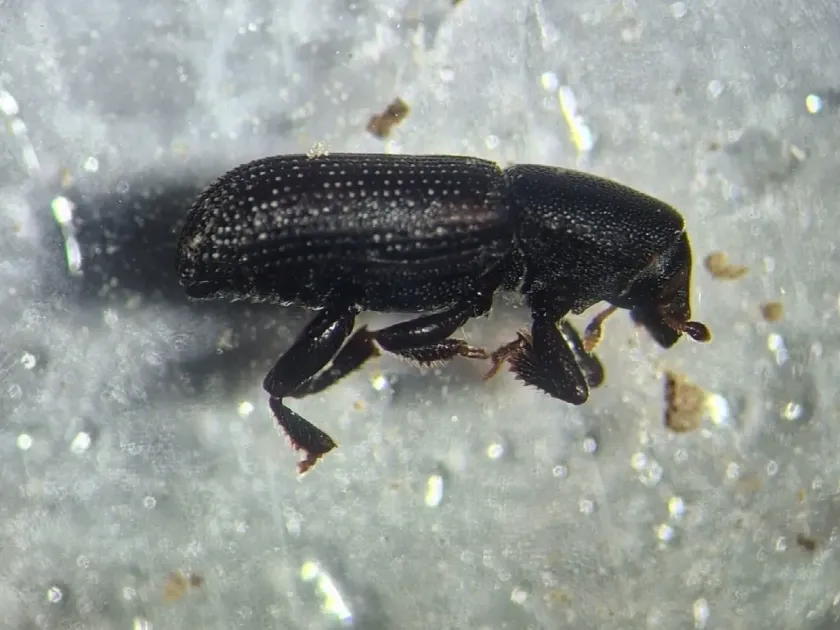
Description
How to identify
The black pine beetle (Hylastes ater) is a member of the Curculionidae family, specifically the Scolytinae subfamily. These beetles are relatively small, typically measuring between 3.5 and 5 mm in length.
The body is elongated and cylindrical, characterized by a glossy, dark-brown or coal-black coloration. The elytra feature deep longitudinal grooves with clearly visible punctures.
Morphologically, they are identified by their elbowed antennae ending in a distinct club. The larvae are white, legless, and C-shaped, featuring a brownish head capsule.
These insects are primarily subterranean or bark-dwelling, making them difficult to detect. They are highly resilient and capable of surviving in various types of pine debris.
Adult beetles possess a specialized snout that allows them to bore effectively into the bark of roots and the base of young tree stems for feeding purposes.
What it damages
The black pine beetle primarily attacks various pine species, but it can also infest spruces. It is considered a major threat to seedlings and young transplants in forest nurseries.
Adult beetles cause significant damage by feeding on the bark of the root collar and primary roots of young trees, which often leads to the death of the plant.
Newly planted forest stands are particularly vulnerable to infestations, especially when they are established on sites where mature conifers were recently harvested.
The beetle not only causes physical damage through feeding but also acts as a vector for various root-rot fungi, which further weaken the host tree and accelerate decline.
Economic losses are often severe in reforestation projects, as high mortality rates among young saplings necessitate expensive replanting efforts in affected areas.
When it appears
The flight period typically begins in early spring, often in April or May, depending on regional temperature increases and the thawing of the soil.
The beetles emerge from their overwintering sites, such as tree stumps or the forest floor, to locate suitable host materials for breeding and supplemental feeding.
During the summer months, adult beetles are active and continue their reproductive cycle. In optimal conditions, they may complete one generation within a single season.
As temperatures begin to drop in autumn, the beetles relocate to wintering quarters, burrowing deep into the bark of stumps or into the soil layer near host trees.
The timing of their emergence is highly synchronized with the availability of fresh pine material, which serves as an attractant for the population.
Signs of infestation
A primary diagnostic sign of infestation is the yellowing and subsequent wilting of the needles on young seedlings, eventually resulting in the tree drying out entirely.
Visual inspection of the root collar often reveals small, circular entry holes and the presence of fine, sawdust-like frass accumulated at the base of the stem.
Peeling back the bark at the root level exposes complex, gallery-like tunnels created by the feeding activities of the beetles and their developing larvae.
- Yellowing of seedling crowns
- Resin flow at the base of the stem
- Entry holes on the root bark
- Presence of galleries under the bark
- Stunted growth of new forest stands
Once an infested tree is pulled from the ground, the lack of bark tissue on the roots confirms that the vascular system has been compromised by the beetle's feeding.
Control measures
The most effective strategy for managing the black pine beetle is the rigorous removal of stumps and logging debris from harvested sites to eliminate breeding grounds.
In nursery settings, insecticide treatments applied to the roots or soil during planting can provide a necessary protective layer against adult beetle attacks.
Implementing spatial and temporal separation between harvesting activities and new planting operations is crucial to prevent the migration of beetles into young stands.
The use of trap logs or bait stations can help monitor the beetle population density and serve as a control mechanism to attract and remove adults from sensitive areas.
Maintaining high standards of silvicultural hygiene and conducting regular field inspections allow for the early detection and management of potential outbreaks.
Taxonomy
- Latin name
- Hylastes ater
- Order
- Coleoptera (beetles)
- Family
- Curculionidae
- EPPO code
- HYASAR
Discussion
No discussions yet — be the first.