
Narrow-headed bark beetle
Hylastes angustatus
Description
How to identify
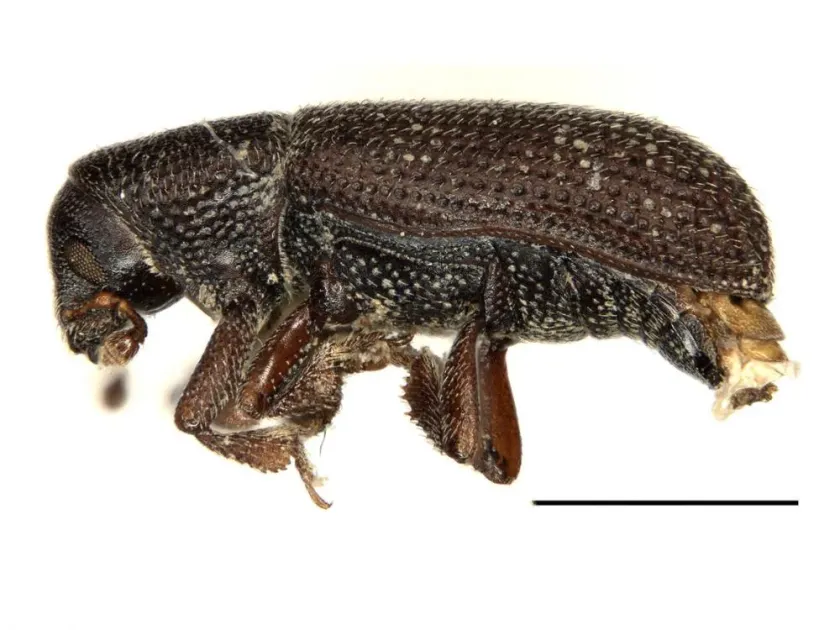
The narrow-headed bark beetle (Hylastes angustatus) is a small wood-boring insect belonging to the Curculionidae family and Scolytinae subfamily.
Adult beetles are approximately 2.5 to 3.5 mm long, exhibiting a cylindrical, dark brown to black body that is perfectly adapted for living under tree bark.
The name "narrow-headed" refers to the specific shape of the pronotum, which is noticeably narrower than the elytra, a key feature for field identification.
Larvae are small, white, legless grubs with a distinctive brown head capsule, specialized for consuming phloem and cambium tissues.
Due to their cryptic behavior, they are rarely seen on the surface, spending their entire development cycle inside the roots or root collars of coniferous trees.
What it damages
This beetle primarily targets young coniferous trees, especially Scots pine (Pinus sylvestris), causing significant damage to the root system.
Adults attack the root collar and primary roots, excavating galleries that disrupt the plant's vascular flow, leading to rapid wilting.
Larval feeding destroys the protective bark and inner tissues of the roots, which often results in the total collapse of the tree's water-conducting capacity.
Young plantations are at the highest risk, as the beetle can cause mass mortality in nurseries and newly established forest stands.
In addition to direct feeding damage, the galleries created by the beetles can facilitate the entry of pathogenic fungi that further weaken the tree.
When it appears
Adult beetles emerge from their overwintering sites in early spring, typically triggered by soil temperatures reaching about +10°C.
The peak activity period for swarming and colonization occurs during May and June, when weather conditions are optimal for flight.
The life cycle can vary based on local temperatures, but typically, new generations complete their development within one growing season.
Overwintering occurs primarily in the adult stage, with beetles residing in the soil, forest litter, or the root systems of weakened trees.
Dense populations often develop in fresh stumps and logging debris, which act as primary breeding grounds for the next seasonal wave.
Signs of infestation
The earliest symptom of an infestation is the chlorosis (yellowing) of the needles, followed by a noticeable decline in tree vigor.
Examination of the soil around the base of the tree reveals bore dust, a mixture of wood frass and excrement pushed out by the beetles.
Peeling back the soil to inspect the root collar will expose small, circular entry holes and evidence of tunneling activity.
Severely infested trees lose their anchor in the soil because the root system is effectively hollowed out and killed by larval feeding.
- Yellowing of coniferous needles.
- Bore dust piles around the root collar.
- Entry holes on the stem base.
- Presence of galleries under the bark.
- Tree dieback or complete death.
Control measures
Effective management begins with strict sanitation, including the removal of stumps and logging residues that serve as breeding sites.
Reforestation planning should include a mandatory waiting period after clear-cutting to allow the local population of Hylastes to decline.
In forest nurseries, preventative insecticidal treatments for seedlings are highly recommended to protect against early colonization.
Monitoring using trap logs or artificial attractants can help track beetle activity and determine the timing for necessary protective measures.
Maintaining high forest hygiene and ensuring vigorous growth through proper spacing and fertilization are key to long-term prevention.
Taxonomy
- Latin name
- Hylastes angustatus
- Order
- Coleoptera (beetles)
- Family
- Curculionidae
- EPPO code
- HYASAN
Discussion
No discussions yet — be the first.