
Water measurer
Hydrometra stagnorum
Description
How to identify
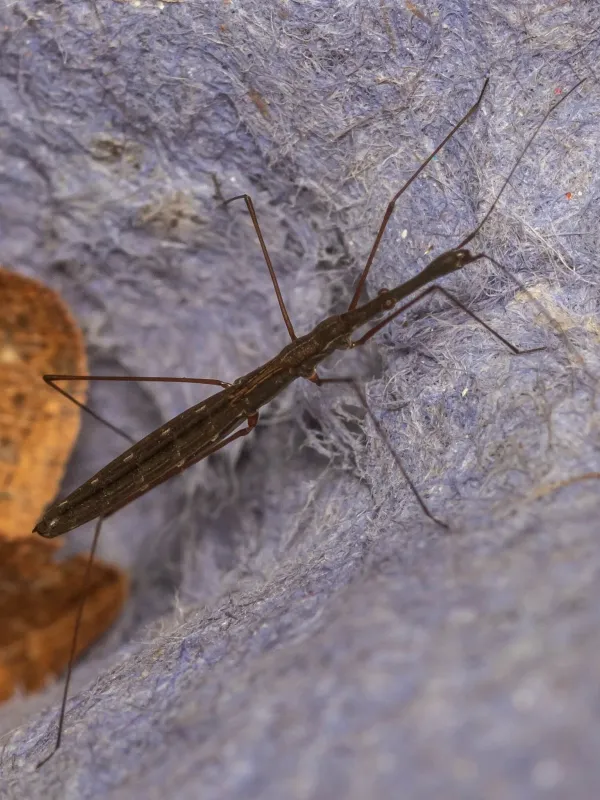
The water measurer (Hydrometra stagnorum) belongs to the order Hemiptera and the family Hydrometridae. This insect has a very slender, elongated body resembling a thin twig, measuring 8–11 millimeters in length.
The head is highly elongated with long antennae that assist the insect in navigating its environment. The color of the adults ranges from dark brown to nearly black.
Wing development varies among individuals, with macropterous, brachypterous, and apterous forms occurring. They move slowly across water surfaces with a distinctive, cautious stepping motion.
Unlike common water striders, water measurers prefer to stay along the water's edge, walking on floating vegetation, moss, or muddy banks rather than the open water surface.
The lifecycle includes an egg stage and five nymphal instars that physically resemble adults, differing primarily in size and reproductive development.
What it damages
While primarily predators, water measurers have an indirect impact on agricultural settings, particularly in aquaculture and nurseries. Their presence can be problematic in fish ponds and aquatic plant cultivation.
Although adults feed on small invertebrates, high populations can create competition for food resources with juvenile fish or fry in commercial ponds.
These insects can act as vectors for various microorganisms, which can be introduced into the water column when large colonies of bugs gather, potentially affecting water quality.
In nurseries or aquatic plant facilities, they may puncture tender stems with their rostrum while searching for prey, creating entry points for secondary fungal or bacterial infections.
Despite their small individual size, dense populations can influence the ecosystem balance of small, closed water bodies used for intensive agricultural operations.
When it appears
Activity begins in early spring, as soon as the ice clears and water temperatures rise to approximately 8–10 degrees Celsius.
The reproductive period peaks in late spring and early summer. Females lay eggs individually, attaching them to submerged plant parts or stones just above the water line.
The development time from egg to adult takes several weeks, depending significantly on weather patterns and the heat accumulation of the pond water.
The insect is capable of producing multiple generations throughout the warm season, allowing for rapid colonization of suitable aquatic habitats.
As temperatures drop, adults enter hibernation, seeking shelter in the shore zone under fallen leaves, thick moss, or organic debris, showing remarkable resistance to cold.
Signs of infestation
The most obvious sign of an infestation is the visual detection of these twig-like insects moving slowly across the water surface or creeping on floating vegetation.
Signs of their presence include tiny, needle-like punctures on the stems of aquatic plants, resulting from their exploratory probing for prey.
The accumulation of exuviae (cast-off larval skins) along the bank is a strong indicator of successful molting and a growing population in the vicinity.
The presence of many small, desiccated carcasses of insect prey in the pond area suggests the active hunting behavior of a local water measurer population.
Changes in the feeding habits of fish fry or reduced zooplankton density due to excessive predatory pressure can also serve as a diagnostic sign for management.
Control measures
The primary control strategy focuses on pond hygiene, including the removal of excess emergent and floating vegetation that provides habitat for the bugs.
Biological control can be effectively managed by encouraging natural predators such as dragonfly larvae, diving beetles, and insectivorous fish species.
Regular maintenance of the shoreline, such as cleaning away debris and excessive algae, limits the available surfaces for egg-laying and reduces nesting sites.
In severe infestation cases within fish farms, a temporary lowering of the water level can force the insects to migrate, leaving them vulnerable to predation by larger aquatic species.
Chemical applications are strictly discouraged due to the risk of contaminating the aquaculture environment, making preventative cultural management the preferred approach.
Taxonomy
- Latin name
- Hydrometra stagnorum
- Order
- Hemiptera (bugs, aphids, leafhoppers)
- Family
- Hydrometridae
- EPPO code
- HYMTST
Discussion
No discussions yet — be the first.