
Water measurer
Hydrometra
Description
How to identify
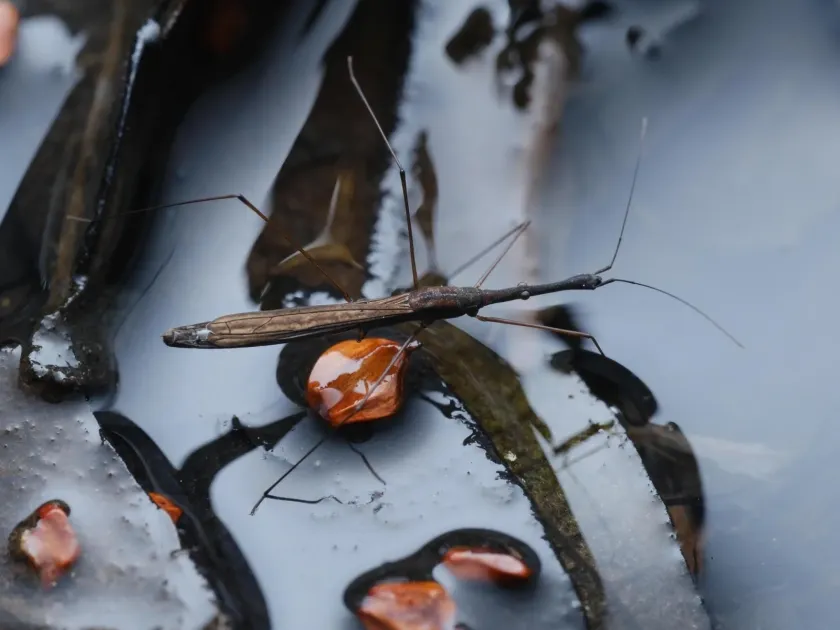
The water measurer (Hydrometra) belongs to the family Hydrometridae within the order Hemiptera. These insects are characterized by a long, extremely slender body that resembles a thin twig.
They possess very long legs that allow them to walk across the surface film of water without breaking it. This specialized mode of locomotion is a distinct evolutionary adaptation to their aquatic environment.
The head of the insect is notably long, nearly as long as the rest of the body, and is equipped with large eyes and a slender, piercing-sucking proboscis used for feeding.
Adults are typically brown or gray, providing effective camouflage against the reeds, grasses, and debris floating in the water near the shore.
The life cycle involves egg, nymph, and adult stages. Females lay their eggs on aquatic vegetation, securing them above the water line or on emergent leaves.
What it damages
It is crucial to clarify that the genus Hydrometra is not considered a pest for agricultural crops. They do not consume plant tissues and pose no threat to the harvest.
Their diet consists strictly of small aquatic invertebrates, insects that have fallen into the water, and mosquito larvae. Consequently, they function as natural predators in aquatic ecosystems.
In irrigation systems or paddy fields, their presence is completely neutral regarding crop health. They do not damage roots, stems, or leaves, making them irrelevant to crop protection programs.
Their only potential impact is the natural predation of other small organisms, which contributes to a balanced insect population within their habitat.
Farmers and agronomists do not need to implement any protective measures against them, as they are not harmful to agricultural productivity.
When it appears
The activity period for water measurers begins in early spring, as soon as the water temperature in ponds and ditches rises significantly after the winter season.
They reach their peak population density during the summer months when warm temperatures accelerate their developmental cycle, allowing for several generations within a single season.
As autumn approaches and temperatures begin to drop, water measurers migrate from the water surface to terrestrial environments to find shelter for the winter.
They overwinter as adults, finding refuge in moist areas like leaf litter, moss, or under the bark of trees near the water's edge, which protects them from frost.
With the return of warmer conditions in the following spring, they emerge from their hibernation sites and return to the water to restart their reproductive cycle.
Signs of infestation
The most common sign of their presence is observing the insects moving in distinct, jerky motions across the surface of quiet, still water in irrigation ditches or ponds.
They are rarely found in areas with strong water currents, preferring calm, sheltered zones where they can easily navigate the surface tension.
If you inspect the stems of emergent aquatic plants, you may find their small, elongated eggs attached to the plant surface just above the waterline.
There is a complete absence of plant damage markers, such as wilting, chlorosis, or necrotized tissue, which confirms they are not feeding on the plants themselves.
High concentrations of these insects are a sign of a healthy aquatic environment rather than an infestation, as they rely on a steady supply of small prey.
Control measures
There is no need for control measures against Hydrometra in an agricultural context. They are entirely harmless to crops and should be treated as part of the local biodiversity.
The use of pesticides to manage this species is highly discouraged, as it would cause unnecessary harm to beneficial aquatic organisms and disrupt the local ecological balance.
If their numbers need to be managed in specific pond systems (e.g., in aquaculture), biological control through the introduction of native predators like frogs or small fish is the preferred method.
Regular maintenance of irrigation infrastructure, such as cleaning out excessive vegetation, naturally limits the available habitat for high population densities.
Agronomists should advise that no chemical intervention or protective action is necessary for this insect, as it does not negatively impact farm output.
Taxonomy
- Latin name
- Hydrometra
- Order
- Hemiptera (bugs, aphids, leafhoppers)
- Family
- Hydrometridae
- EPPO code
- HYMTSP
Discussion
No discussions yet — be the first.