
Hoshinoa longicellana
Hoshinoa longicellana
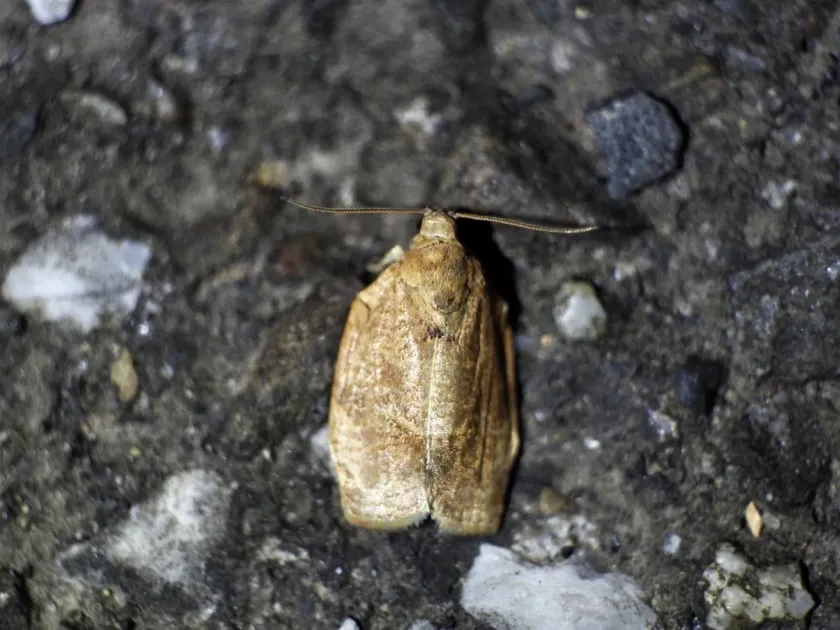
Description
How to identify
Hoshinoa longicellana is a species of moth belonging to the Tortricidae family. These insects are commonly referred to as leafrollers due to the behavior of their larvae.
The adult moth has a wingspan of approximately 20–25 mm. The forewings are brownish-grey, often featuring distinct, darker bands that provide camouflage against tree bark.
Larvae are typically green in color with a darker, brownish head capsule. They are highly active and respond quickly to physical disturbance by dropping on silken threads.
The life cycle involves complete metamorphosis. Overwintering occurs in the larval stage, hidden within bark crevices or protected plant debris.
As a nocturnal species, adults are most active during the night, making them difficult to detect without the use of pheromone traps or light traps.
What it damages
This pest is known for attacking various rosaceous fruit trees, with a strong preference for apples, pears, and plums in commercial orchard settings.
Larval feeding activity begins in the early spring, coinciding with bud break. They feed on young leaves, buds, and later on the developing fruit surface.
Fruit damage usually appears as superficial scarring or deep holes. Such defects render the fruit unmarketable and susceptible to rot during storage.
Young trees are particularly vulnerable, as repeated defoliation by larvae can stunt growth and delay tree maturation significantly.
Secondary infections, such as fungal pathogens, often enter through the wounds caused by larvae, complicating the management of the orchard health.
Signs of infestation
The most obvious sign of infestation is the presence of rolled or folded leaves tied together with silk, which serve as shelters for the larvae.
Skeletonized leaves or missing tissue on the margins are indicative of early-stage larval feeding, which can quickly progress to entire leaf consumption.
Presence of frass (larval excrement) trapped within leaf clusters is a clear diagnostic feature confirming that the damage is recent and ongoing.
On fruits, shallow, irregular feeding marks and brown necrotic spots are strong indicators of leafroller activity during the mid-summer period.
In early spring, the failure of buds to open properly or the presence of webbed floral clusters serves as an early warning for potential infestation.
Control measures
Integrated Pest Management (IPM) is essential for controlling Hoshinoa longicellana, focusing on minimal chemical intervention and preservation of beneficial insects.
Biological control agents, such as parasitoid wasps and predatory bugs, play a significant role in keeping the population levels below the economic threshold.
Chemical control should be timed based on pheromone trap data to target the most vulnerable larval stages, thereby maximizing the efficacy of applications.
Cultural practices like pruning infested tips and cleaning up orchard debris are vital to reducing the overwintering population of the pest.
- Installation of pheromone traps for monitoring peak adult flight times.
- Strategic application of Bacillus thuringiensis during warm periods.
- Maintenance of orchard hygiene to disrupt the pest's life cycle.
Taxonomy
- Latin name
- Hoshinoa longicellana
- Order
- Lepidoptera (butterflies)
- Family
- Tortricidae
- EPPO code
- CACOLO
Discussion
No discussions yet — be the first.