
Fruit tree tortrix
Homona nubiferana
Description
How to identify
The fruit tree tortrix (Homona nubiferana) is a moth belonging to the family Tortricidae. The adult moth has a wingspan of approximately 20–25 mm. Its forewings display a distinctive mottled pattern of brown and grey tones, providing excellent camouflage against tree bark.
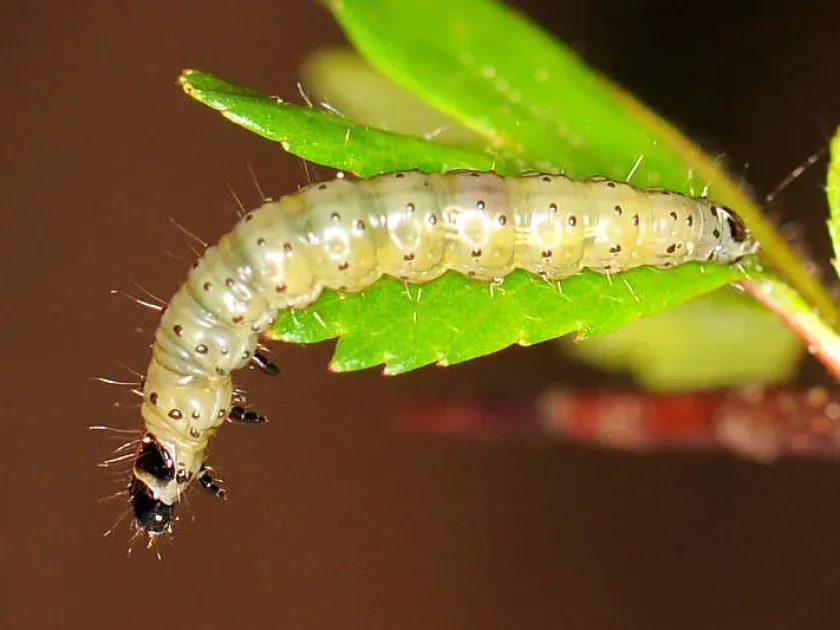
The larvae progress through several developmental stages. Initially, they are light green, gradually darkening as they mature, typically possessing a dark brown head capsule. Fully grown larvae reach a length of about 20 mm.
Pupae are generally dark brown and are found tucked within tightly spun leaves or hidden in crevices of the tree bark, which serves as a protective shelter during metamorphosis.
This species is highly adaptable to various environments. Depending on the geographical region and climate, the moth can complete one or two generations per year, with activity peaking in late spring and summer.
The species overwinters as second or third-instar larvae. They spin tight silk cocoons in branch forks or under loose bark, where they remain in diapause until spring temperatures initiate their activity.
What it damages
This pest is a polyphage, meaning it feeds on a wide range of host plants. The primary targets in orchards include apple, pear, plum, and cherry trees, as well as various berry bushes like currants and raspberries.
Larvae cause damage immediately after buds begin to open in spring. They feed on buds, young foliage, and flower clusters, webbing them together into dense nests that protect them from predators and pesticides.
In the summer, the larvae often shift their feeding focus to the developing fruit. They chew shallow cavities into the fruit skin, which leads to scarring, deformation, and premature fruit drop.
Heavy infestations can significantly impact orchard yields, sometimes causing losses of up to 50%. Furthermore, damaged fruit is highly susceptible to secondary infections, such as rot and fungal diseases entering through the larval feeding sites.
In nurseries, the damage to apical buds is particularly detrimental, as it causes stunted growth and loss of vitality in young saplings, making them less suitable for commercial planting.
When it appears
The emergence of larvae from hibernation coincides with the "green cluster" stage of apple development. This is a critical window for early intervention and pest management.
The flight period for the first generation of adults typically occurs from late May to early June. Mating and egg-laying usually take place at dusk or during the night hours.
Eggs hatch after approximately 10 to 15 days, depending on ambient temperatures. The appearance of the summer larval generation coincides with fruit set, posing a significant threat to the developing harvest.
A second generation may develop by late summer, with these larvae primarily feeding on leaves as they prepare for the upcoming winter dormancy.
The number of generations is highly dependent on the local climate. Warmer regions support two full generations, while cooler regions may limit the pest to a single annual life cycle.
Signs of infestation
The most prominent sign of infestation is the presence of silk webbing on the tips of young shoots. Leaves within these webs are often rolled or bundled tightly together.
Damage to flower buds is indicated by clustered, wilted buds held together by silk threads. Upon opening these clusters, the larva is usually found feeding inside.
On the surface of fruits, feeding signs appear as dried, brownish patches or irregular scars. These injuries often become calloused as the fruit grows, resulting in unsightly markings.
Premature fruit drop in early summer can be a sign of larval activity, as larvae often bore into the fruit stalks or the bases of the fruit, causing them to detach from the tree.
- Silk webbing on shoot tips
- Rolled or bundled leaves
- Deformed flower buds and fruit clusters
- Scarring and shallow pits on fruit surfaces
Control measures
Effective management begins with cultural practices, such as removing old bark and cleaning up fallen leaves in the autumn, which eliminates potential overwintering sites for the larvae.
Biological control methods, including the use of Bacillus thuringiensis, are highly effective against younger larvae and are preferred to maintain balance in the orchard's natural predator population.
Chemical control should be timed carefully. Insecticides are most effective when applied during the larval emergence period, before the pests have successfully sheltered inside rolled leaves.
Pheromone traps are essential tools for monitoring adult populations. By tracking the flight activity, growers can identify the precise time to intervene, reducing the need for excessive spraying.
Regular orchard scouting starting from early spring allows for the detection of initial hotspots, ensuring that localized control can prevent a larger outbreak throughout the season.
Taxonomy
- Latin name
- Homona nubiferana
- Order
- Lepidoptera (butterflies)
- Family
- Tortricidae
- EPPO code
- HOMONI
Discussion
No discussions yet — be the first.