
Sunflower moth
Homoeosoma nebulellum
Description
How to identify
The sunflower moth (Homoeosoma nebulellum) belongs to the Pyralidae family. The adult moth has a wingspan of up to 27 mm and is characterized by grayish-brown forewings with small dark spots.
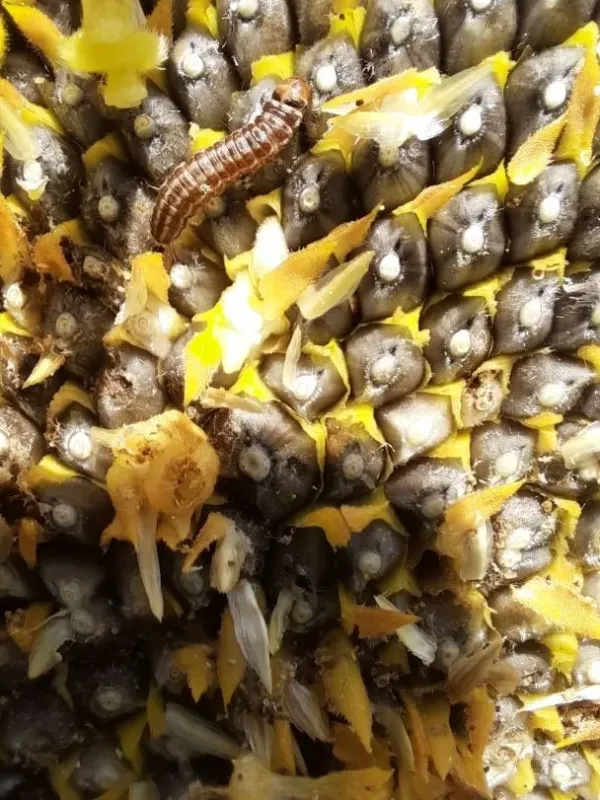
The larvae progress through five instars. In the final stage, they can reach up to 18 mm in length, showing a color range from light green to reddish-brown with longitudinal dark stripes along the body.
Females lay eggs primarily on the florets and bracts of sunflower heads during the blooming stage. The embryonic period lasts between 3 to 10 days depending on climate conditions.
The larvae overwinter in the soil within dense silk cocoons. When temperatures rise in the spring, they pupate, and the first generation of adults emerges to start the cycle on sunflower crops.
Depending on the region, this pest can complete one or two generations per year, making it a persistent threat to sunflower cultivation in many parts of the world.
What it damages
The larvae are the primary damaging stage. They feed on the pollen, florets, and developing seeds of sunflower heads, causing direct yield loss.
Besides sunflowers, the moth hosts on various wild plants of the Asteraceae family, such as thistles and ragweed, which serve as reservoirs for the population.
The feeding activity creates silk webs across the head, which disrupts normal pollination and allows fungal pathogens to enter the damaged tissues.
High infestation levels can result in up to 50% yield reduction, as the larvae destroy the inner tissues of the sunflower head and the seeds themselves.
Quality reduction is also significant; damaged seeds are often lightweight, have lower oil content, and are susceptible to secondary rot infection.
Signs of infestation
The most noticeable sign is the presence of fine silk webbing over the sunflower head, often mixed with larval excrement known as frass.
A careful inspection of the seed heads reveals entry holes in the seeds where larvae have tunneled into the tissues to feed on the kernel.
The sunflower heads may show uneven development, necrosis, or premature browning due to the destruction of the receptacle and seed tissues.
- Silk webbing across the face of the flower head.
- Dark, granular frass accumulation on the seed head.
- Visible holes in the seeds or damaged seed coats.
- Premature rotting or drying of individual sectors of the sunflower head.
Adult moths may be observed flying near the crop at dusk or hiding among the foliage during the daylight hours.
Control measures
Planting resistant sunflower hybrids with high-density floral bracts makes it physically difficult for the moths to oviposit eggs on the florets.
Cultural practices such as deep tillage or plowing after harvest help bury the overwintering pupae, reducing the next year's emerging population.
Managing weeds, particularly those in the Asteraceae family, is essential to minimize the available alternative food sources for the moths.
Chemical control is effective when timed correctly during the egg-laying period and before the larvae enter the head, where they are protected from sprays.
Biological control through the release of beneficial egg parasitoids, such as Trichogramma species, is a sustainable way to suppress the moth population without heavy pesticide use.
Taxonomy
- Latin name
- Homoeosoma nebulellum
- Order
- Lepidoptera (butterflies)
- Family
- Pyralidae
- EPPO code
- HMOENE
Discussion
No discussions yet — be the first.