
Sunflower moth
Homoeosoma heinrichi
Description
How to identify
The sunflower moth (Homoeosoma heinrichi) is a lepidopteran pest belonging to the Pyralidae family. The adult moth has a wingspan of approximately 20-25 mm, with a generally grayish-brown appearance.
Its forewings display a pattern of dark spots, while the hindwings are lighter and feature a subtle pearlescent sheen. The body is slender, making it well-adapted for hiding within the dense florets of sunflower heads.
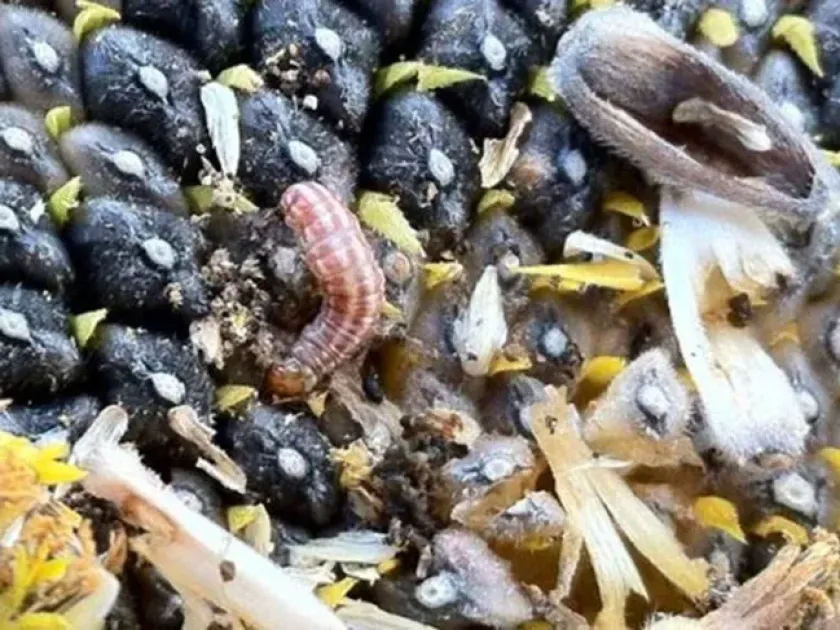
Larvae, commonly known as caterpillars, progress through several instars, eventually reaching 15-18 mm in length. They are characterized by longitudinal stripes along their body, with colors shifting from light yellow to reddish-brown.
The pupal stage occurs inside a sturdy silken cocoon, typically found in the topsoil or within decaying plant material near the sunflower remnants after harvest.
The lifecycle involves a complete metamorphosis: egg, larva, pupa, and adult. Depending on the geographical region, this species can produce one or two generations per season, timed with the sunflower's development.
What it damages
The sunflower moth specifically targets sunflower heads (Helianthus annuus). The damage is caused by larvae that feed on pollen, florets, and developing seeds, leading to significant yield loss.
Young larvae consume the outer parts of the sunflower head, while older larvae bore deep into the receptacle. This destruction disrupts nutrient flow to the seeds, resulting in shriveled or empty achenes.
The feeding activity creates wounds that serve as entry points for pathogens. Consequently, secondary infections like head rot are frequently associated with moth infestations, further reducing oil quality.
Economic damage is exacerbated by the loss of seed weight and the potential for premature seed drop. Even moderate infestations can lead to substantial financial losses in oilseed production.
Threshold levels for treatment are generally low, as the direct damage to the reproductive organs prevents the plant from reaching its full potential, making timely intervention critical.
When it appears
Adult moths are most active during the sunflower flowering period, which provides an ideal environment for egg-laying. Nighttime activity is typical for this species, making them difficult to spot during the day.
Female moths deposit their eggs on the surface of the flowering head. A single female can lay hundreds of eggs, creating a significant potential for rapid population growth if conditions are favorable.
The eggs hatch within about a week. The newly emerged larvae begin feeding immediately on the flowering parts before migrating deeper into the sunflower receptacle to avoid predators.
The peak activity of larvae usually spans mid-summer. This period is the most important for field scouting to determine whether chemical or biological control measures are necessary.
As the sunflower matures, larvae reach their final stage and descend to the soil or stay in the dried head to pupate. They remain dormant through the winter, protected by their cocoons until the next warm season.
Signs of infestation
A primary sign of infestation is the presence of webbing on the surface of the sunflower head. Larvae use this silk to create shelters and trap debris from their feeding activities.
Fine granular waste, known as frass, often accumulates on the surface of the floret disk. This is a clear indicator that larvae are present and actively feeding inside the head.
If the head is opened, distinct tunnels can be found within the receptacle. These tunnels are often blocked or lined with silk and frass, which can eventually lead to tissue decay.
- Silk webbing visible on the sunflower disk.
- Small, dark pellet-like frass on the flowers.
- Entry holes on the back or side of the flower head.
- Premature darkening or rot of floret areas.
- Poorly filled or shriveled seeds during the harvest.
Pheromone traps are essential tools for early detection. Monitoring adult flight patterns allows agronomists to predict potential infestations and time insecticide applications effectively.
Control measures
The primary control strategy involves the use of resistant sunflower hybrids. Breeding programs focus on creating lines with dense, hard tissues in the receptacle that physically inhibit larval boring.
Cultural practices, such as crop rotation and fall tillage, are vital for breaking the pest's cycle. Deep plowing buries the pupae, making it difficult for the next generation of moths to emerge.
Chemical control is effective when applied during the peak flight period and before larvae move deep into the sunflower head. Insecticides with contact and systemic properties are preferred.
Biological control, such as releasing Trichogramma wasps, is a common practice in integrated pest management. These parasitoids target the moth eggs, effectively reducing the population without chemical input.
Ensuring spatial isolation from other host plants (like wild Asteraceae species) can also reduce the pest pressure. Proper monitoring and threshold-based decisions remain the gold standard for management.
Taxonomy
- Latin name
- Homoeosoma heinrichi
- Order
- Lepidoptera (butterflies)
- Family
- Pyralidae
- EPPO code
- HMOEHE
Discussion
No discussions yet — be the first.