
Palm weevil
Homalinotus coriaceus
Description
How to identify
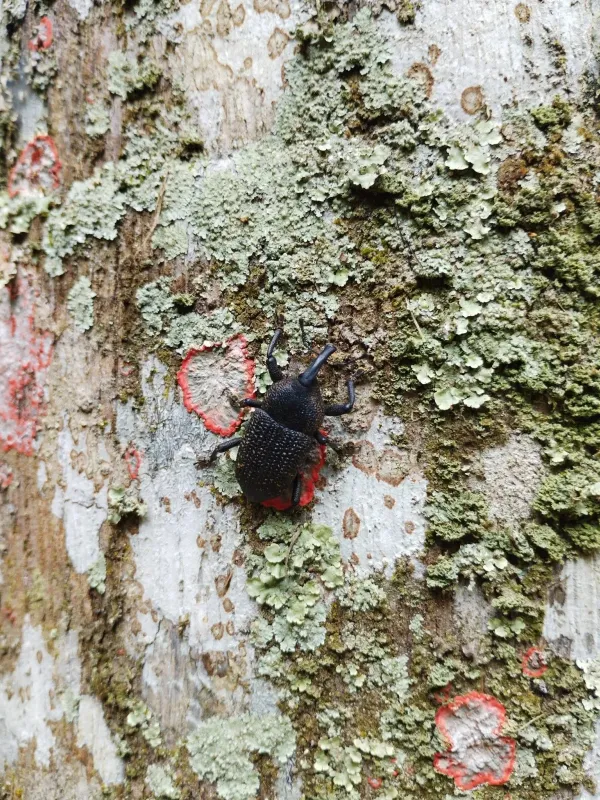
The palm weevil Homalinotus coriaceus belongs to the order Coleoptera and the Curculionidae family. It is identified by its elongated, robust snout, which is specifically adapted for penetrating plant tissues for both feeding and oviposition.
The adult weevil features a dark, near-black chitinous exoskeleton with a matte or slightly glossy finish. Its body is compact and heavy, allowing it to navigate through dense palm tissues during its lifecycle.
Larvae are legless, fleshy, and typically cream-colored with a hardened, dark-brown head capsule. They spend their entire developmental phase concealed within the host plant, constantly feeding on the vascular tissue.
The life cycle encompasses the egg, larva, pupa, and adult stages. Females strategically deposit eggs into the soft tissues of leaf bases or the main trunk, providing an immediate nutrient source for hatching larvae.
Pupation occurs within a specialized fibrous cocoon constructed by the mature larva. This cocoon is formed from shredded palm fibers, providing a secure environment until the adult beetle emerges.
What it damages
Homalinotus coriaceus primarily infests various species of palm trees, including coconut and oil palms. It can also impact ornamental palms within its natural geographical range, causing significant landscape degradation.
Larval feeding is the most destructive aspect, as they excavate extensive galleries within the trunk. This tunneling disrupts the plant's vascular system, hindering nutrient and water transport throughout the tree.
Damage to the apical meristem, or the growing point, is particularly lethal. Once the central growth point is destroyed, the palm loses its ability to produce new foliage, leading to the rapid decline and death of the plant.
Adult feeding on leaves and petioles creates physical wounds, which often become entry points for secondary pathogens like fungi and bacteria, further weakening the host's internal structure.
In high-density plantations, the presence of the palm weevil can lead to widespread economic losses. The rapid reproductive rate of the pest necessitates proactive and frequent field inspections.
Signs of infestation
One of the earliest warning signs is the presence of holes in the trunk, often accompanied by the oozing of plant sap or gum. This dark, viscous exudate is a classic indicator of larval activity deep inside the stem.
Visible wilting, yellowing, or asymmetrical growth of the crown suggests that the plant's internal integrity has been compromised. In severe cases, the entire central part of the crown may collapse.
Accumulations of fibrous frass, which looks like sawdust, can be found near the entry holes at the base of the petioles. This material is expelled by larvae as they continue to expand their internal tunnel network.
Adult weevils are often active during twilight hours, making night inspections a viable method for identifying their presence. They are frequently observed crawling along the trunks of healthy palms searching for breeding sites.
Reduced vigor and stunted leaf development in previously healthy trees indicate a long-term infestation that may already be difficult to reverse without drastic intervention.
Control measures
Sanitary management is paramount; heavily infested palms should be promptly cut down and burned to destroy the larvae and pupae within, preventing the emergence of the next generation of adults.
Pheromone traps are essential for monitoring population levels. By analyzing catch rates, agronomists can determine the optimal timing for targeted insecticide applications and coordinate pest management efforts.
Systemic insecticides, applied through trunk injections or topical sprays, are effective in reaching the larvae hidden within the plant tissue, provided they are applied during the early stages of infestation.
Cultural practices, such as minimizing mechanical injuries to the trunks during harvesting or pruning, reduce the number of attractive sites for female weevils to lay their eggs.
- Regular monitoring using pheromone-baited traps.
- Immediate removal and destruction of infested palm trees.
- Application of biological agents, such as entomopathogenic fungi.
- Preventive trunk spraying to deter adult oviposition.
Taxonomy
- Latin name
- Homalinotus coriaceus
- Order
- Coleoptera (beetles)
- Family
- Curculionidae
- EPPO code
- HOMICO
Discussion
No discussions yet — be the first.