
Mimosa webworm
Homadaula anisocentra
Description
How to identify
The mimosa webworm (Homadaula anisocentra) belongs to the family Galacticidae. The adult moth is small, with a wingspan of approximately 12–15 mm, typically displaying a greyish-brown color pattern with faint dark spots.
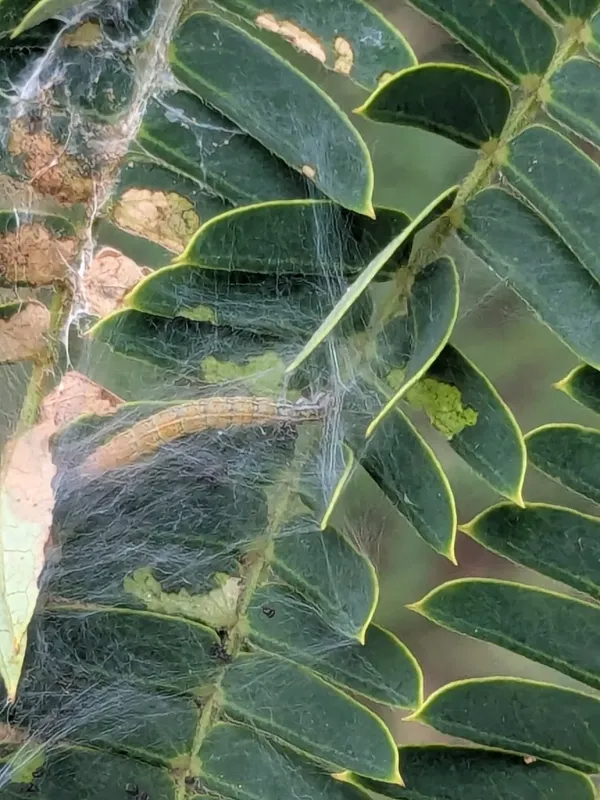
The larvae are the primary damaging stage. Newly hatched larvae are pale, while mature caterpillars reach about 10–12 mm in length, possessing a greenish-grey body with longitudinal stripes.
The pupal stage occurs within small, dense white silken cocoons. These are often tucked away in leaf clusters or bark crevices, providing protection against environmental stress and predators.
Adult moths are nocturnal and are easily monitored using light traps. During the day, they remain stationary in the upper canopy, making visual detection of adults challenging.
Identification is most reliably achieved by recognizing their unique web-nest building behavior on the leaflets of leguminous host trees, which is a hallmark of this species.
What it damages
This pest specializes in leguminous tree species, with a strong preference for Albizia julibrissin (mimosa tree), Gleditsia triacanthos (honeylocust), and Robinia pseudoacacia.
Larvae feed gregariously by tying leaflets together with silk, creating webbed nests. They skeletonize the leaf tissue from within, which causes the foliage to brown, wither, and drop prematurely.
Severe infestations lead to total defoliation, which causes significant stress to the host tree. This decline in health can make the tree susceptible to secondary diseases and environmental stressors.
In landscaping, the aesthetic impact is severe, as the trees appear blighted and unkempt due to the accumulation of webbing and necrotic tissue throughout the summer months.
Continuous attacks over several years can result in stunted growth, reduced vigor, and in extreme cases, the death of young or already weakened ornamental trees.
When it appears
The life cycle of the mimosa webworm is highly dependent on climate, typically consisting of two to three overlapping generations per season in temperate regions.
The species overwinters in the pupal stage. They shelter in cocoons located in protected areas such as tree bark fissures, organic debris, or even protected spots on building walls near host trees.
Adult emergence in the spring is timed with the availability of fresh foliage on host trees. This ensures that the subsequent larval generation has immediate access to food.
The activity peaks during mid-summer. During this time, the development is rapid, and the webbed nests become most prominent across the canopy of the affected trees.
As temperatures begin to drop in autumn, the final generation of larvae pupates to enter diapause, ensuring survival through the cold winter months.
Signs of infestation
The most recognizable sign of infestation is the presence of webbed clusters of leaflets on the ends of branches or dispersed throughout the foliage.
- Withered, brown leaf clusters held together by silk.
- Frass (caterpillar excrement) trapped inside the webbed nests.
- Skeletonized leaflets that turn transparent and eventually brittle.
- Presence of small greyish moths fluttering around the canopy at dusk.
These nests often give the tree a scorched appearance, particularly on the outer periphery of the crown where the larvae have been actively feeding.
Control measures
Effective management involves an integrated pest management (IPM) strategy that focuses on prevention, biological control, and targeted insecticide applications.
Mechanical removal is a practical approach for small or young trees; by pruning and disposing of webbed nests early, you can significantly reduce the local pest population.
Biological control agents, particularly Bacillus thuringiensis (Bt), are highly effective against larvae if applied when the caterpillars are still young and actively feeding.
Systemic insecticides may be used for mature trees where spraying is difficult. These are applied to the soil or trunk to ensure protection throughout the season.
Monitoring the adult population with pheromone or light traps helps in timing the applications, ensuring that treatments are applied when the larvae are most vulnerable.
Taxonomy
- Latin name
- Homadaula anisocentra
- Order
- Lepidoptera (butterflies)
- Family
- Galacticidae
- EPPO code
- HOMAAN
Discussion
No discussions yet — be the first.