
Homadaula
Homadaula
Description
How to identify
Homadaula is a genus of moths belonging to the family Galacticidae. Among the species within this genus, Homadaula anisocentra is recognized as a significant pest of certain ornamental trees, particularly in landscaping and forestry.
Adult moths are relatively small, typically measuring about 12–15 mm in wingspan. Their coloration is generally drab, ranging from gray to brown, which provides excellent camouflage against the bark of their host plants.
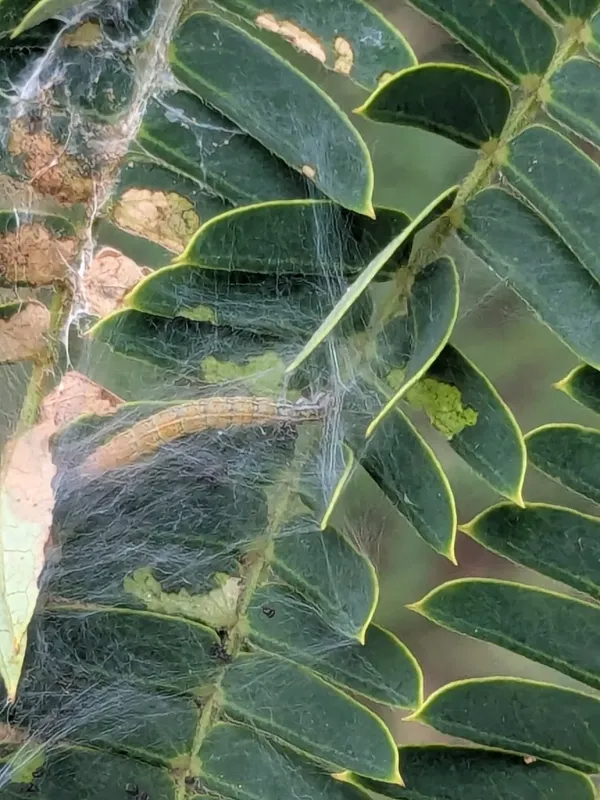
The larvae are the stage most responsible for damage. They are characterized by their social behavior in early instars, living together in interconnected webbing nests that serve as both protection and a feeding site.
Pupation occurs within dense, silk-like cocoons. These are often tucked away in crevices of the tree bark or within rolled-up leaves, making them difficult to detect without careful inspection.
As with many small Lepidoptera, correct identification often requires expert analysis of wing patterns or larval morphology to distinguish between species that may occupy similar ecological niches.
What it damages
The primary host for Homadaula anisocentra is the silk tree, Albizia julibrissin. The larvae thrive on this species, often leading to heavy infestations in both urban and rural settings.
Larvae consume the leaf tissue, frequently leaving only the midribs and major veins, a feeding pattern known as skeletonization. This significantly reduces the foliage's ability to perform photosynthesis.
Severe infestations can lead to premature leaf drop, which weakens the tree's overall vigor. Repeated defoliation over consecutive seasons can eventually lead to branch dieback or total tree death.
Young trees are particularly susceptible to damage. Losing a substantial portion of their leaf area early in the growing season can stunt growth and hinder the development of a healthy crown.
Beyond the direct impact on the foliage, the webbing nests created by the larvae collect debris and frass, which can attract secondary pests and foster the growth of sooty mold, further degrading the tree's health.
When it appears
The life cycle of Homadaula is closely linked to the phenology of the host plant. Emergence of the first generation of adults typically aligns with the flushing of new leaves on the host trees in late spring.
Multiple generations can occur throughout the growing season, depending on the climatic zone. Each generation builds upon the previous one, leading to increased population pressure by mid-to-late summer.
Winter is typically spent in the pupal stage. The pupae overwinter in silken cocoons hidden in bark crevices, which protects them from extreme winter temperatures and fluctuations.
Monitoring for adults or early larval nests should begin as soon as temperatures stabilize in the spring, as early intervention is key to preventing widespread infestation of the canopy.
Because generations often overlap, it is common to find multiple life stages of the pest present simultaneously on the same tree, complicating simple control schedules.
Signs of infestation
The most diagnostic sign of a Homadaula infestation is the presence of silk webbing nests between leaves. These nests act as communal feeding chambers for the larvae.
Leaves that appear skeletonized or tattered are clear indicators of larval activity. Closer inspection of these leaves usually reveals the presence of frass (larval excrement) trapped within the webbing.
The appearance of premature yellowing and canopy thinning during the summer months is a strong symptom that a large colony has established itself in the tree.
The discovery of small, grey-brown pupal cocoons on the trunk or branches during the off-season serves as a warning that the population is preparing for the next year.
If the tree appears generally unhealthy or "off-color" despite adequate watering and fertilization, an infestation of Homadaula should be suspected and verified via inspection.
Control measures
Physical control, such as pruning and destroying infested branches when nests are first spotted, is highly effective for localized infestations on small to medium-sized trees.
Biological control methods include the application of Bacillus thuringiensis (Bt), which is a selective insecticide that targets larvae without disrupting beneficial predatory insects.
Chemical intervention should be timed to coincide with the emergence of larvae. Systemic insecticides can provide long-lasting protection if applied when the tree is actively transpiring.
Encouraging natural predators such as parasitic wasps and predatory beetles helps to maintain the pest population below economic or aesthetic injury levels in the long term.
- Regular inspection of the canopy for webbing and skeletonized foliage.
- Use of pheromone traps to monitor adult flight activity and timing of control.
- Sanitation practices that include clearing leaf litter around the tree base.
- Choosing resistant cultivars of Albizia if available in your region.
Taxonomy
- Latin name
- Homadaula
- Order
- Lepidoptera (butterflies)
- Family
- Galacticidae
- EPPO code
- HOMASP
Discussion
No discussions yet — be the first.