
Lab mite
Histiostoma laboratorium
Description
How to identify
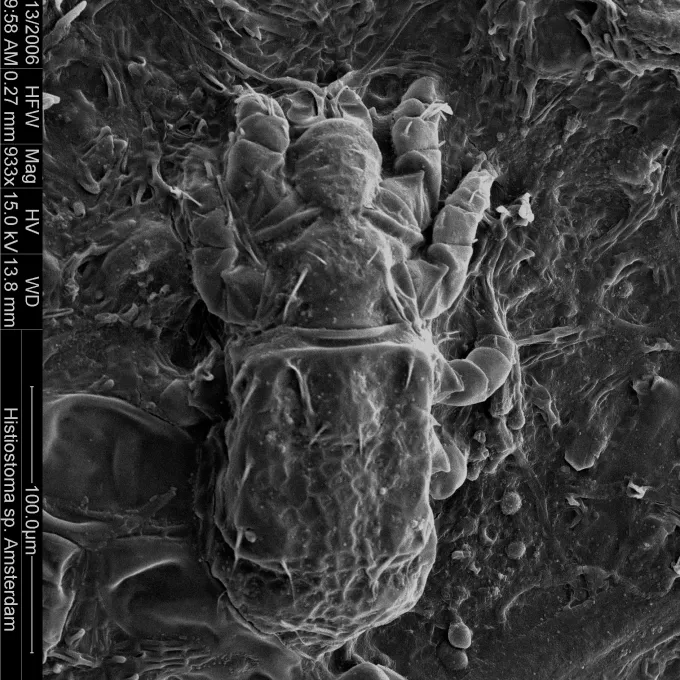
The lab mite (Histiostoma laboratorium) belongs to the family Histiostomidae, order Sarcoptiformes. It is a microscopic mite characterized by a translucent, whitish, and oval-shaped body.
These mites are primarily saprophagous, living on decaying organic matter and fungi, but under high humidity conditions, they can infest living plant tissues.
The life cycle includes the egg, larva, two nymphal stages, and the adult stage. The species is known for its ability to form a "hypopus" stage—a specialized dispersal phase resistant to harsh environmental conditions.
They thrive in environments with high humidity (above 80%) and temperatures between 20°C and 28°C, which are typical for greenhouse operations.
Colonies develop rapidly when a food source like decaying plant matter or fungal mycelium is abundant, quickly expanding across the surface of the substrate.
What it damages
These mites primarily damage greenhouse seedlings and young plants grown in overly moist substrates, as well as stored grain with high moisture content.
The feeding process causes tissues to lose integrity, leading to wateriness, softening, and eventually the decay of roots or stems.
Damage is often exacerbated by the mite's tendency to carry pathogens on their bodies, facilitating the spread of fungal and bacterial rots to healthy plants.
In stored grain, these mites feed on fungi growing on the seeds, but if population densities become too high, they can begin to consume the seed embryo itself.
Infested plants exhibit stunted growth, wilting, and discoloration, which severely impacts the overall health and yield potential of the crop.
Signs of infestation
A distinct sign of infestation is a noticeable sour or musty odor in the greenhouse or storage area, resulting from localized rot and mite activity.
Microscopic examination of the substrate or plant base often reveals dense clusters of these pale, mobile mites moving across the surface.
Affected plant tissues appear dark and necrotic, often turning into a mushy, water-soaked mass as the feeding progresses.
On stored seed lots, one may observe patches of mold growth which serve as focal points for mite populations gathering to feed.
Persistent wilting of seedlings, even when irrigation is sufficient, is a strong indicator of root damage caused by high concentrations of these mites.
Control measures
Management focuses primarily on environmental manipulation, specifically lowering humidity to below 60% and ensuring proper air circulation in greenhouses.
Sanitation is critical; removing decaying organic debris and regularly disinfecting tools and containers significantly reduces the mite's survival rate.
Fungicidal seed treatments serve a dual purpose: preventing mold growth and eliminating the primary food source required by the mites to establish a population.
If chemical intervention is necessary, targeted acaricides should be applied strictly according to the label requirements and local pest management guidelines.
Biological control agents, such as predatory mites (e.g., Phytoseiidae family), can be released in greenhouse environments to suppress lab mite populations naturally.
Taxonomy
- Latin name
- Histiostoma laboratorium
- Order
- Mites
- Family
- Histiostomatidae
- EPPO code
- HISTLA
Discussion
No discussions yet — be the first.