
Mushroom mite
Histiostoma feroniarum
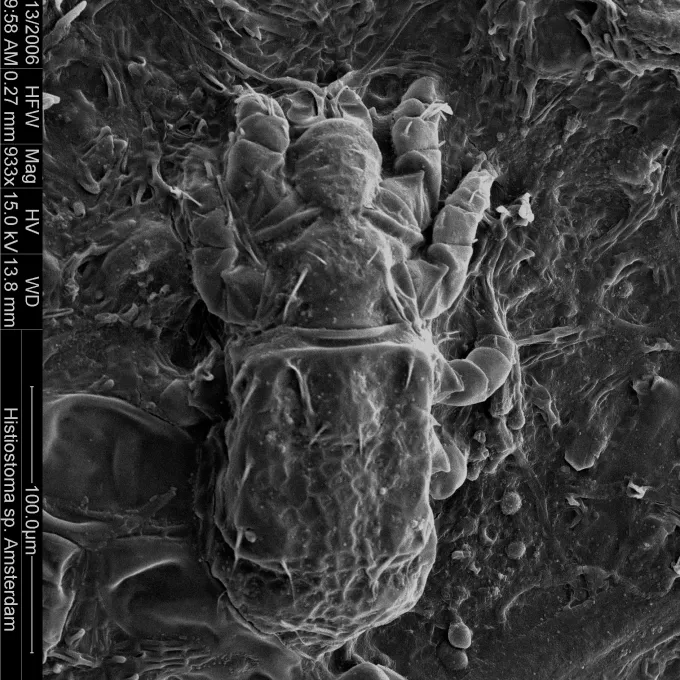
Description
How to identify
The mushroom mite (Histiostoma feroniarum) belongs to the Acaridae family, order Sarcoptiformes. It is a minute, semi-transparent arachnid with a pale, yellowish hue.
Adults are oval-shaped and typically measure between 0.2 and 0.4 mm, making them nearly invisible to the naked eye without magnification tools.
The biological life cycle consists of egg, larva, two nymphal stages, and the adult stage. Development is highly sensitive to substrate moisture and ambient temperature.
Under stressful conditions, these mites can enter a specialized survival stage known as a hypopus, which facilitates dispersal by hitchhiking on insects or equipment.
Populations flourish in high-humidity environments, especially in mushroom cultivation facilities where the presence of organic matter provides abundant food.
What it damages
This species primarily feeds on fungal mycelium, posing a significant threat to commercially grown mushrooms such as button mushrooms and oyster mushrooms.
They consume both the vegetative mycelium in the substrate and the fruiting bodies, causing structural degradation and yield loss.
Mushroom mites are active vectors for pathogenic bacteria and fungi, introducing infections into the mushroom tissues that lead to rapid rot and decay.
In addition to indoor damage, they may occur in soil settings, attacking seeds, bulbs, and roots that are already in a state of decomposition.
Economic damage is most severe in confined spaces, where the mite's rapid reproduction rate allows it to infest entire cultivation blocks in a very short time.
Signs of infestation
A primary indicator of infestation is the thinning and weakening of the mycelial mat, which appears less dense than healthy mycelium.
A dusty, grainy layer often appears on the surface of the casing or the stalks of the mushrooms, which is actually a large concentration of moving mites.
Infested fruiting bodies become discolored, soft, and emit a foul, putrid odor due to the breakdown of tissue and secondary bacterial colonization.
Deformation and stunted growth of young mushrooms are common, with many pins failing to develop into marketable produce.
- Poor mycelium development
- Strong, unpleasant odor in growing rooms
- Browning and softening of mushroom stems
- Visible dusty layer on the substrate surface
Control measures
Strict thermal pasteurization of the compost before inoculation is the most effective preventative measure to ensure the elimination of all life stages of the mite.
Maintaining high hygiene standards, including regular disinfection of tools, containers, and floors, is essential to prevent re-infestation.
Climate control, particularly regulating air humidity and ensuring proper airflow, significantly reduces the environmental suitability for mite population growth.
If an outbreak occurs, targeted acaricide applications may be used, provided they are approved for use in mushroom cultivation and applied carefully.
Biological control measures, such as introducing predatory mites or entomopathogenic fungi, offer an eco-friendly alternative for managing mite populations in commercial farms.
Taxonomy
- Latin name
- Histiostoma feroniarum
- Order
- Mites
- Family
- Histiostomatidae
- EPPO code
- HISTFE
Discussion
No discussions yet — be the first.