
Cryptorrhynchus weevil
Himatium errans
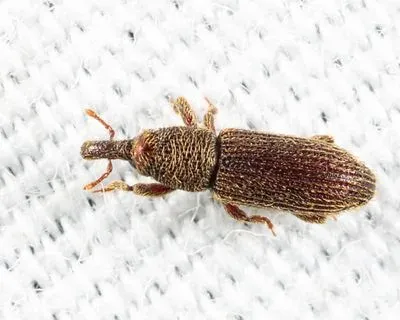
Description
How to identify
The Cryptorrhynchus weevil (Himatium errans) belongs to the order Coleoptera and the family Curculionidae. This small insect possesses the characteristic elongated snout (rostrum) typical of the family, which allows it to penetrate deep into plant tissues.
Adults are known for their cryptic behavior, which reflects their common name. They possess a dark-colored body, making them nearly invisible on tree bark or stems, where they prefer to spend most of their active time.
The development of this species follows a complete metamorphosis cycle: egg, larva, pupa, and adult. The larvae generally live within plant tissues, which complicates their detection in the early stages of infestation and requires careful monitoring of plantings.
In their natural environment, weevil populations are supported by high adaptability to temperature fluctuations. These insects are capable of surviving moderate winter cold by hiding in plant debris or under the bark of trees.
Sexually mature beetles exhibit high viability during the growing season. Their morphological features, including a powerful mouthpart, are adapted for feeding on plant sap and tissue, making them dangerous to the health of agricultural crops.
What it damages
The primary damage is caused mainly by the larval stage, which tunnels inside stems or buds. This leads to the disruption of the plant's normal metabolism, weakening its immune system and reducing the overall productivity of the infested crop.
Adults can also damage vegetative organs by gnawing small depressions in young shoots or leaves. Although these injuries seem minor, they often become "entry points" for the penetration of pathogenic fungi and bacteria.
The most sensitive plants are those already experiencing stress from unfavorable weather conditions or lack of mineral nutrition. The pest selects such specimens for oviposition as a priority.
In infested plants, deformation of shoots and premature shedding of fruits or flowers are frequently observed. Under conditions of intensive pest reproduction, the total yield of agricultural crops can significantly decrease in a single season.
The degree of economic damage directly depends on the insect population density on the site. During mass outbreaks, the weevil can destroy a significant portion of the annual growth of trees or shrubs, which is particularly critical for young orchards.
When it appears
The activity of these weevils begins in early spring, immediately after stable positive air temperatures are established. During this period, overwintered individuals emerge from hiding places and begin active feeding.
The peak of damage usually coincides with the phase of intensive sap flow in plants, which occurs in April-May. At this time, insects actively mate and lay eggs, choosing the most succulent and nutritious parts of plants for the development of their offspring.
The summer development of generations continues throughout the warm season. In the presence of favorable humid conditions, several waves of activity may be observed, which complicates the process of controlling pest populations in orchards and fields.
In autumn, as temperatures drop, beetle activity noticeably declines, and they begin preparation for winter diapause. The insects seek secluded places to ensure the survival of the population until the next year.
Monitoring should be conducted regularly throughout the growing season, but it is especially important to focus on plant inspection during moments of active growth, when crops are most vulnerable to the pest.
Signs of infestation
The first visual sign of infestation is small punctures on young leaves and stems left by the adult beetle while feeding. These holes may gradually increase in size, taking the form of irregular spots or necrotic lesions.
Internal damage by larvae manifests through wilting or twisting of individual shoots, even when sufficient watering is provided. The plant begins to lag in growth compared to healthy specimens in the same area.
During inspection of bark or bud bases, one can find insect excrement, which looks like fine brown sawdust (frass). This is direct evidence that active feeding and development of the larval stage are occurring inside the tissues.
At later stages, premature yellowing and leaf fall may be observed, which is associated with the disruption of plant tissue transport functions. This is often accompanied by the clogging of vascular bundles by the parasite's waste products.
The use of pheromone traps or the "beating" method over a white cloth helps to detect adult individuals at early stages, when damage has not yet become critical to the survival of the plant or the entire harvest.
Control measures
Agrotechnical methods are the basis of prevention and include thorough cleaning of plots from plant debris where adults may hibernate. It is important to perform deep autumn soil tilling to destroy the pest's pupation sites.
Biological control methods involve the use of preparations based on entomopathogenic fungi, which effectively suppress larval populations in natural conditions without harming the environment or beneficial insects.
Chemical protection is used only when the damage threshold is exceeded. Systemic insecticides are used, which penetrate plant tissues making them toxic to hidden larvae, as well as contact preparations against adult beetles.
Adherence to crop rotation and spatial isolation of new plantings from old, infested areas significantly reduces the likelihood of invasion. It is necessary to select resistant crop varieties and provide them with optimal care.
- Regular pruning and destruction of infested shoots
- Application of insecticides during the beetle emergence period
- Installation of adhesive bands on tree trunks
- Maintaining high plant immunity levels through fertilization
Taxonomy
- Latin name
- Himatium errans
- Order
- Coleoptera (beetles)
- Family
- Curculionidae
- EPPO code
- HIMTER
Discussion
No discussions yet — be the first.