
Himatium weevil
Himatium
Description
How to identify
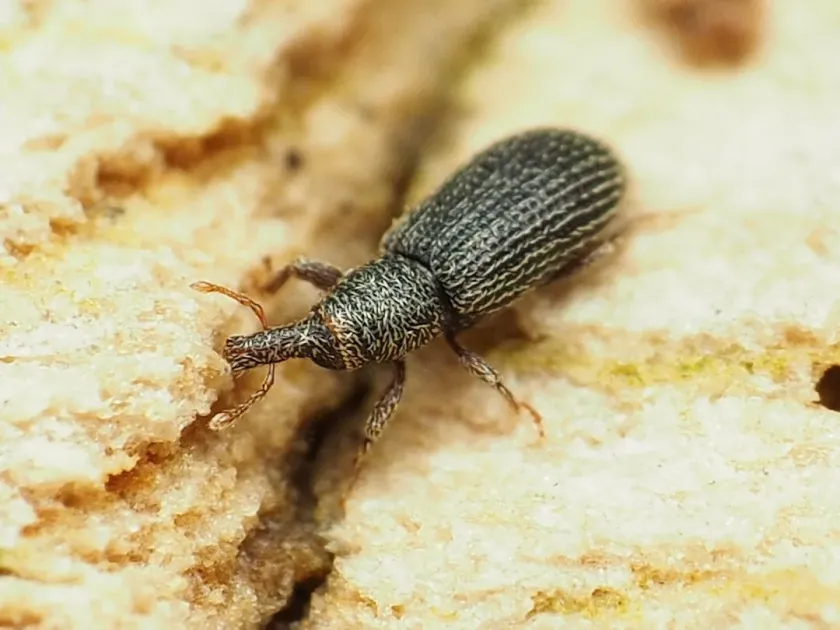
The Himatium weevil belongs to the Curculionidae family, characterized by a distinct rostrum (snout) and elbowed antennae, typical for most weevil species.
These insects are generally small, with bodies adapted for life in tight spaces such as bark crevices or beneath the outer layer of tree trunks.
Their coloration ranges from dark brown to reddish, providing camouflage against the backdrop of tree bark and forest debris, making them difficult to spot.
The larvae of the Himatium weevil are legless, soft, and cream-colored, with a hardened, dark head capsule adapted for boring into woody tissue.
Identification often requires careful inspection of the bark and cambium layers, as these beetles are frequently mistaken for other wood-boring insects.
What it damages
The Himatium weevil primarily attacks coniferous trees, including various species of pine and spruce, often targeting trees that are already weakened.
While adult beetles may feed on buds or new growth, the most significant damage is caused by the larvae feeding on the inner bark and cambium layer.
This feeding disrupts the transport of water and nutrients within the tree, which can significantly weaken the plant and hinder its development.
In cases of heavy infestation, the damaged trees show signs of decline, including stunted growth and increased susceptibility to secondary fungal infections.
High-density infestations in nurseries or young plantations can lead to significant economic loss and the eventual death of affected seedlings.
When it appears
Adult weevils typically emerge in the spring as temperatures rise, signaling the beginning of the breeding season and the search for host trees.
The mating and oviposition process occurs throughout the late spring and early summer, when the tree's metabolic activity is high.
Larval development takes place during the warm summer months, with the larvae actively tunneling through the inner bark as they grow.
By late autumn, most of the population has reached the adult stage and begins to seek out sheltered overwintering sites.
Winter survival is crucial for the population, and the insects effectively hide in forest litter or deep within thick bark to endure cold weather.
Signs of infestation
Small, circular exit holes in the bark are one of the most prominent visual signs that Himatium weevils have been present in a tree.
Sap flow, or resinosis, on the trunk is a common defensive response by the tree and often marks the entry points of adult weevils.
Peeling back the bark often reveals characteristic galleries, which are filled with frass, a powdery wood-like material produced by the larvae.
The foliage of infected trees may begin to show discoloration, turning yellow or brown as the tree's internal circulation system fails due to bark damage.
- Small boreholes on the bark surface
- Sticky resin spots on the trunk
- Frass buildup around the base of the tree
- Gradual yellowing and wilting of the canopy
Control measures
Sanitation is the cornerstone of management: removing infested trees helps reduce the local population and prevents the spread of the weevils.
Applying systemic insecticides is an effective strategy in nurseries, particularly when timed to coincide with the spring emergence of adult beetles.
Maintaining high forest health standards through proper irrigation and soil management ensures that trees remain resilient to pest attacks.
The use of trap trees, which are selectively felled and then treated or destroyed once infested, can effectively pull pests away from healthy stands.
Encouraging natural predators such as woodpeckers and predatory beetles can help keep Himatium populations below damaging levels naturally.
Taxonomy
- Latin name
- Himatium
- Order
- Coleoptera (beetles)
- Family
- Curculionidae
- EPPO code
- HIMTSP
Discussion
No discussions yet — be the first.