
Hexarthrum ulkei weevil
Hexarthrum ulkei
Description
How to identify
The Hexarthrum ulkei weevil belongs to the Curculionidae family and the Coleoptera order. This species is a specialized pest known for its cryptic lifestyle, primarily inhabiting the wood of host plants.
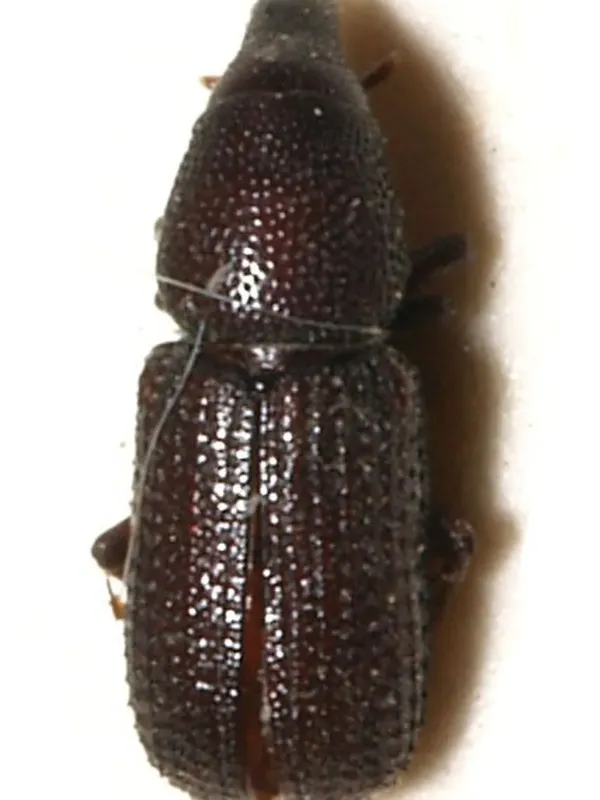
Adult beetles exhibit typical morphological traits for the family, including a small body size and a characteristic elongated rostrum. Their dark brown coloration serves as an effective camouflage against the bark.
The beetles measure only a few millimeters in length, making them difficult to detect without careful inspection. The surface of the elytra displays distinct punctation characteristic of the species.
The larvae are legless, white-colored, and feature a well-developed head capsule. They spend their entire developmental period tunneling through the wood, which is the primary source of damage.
Systematically, this species is frequently found in forest ecosystems, preferring to colonize weakened, dying, or decaying sections of tree trunks and branches.
What it damages
Hexarthrum ulkei feeds on the wood of various tree species, most commonly deciduous ones. The pest thrives in tissues already compromised by fungal infections or natural decay processes.
In forestry and horticulture, it is regarded as a secondary pest. While it does not typically attack healthy, vigorous trees, it significantly accelerates the decline of already compromised specimens.
Larvae create intricate tunnels deep within the wood, which degrades the structural integrity of the plant. This makes the tree highly susceptible to mechanical breakage during severe weather events.
These tunnels serve as entry points for wood-decay fungi. The presence of the weevil facilitates the rapid spread of decay, which can eventually lead to the total collapse of the wood structure.
In nurseries, an outbreak of this weevil can lead to the loss of young saplings, causing significant economic damage to producers and forest managers.
When it appears
The activity of Hexarthrum ulkei adults generally begins in the spring, coinciding with rising temperatures that trigger their mating and dispersal behaviors.
Females deposit eggs directly into crevices in the bark or into pre-existing holes in the wood. This process usually correlates with the active growth season of the host tree.
Larvae develop internally for an extended period, often throughout the entire summer. In favorable conditions, generations may overlap, making the infestation persistent throughout the season.
Pupation occurs within the tunnels carved by the larvae. Adults may choose to overwinter inside the wood, emerging only when environmental conditions become optimal in the following spring.
Host tree hydration plays a critical role: moisture levels in the wood significantly influence the success of the larval colony's establishment and growth.
Signs of infestation
The primary symptom of infestation is the presence of small, circular exit holes on the bark surface. These holes are often accompanied by fine wood dust or frass.
Removing a section of the bark reveals a complex network of galleries. These tunnels are typically packed with larval waste, excrement, and wood fibers.
Externally, the tree may show signs of decline, such as premature yellowing of leaves or the dieback of skeletal branches, particularly in the lower trunk region.
Finding live adults or larvae beneath the bark is definitive proof of infestation. Signs of drilling activity at the base of the tree are also common indicators.
Bark loosening and the development of localized decay spots are key indicators of Hexarthrum ulkei activity, especially when other major pests are absent.
Control measures
Effective management relies on maintaining high cultural standards. Healthy, robust trees possess natural defenses that discourage infestation by this weevil species.
- Prompt removal and destruction of dead wood and heavily infested branches to reduce the pest population.
- Sanitary pruning of trees in gardens and nurseries to eliminate weakened or decaying wood.
- Implementation of monitoring tools, such as traps, during peak adult activity to detect population spikes.
- Targeted application of systemic insecticides if infestation levels become critical, although efficacy is limited against larvae living deep in the wood.
- Biological control by encouraging natural predators and parasitoids that help regulate the weevil population in the wild.
Taxonomy
- Latin name
- Hexarthrum ulkei
- Order
- Coleoptera (beetles)
- Family
- Curculionidae
- EPPO code
- HEXRUL
Discussion
No discussions yet — be the first.