
Hexarthrum
Hexarthrum
Description
How to identify
Hexarthrum is a genus of small beetles belonging to the Curculionidae family, commonly known as true weevils, which often inhabit decaying or stressed wood tissues.
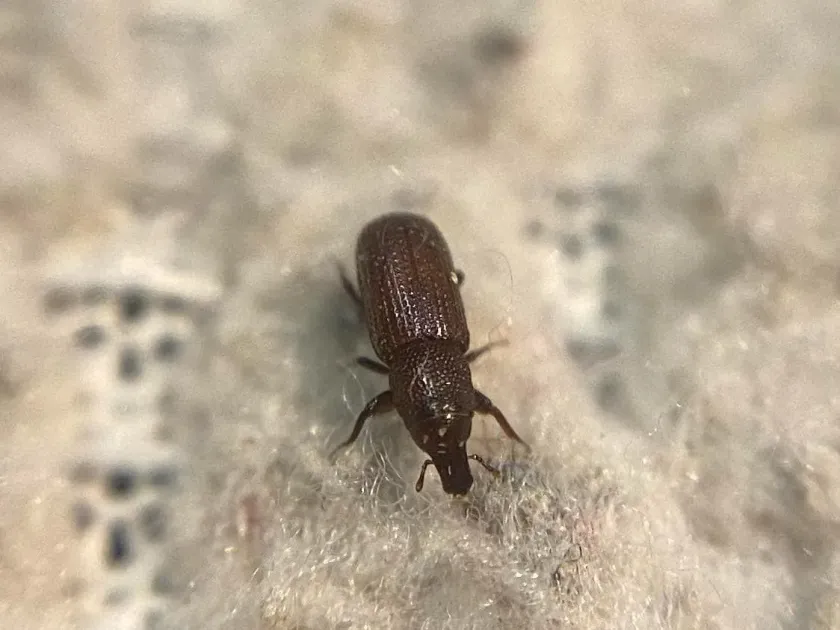
The adults are characterized by a small, cylindrical body and a prominent rostrum (snout), typical of the weevil group, although their size is significantly smaller than many common agricultural pests.
Their coloration typically ranges from dark brown to black, a cryptic feature that allows them to blend into the dark tunnels they excavate within tree trunks.
The larval stage consists of legless, creamy-white grubs with a well-developed head capsule, designed specifically for boring through dense lignified plant material.
Taxonomically, they are categorized within the subfamily Cossoninae, which is renowned for its role in the natural decomposition of wood but can also impact weakened ornamental or fruit trees.
What it damages
Hexarthrum beetles primarily target trees that are already physiologically weakened, suffering from moisture stress, or previously attacked by fungal pathogens.
In orchards and landscapes, these beetles can cause internal structural damage by mining tunnels through the cambium and xylem, which disrupts the tree's nutrient transport system.
Although they are not typically primary killers of healthy trees, their cumulative activity can lead to branch dieback, crown thinning, and overall decline in tree health.
Larval galleries significantly weaken the wood structure, making the tree susceptible to mechanical breakage during high winds or heavy snow loads.
The damage is often localized initially, but if left unmanaged, the infestation can spread to surrounding weakened trees, creating a recurring pest problem on the site.
When it appears
The biological cycle of Hexarthrum is synchronized with the seasons, with adult activity beginning as ambient temperatures rise during the early spring.
Reproduction and egg-laying occur throughout the warmer months, allowing the larvae to develop rapidly in moisture-rich wood environments.
The developmental rate is highly dependent on environmental humidity; therefore, the infestation tends to be more aggressive during seasons with stable, warm conditions.
Overwintering usually occurs within the host wood as larvae or adults, enabling them to survive harsh winter conditions within the insulated chambers they create.
Because multiple generations can overlap, monitoring for these pests requires persistent vigilance throughout the entire growing season.
Signs of infestation
The most visible indicator of an infestation is the accumulation of "frass" or boring dust, which resembles fine sawdust, found at the base of the tree or in bark crevices.
Small, circular entry holes appearing on the bark surface are clear signs that beetles have successfully penetrated the trunk to initiate galleries.
The canopy of the tree may exhibit signs of stress, such as yellowing of leaves, premature drop, or sparse foliage, which reflects systemic damage to the vascular tissues.
When investigating beneath the bark, one can observe complex, winding galleries filled with dark excrement, confirming the presence of the beetle larvae.
The affected areas of the wood become soft, punky, and brittle, which is a classic symptom of advanced wood-boring activity within the host plant.
Control measures
The primary control strategy involves strict sanitation practices, such as the prompt removal and disposal of infested branches, dying trees, or abandoned stumps.
Maintaining tree vitality through consistent watering, proper pruning, and fertilization is essential to reduce the likelihood of attracting these opportunistic wood-borers.
Mechanical injuries should be promptly treated with pruning sealers or wound dressings to prevent the initial entry of insects and fungal spores.
In cases where infestations threaten high-value ornamental trees, systemic insecticides applied as soil drenches or trunk injections may be considered.
- Inspect tree trunks regularly for circular entry holes.
- Remove and destroy severely infested woody debris from the orchard.
- Promote healthy growth to make trees less attractive to wood-boring pests.
Taxonomy
- Latin name
- Hexarthrum
- Order
- Coleoptera (beetles)
- Family
- Curculionidae
- EPPO code
- HEXRSP
Discussion
No discussions yet — be the first.