
East Asian bark beetle
Heteroborips seriatus
Description
How to identify
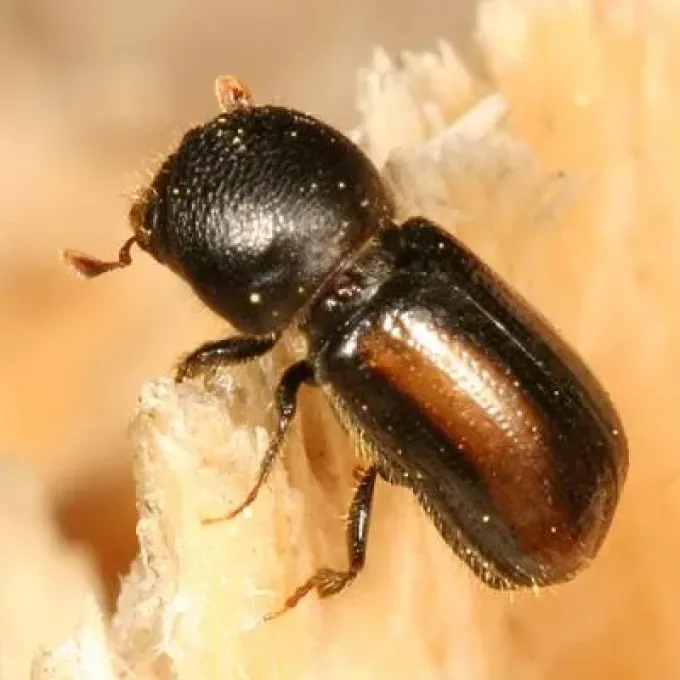
The East Asian bark beetle (Heteroborips seriatus) belongs to the order Coleoptera, family Curculionidae, and subfamily Scolytinae. These are small beetles, typically measuring between 2.5 and 3.5 mm in length.
The body of the insect has a cylindrical shape and a dark brown to black coloration. The surface of the elytra is covered with dense, small punctures and fine hairs, which serves as a key diagnostic feature for the species.
The larvae of this bark beetle are legless, white in color, with a yellowish head. They develop directly within the wood, excavating galleries in the phloem and sapwood layers, which is a critical stage in the species' lifecycle.
The pupae are also white or cream-colored and are often found in specialized chambers (pupal cradles) that the larvae construct deep within the bark or the outer layers of the wood before transforming.
Adult beetles are capable of strong flight, allowing them to travel significant distances in search of suitable weakened trees to colonize and reproduce.
What it damages
The primary hosts for Heteroborips seriatus are various coniferous tree species, particularly spruces and firs, which are most susceptible to attacks during periods of stress.
The pest targets primarily weakened, dying, or fallen trees. However, when population density is high, they can also attack healthy specimens, leading to mass mortality in coniferous stands.
Damage is caused by both adult beetles and larvae. They bore extensive networks of galleries into the bark and cambial layer, disrupting the transport of nutrients throughout the tree.
During their activity, the beetles introduce pathogenic fungi into the wood, which cause blue stain and rapid tissue necrosis, significantly accelerating the death of the host tree.
Significant economic loss arises from the degradation of timber value, the reduction of forest ecosystem resilience, and the necessity for costly large-scale sanitary logging in infested areas.
When it appears
The activity of the East Asian bark beetle is directly influenced by climatic conditions and air temperature. The emergence of beetles after winter typically begins when tree trunks warm up to +15...+18°C.
The period of mass flight of the adults generally occurs in May and June. During this time, the insects actively search for host trees, guided by the scent of terpenes and pheromones released by early colonizers.
The lifecycle includes development from egg to adult, occurring within a single season. Under favorable conditions, one or two generations per year are possible depending on the geographic latitude.
The beetles primarily overwinter as adults in the forest litter at the base of trees or within the trunks under the bark, where they are protected from extreme winter temperatures.
Towards the end of summer, usually in August, a gradual decrease in activity is observed as the population prepares for overwintering, characterized by a slowing of their metabolic processes.
Signs of infestation
One of the first signs of infestation is the appearance of "frass" — fine sawdust that accumulates at the base of the tree trunk or within bark crevices.
Upon inspection of the trunk, one can notice numerous entrance holes made by the beetles as they bore into the bark. These holes are typically 1–1.5 mm in diameter.
Gradually, the needles of the infested tree change color, turning yellowish and then reddish-brown, indicating a failure in the tree's vascular conduction system.
The falling off of bark patches, revealing complex patterns of larval and maternal galleries, is a late and obvious indicator that the tree is severely infested and irreversible damage has occurred.
- Presence of entry holes in the bark;
- Accumulation of frass at the root collar;
- Yellowing and shedding of needles;
- Peeling bark exposing beetle galleries;
- Increased bird activity (woodpeckers) on tree trunks.
Control measures
The primary control method is timely sanitary logging of infested trees. Removing infected trees before the new generation emerges prevents the expansion of the pest population.
Using trap trees is a classic silvicultural technique. Freshly felled coniferous trunks are laid out to attract the beetles, after which they are removed and debarked before the progeny can exit.
The deployment of pheromone traps allows for the monitoring of population density and the mass trapping of adult beetles during their active dispersal periods in spring and summer.
Chemical control measures, including the application of contact or systemic insecticides, are appropriate for forest parks and high-value stands to prevent the colonization of healthy trees.
Maintaining forest health through proper silvicultural management, preventing over-mature stands, and the prompt removal of windthrow or broken trees is the foundation for preventing outbreaks.
Taxonomy
- Latin name
- Heteroborips seriatus
- Order
- Coleoptera (beetles)
- Family
- Curculionidae
- EPPO code
- XYLBSE
Discussion
No discussions yet — be the first.