
Heteroborips
Heteroborips
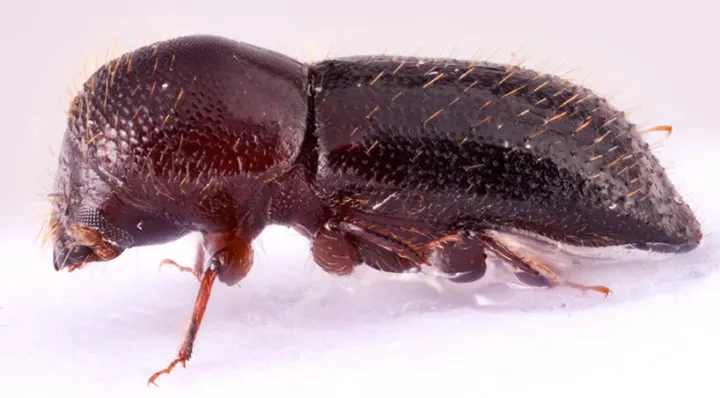
Description
How to identify
Heteroborips belongs to the Curculionidae family, specifically the Scolytinae subfamily. These are microscopic beetles that live cryptically within wood tissues.
Adult specimens typically possess a cylindrical body, colored dark brown or black. The size of these beetles usually does not exceed 2–3 millimeters, making them difficult to detect during initial tree inspections.
Systematically, this genus is closely related to better-known bark and ambrosia beetles that inhabit the stems and branches of woody plants.
The life cycle of this insect is closely linked to fungal microflora, which the beetles introduce into their galleries to serve as food for the larvae.
Morphologically, the species is adapted for tunneling through wood, possessing a powerful chewing mouthpart for excavating narrow channels.
What it damages
The primary hosts of this pest include various deciduous and coniferous tree species, particularly those already weakened by environmental stress.
Heteroborips causes significant damage to orchards, ornamental plantings, and forest stands by disrupting the normal flow of sap within the trunks.
The damage manifests as deep wood boring, which leads to general weakening of the tree and its subsequent desiccation and death.
Infested areas serve as entry points for secondary infections, including fungal pathogens and bacterial rots that further degrade the wood.
In cases of mass infestation, the pest is capable of killing mature trees over the course of several active colonization seasons.
When it appears
Adult beetle activity typically begins in early spring, once air temperatures stabilize at consistently favorable levels.
The primary period for flight and tree colonization occurs in late spring and early summer, when females search for suitable substrate for oviposition.
During the summer months, larval development takes place, with larvae actively excavating galleries within the trunk or thick branches.
Pupation generally occurs at the end of summer, after which the new generation of beetles prepares for overwintering.
Insects overwinter mainly as adults, residing within the galleries of old infested trees or beneath the bark near the root collar.
Signs of infestation
The first visual sign of the pest's presence is the appearance of tiny entry holes on the bark, resembling pinpoint drilling marks.
Surrounding these holes, one can often observe "frass" — fine wood dust or sawdust expelled by the beetles during their boring activities.
Affected specimens often show premature yellowing and leaf drop, as well as the drying out of individual scaffold branches.
If a portion of the bark is removed from an infested area, a complex system of branched tunnels can be seen penetrating the sapwood.
- Entry holes with a diameter of 1-2 mm.
- Accumulations of frass on the tree surface.
- Dieback of terminal shoots.
- Bark discoloration near the infestation sites.
Control measures
The primary control measure involves timely sanitary felling and proper disposal of heavily infested trees that serve as breeding grounds.
Maintaining high agricultural standards is crucial: provide regular irrigation and fertilization to enhance the tree's natural immunity against borers.
The use of pheromone traps allows for monitoring population dynamics and determining the precise timing for protective treatments.
When necessary, systemic insecticides are applied; these penetrate the plant tissues and affect beetles upon their attempt to penetrate the bark.
Preventive trunk whitewashing with the addition of insecticidal components can help deter pests during their period of active flight.
Taxonomy
- Latin name
- Heteroborips
- Order
- Coleoptera (beetles)
- Family
- Curculionidae
- EPPO code
- HTBOSP
Discussion
No discussions yet — be the first.