
Hersiliola
Hersiliola
Description
How to identify
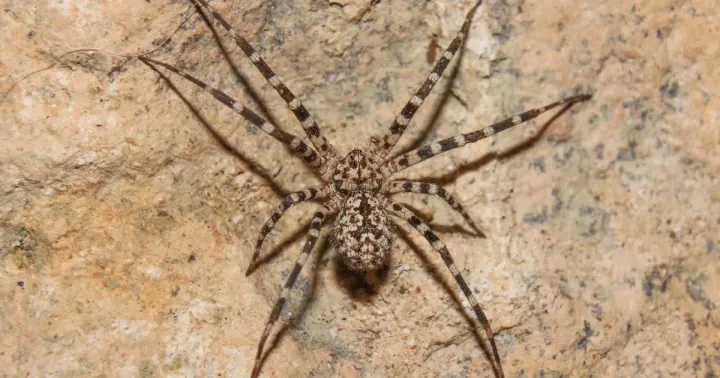
Hersiliola is a genus of spiders belonging to the family Hersiliidae, often commonly referred to as two-tailed spiders due to their exceptionally long posterior spinnerets which resemble tails.
These spiders are characterized by a flattened body shape, which is an evolutionary adaptation for living in narrow crevices of tree bark, stones, or dry soil. Their coloration is usually cryptic, mimicking sandy or wooden surfaces to remain hidden from both prey and predators.
Unlike many spider families, Hersiliola species do not construct traditional orb-webs to trap prey. They are active ambush hunters that rely on extreme speed and rapid movement to overwhelm their insect prey.
Identification at the species level requires microscopic examination of the reproductive organs, as they share very similar morphological features with other genera within the Hersiliidae family.
They are primarily distributed in arid and semi-arid regions, thriving in environments where they can easily find suitable micro-habitats for hunting and hiding.
What it damages
It is crucial to note that Hersiliola is a predatory arachnid. It does not possess mouthparts capable of damaging plant tissues, nor does it feed on plant sap or foliage.
Consequently, they are not classified as agricultural pests. Their presence in an agro-ecosystem is generally neutral or potentially beneficial, as they contribute to the predation of various small insects.
However, in rare cases, they might prey upon beneficial insects or pollinators, which could theoretically affect agricultural yields, although there is no significant evidence of this causing economic loss.
Their activity is mostly restricted to bark surfaces or ground level, meaning they rarely interact with the fruit or the main productive parts of most crops.
Because they do not cause direct damage, there is no economic threshold defined for Hersiliola, and farmers are advised not to treat them as targets for pest control.
When it appears
The activity cycle of Hersiliola is highly dependent on temperature and seasonal changes. They are most active during the warmer spring and summer months.
During the spring, as temperatures rise, the spiders emerge from their overwintering sites to begin feeding and reproduction. This aligns with the peak activity of their insect prey.
Reproduction involves the production of flat egg sacs that are camouflaged against the substrate. These sacs are usually guarded by the female until the spiderlings hatch.
In autumn, as the climate turns cooler, Hersiliola individuals begin to seek out shelters such as deep bark fissures or leaf litter to survive the winter months.
The winter period is spent in a state of diapause, a biological suspension of activity that allows the population to persist through unfavorable conditions.
Signs of infestation
The most reliable sign of their presence is the observation of flattened spiders with elongated spinnerets on tree trunks or rocks, especially in arid agricultural settings.
Because they do not spin large webs, they are often overlooked. One might notice them darting away when the bark they are resting on is disturbed.
The remains of small insects, such as empty exoskeletons found near their resting spots on bark, can indicate that a predator has been hunting in the vicinity.
During the breeding season, one might find small, flattened, silk-like cocoons tucked into tight crevices, which are characteristic of this genus.
Visual detection is easiest during the daytime, as these spiders often sun themselves or wait in the open on bark, ready to strike at any nearby insect movement.
Control measures
No formal pest control measures are required for Hersiliola, as they are not pests. Excessive pesticide use targeting these spiders can disrupt the natural balance of the ecosystem.
Standard orchard hygiene, such as removing dead, loose bark or debris, is a recommended agronomic practice that naturally limits the number of suitable shelters for these spiders if they are perceived as a nuisance.
Farmers should focus on managing actual pests through integrated pest management (IPM) strategies, which naturally protect beneficial predators like Hersiliola.
Maintaining biological diversity in and around the orchard helps sustain a healthy population of predatory spiders, which can assist in controlling other harmful insect species.
- Removal of dead or flaky bark from trees.
- Promotion of natural predatory populations.
- Avoidance of broad-spectrum insecticides.
- General sanitation of the field or orchard environment.
Taxonomy
- Latin name
- Hersiliola
- Family
- Hersiliidae
- EPPO code
- HRSOSP
Discussion
No discussions yet — be the first.