
Ground spider
Herpyllus
Description
How to identify
The genus Herpyllus belongs to the family Gnaphosidae (ground spiders). These are active nocturnal hunters that do not weave capture webs but prefer to hunt insects on the soil surface or under plant debris.
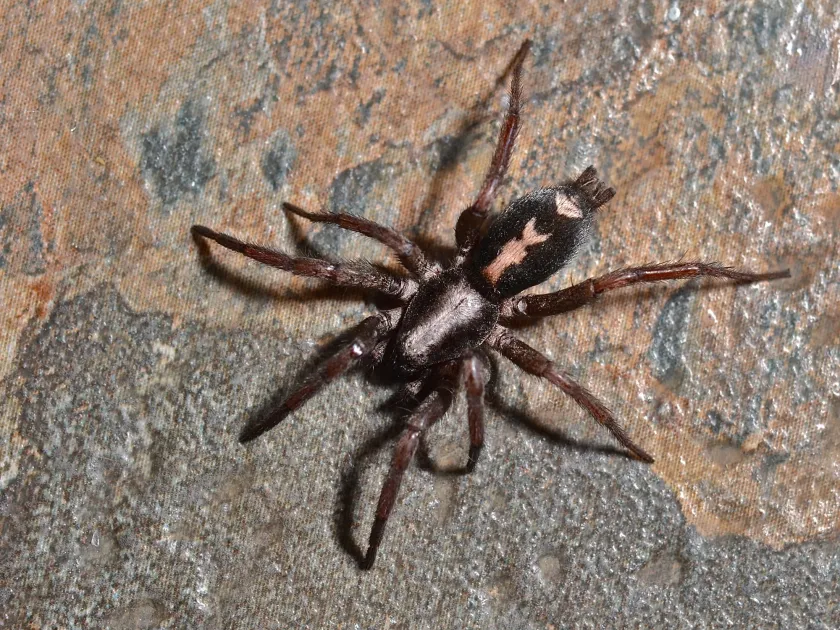
Externally, spiders of this genus have a flattened body, dark brown or black in color, often with a characteristic light pattern on the carapace. Adult sizes range from 5 to 15 millimeters.
They are often mistaken for dangerous species, but Herpyllus are not poisonous to humans and pose no direct threat to the health of an agronomist during fieldwork.
These spiders lead a secretive lifestyle, hiding during the day in natural shelters such as under stones, in bark crevices, in fallen leaves, or in soil cavities, which makes them difficult to detect.
Accurate species identification often requires microscopic examination of the epigyne structure in females or pedipalps in males, as morphological features between members of the genus are subtle.
What it damages
It is important to note that members of the genus Herpyllus are not phytophagous. In agronomic practice, they do not damage plant tissues, do not suck plant sap, and do not destroy the harvest.
These spiders are obligate entomophagous predators. Their diet consists exclusively of other insects and small invertebrates living in the soil layer or on the lower parts of plant stems.
Furthermore, they can be beneficial to the agroecosystem by reducing the total population of harmful insects, such as larvae of soil pests, small caterpillars, or other invertebrates that damage roots.
Direct damage to crops by this species has not been documented in scientific literature. Mentions of their "pest status" are usually related to human discomfort caused by spiders entering buildings.
Therefore, classifying Herpyllus as a "pest" is incorrect; they act more as biological controllers of pest populations.
When it appears
The activity of ground spiders is directly dependent on soil temperature. They are most active during the warm season, from late spring until mid-autumn.
At the beginning of the season, a peak in their movement occurs as they seek prey. During this period, they are most often observed when tilling the soil or applying mulch.
In autumn, as frosts approach, spiders enter diapause, burrowing deeper into the soil or hiding in frost-free locations to overwinter until the next growing season.
The life cycle includes laying eggs in cocoons, which the female often guards in a secluded spot. Juvenile development is rapid, allowing the population to recover after adverse conditions.
Spider migration into buildings often increases in late summer or early autumn when food sources in fields are depleted and ambient temperatures begin to drop.
Signs of infestation
The presence of ground spiders in a field or garden can be detected only indirectly, as they do not leave typical capture webs on plants.
The main sign of their habitation is the presence of individuals under mulching materials, agricultural fabric, boards, or stones that serve as temporary shelters.
Sometimes evidence of their activity is found in the form of dense white cocoons hidden in soil cracks or under tree bark, where females guard their offspring.
When visually inspecting the soil at dusk or night with a flashlight, one can notice the active movement of dark individuals, which quickly hide when exposed to light.
The absence of damage to leaves, stems, or fruits in the presence of observed spiders is direct confirmation that these individuals are not crop pests.
Control measures
Given the beneficial entomophagous role of ground spiders, the use of specialized insecticides against them is not recommended and is economically unjustifiable.
To prevent spiders from entering greenhouses or storage facilities, mechanical sealing, the installation of insect screens, and the closing of foundation gaps are recommended.
Limiting the use of broad-spectrum insecticides on the site helps preserve the population of beneficial predators, which positively affects the balance of the biocenosis and pest suppression.
If the presence of spiders in utility rooms causes concern, a thorough cleaning, removing debris, dry leaves, and other shelters near buildings is usually sufficient.
Biological protection consists of maintaining conditions favorable for the natural existence of beneficial arthropods, which minimizes the need for harsh chemical control measures.
Taxonomy
- Latin name
- Herpyllus
- Family
- Gnaphosidae
- EPPO code
- HERYSP
Discussion
No discussions yet — be the first.