
Banana thrips
Hercinothrips femoralis
Description
How to identify
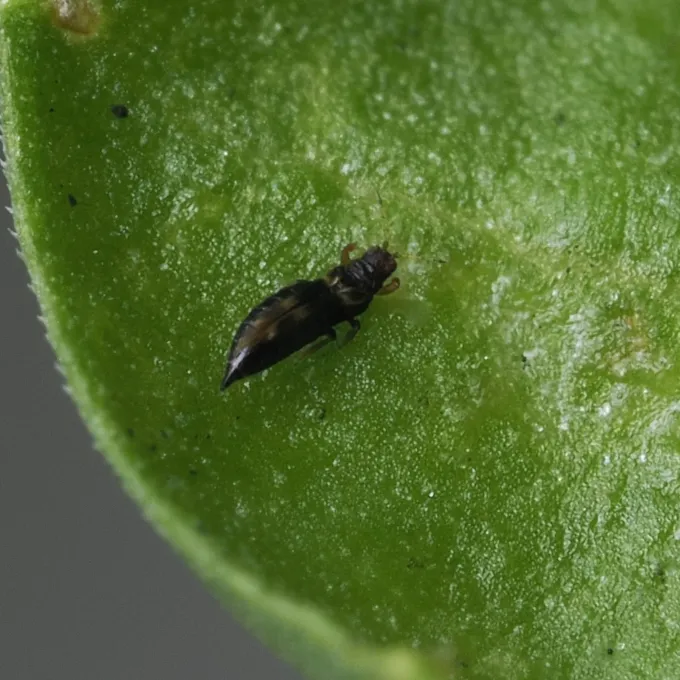
Banana thrips (Hercinothrips femoralis) is a member of the Thripidae family, known for its distinct morphological features. Adults are dark brown to black, measuring approximately 1.2–1.5 mm in length.
A key identifying feature is the presence of pale or yellowish tibiae on their legs, contrasted with their darker bodies. Their wings are transparent with noticeable dark transverse bands.
The larvae are typically pale yellow or white, wingless, and tend to stay on the undersides of leaves, making them difficult to detect during the early stages of infestation.
The life cycle encompasses several stages: egg, two larval instars, prepupa, and pupa. Unlike many other species, pupation often occurs in the soil or protected crevices of the plant.
These insects are highly efficient at exploiting greenhouse environments, where stable temperatures allow for rapid, continuous reproduction cycles throughout the year.
What it damages
This pest is a significant threat to various greenhouse crops, including bananas, orchids, palms, and many ornamental plants. They feed primarily on the foliage and developing fruits.
Damage is caused by both adults and larvae piercing plant cells and sucking out the contents. This process leads to the collapse of epidermal tissue, resulting in silver or whitish spotting.
On fruits, such as bananas, feeding activity creates unsightly rusty patches or scabby marks, which drastically reduce the aesthetic and commercial value of the harvest.
Heavy infestations can lead to significant defoliation, stunted growth, and a severe reduction in the plant's overall photosynthetic capacity, weakening the host's vigor.
In addition to direct feeding damage, banana thrips can act as vectors for various plant viruses, potentially causing systemic diseases in sensitive greenhouse populations.
When it appears
In temperate climates, Hercinothrips femoralis is strictly a greenhouse pest and does not survive cold outdoor winters. It thrives in humid, warm conditions year-round.
The optimal temperature range for rapid population growth is between 22°C and 28°C. In these conditions, a generation can complete its cycle in less than a month.
Humidity is a critical factor for their survival; they prefer environments with relative humidity above 60%. Lower humidity levels can sometimes slow down larval development.
Infestations often begin in shaded, stagnant areas of the greenhouse where high foliage density provides protection for the colonies.
Because they lack a diapause stage, there is no dormant season for this pest; management efforts must be consistent throughout the year to prevent outbreaks.
Signs of infestation
The first signs of banana thrips are tiny, silvery, or bleached patches on the upper leaf surface, representing areas where chlorophyll has been extracted.
Evidence of infestation is easily confirmed by the presence of small, black fecal spots on the underside of leaves, which are typical indicators of their feeding sites.
Inspect the undersides of leaves using a magnifying lens to spot the small, dark-colored adults and pale larvae moving along the veins of the plant.
As the damage progresses, affected leaf areas turn brown or necrotic, leading to leaf curling or distortion. In severe cases, the entire leaf may dry out prematurely.
Always examine the tightest clusters of leaves and the undersides of flower petals, as these locations provide perfect shelter for thrips attempting to avoid detection.
Control measures
Effective management begins with strict quarantine protocols for new plants entering the facility and the deployment of blue sticky traps for monitoring populations.
Physical control methods, such as washing the foliage with a pressurized water spray, can significantly reduce the larval population if applied consistently.
Biological control agents, particularly predatory mites such as Amblyseius swirskii or predatory bugs, are highly effective when introduced early in the infestation cycle.
Chemical control should utilize systemic insecticides, such as spinosad-based products, applied in repeat cycles to target subsequent generations of larvae emerging from the soil.
To avoid the development of insecticide resistance, it is crucial to rotate between different chemical classes and maintain high hygiene standards within the greenhouse environment.
Taxonomy
- Latin name
- Hercinothrips femoralis
- Order
- Thrips
- Family
- Thripidae
- EPPO code
- HERCFE
Discussion
No discussions yet — be the first.