
Banana thrips
Hercinothrips bicinctus
Description
How to identify
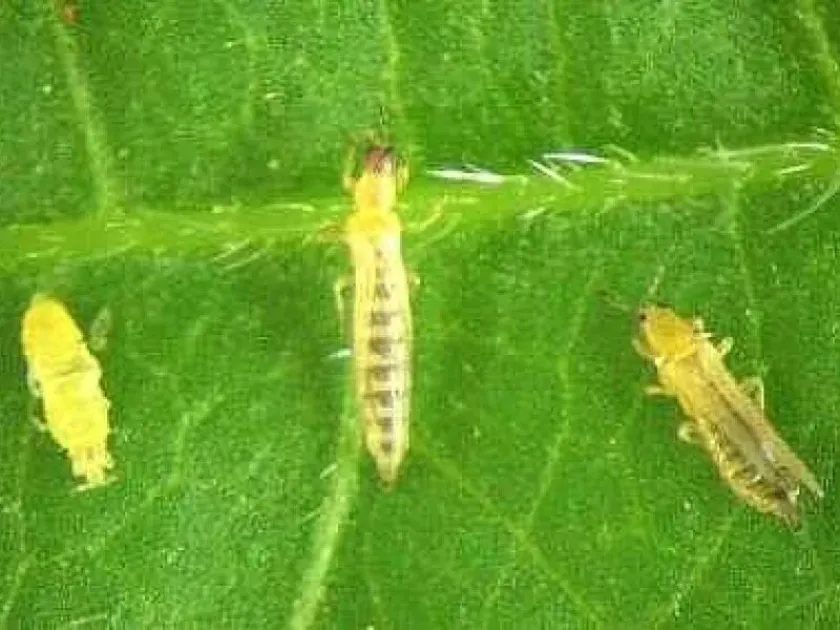
The banana thrips (Hercinothrips bicinctus) belongs to the order Thysanoptera and the family Thripidae. These insects are characterized by a dark brown body with two distinctive pale transverse bands on the abdomen, which is their key morphological feature.
The life cycle encompasses the egg, larva, propupa, pupa, and adult stages. Depending on environmental conditions, the development from egg to adult takes approximately two to four weeks, allowing for multiple generations per year in warmer climates.
They predominantly reside on the undersides of leaves, forming dense colonies. As adults, they are highly mobile and exhibit jumping behavior when disturbed, which facilitates their spread within a plant canopy.
These pests thrive in humid conditions with temperatures ranging from 22 to 28 degrees Celsius. Consequently, they are a significant pest concern in tropical, subtropical, and greenhouse environments globally.
Accurate identification usually requires a hand lens or microscope, as the insects are very small. Blue sticky traps are widely used by agronomists for field monitoring and population estimation.
What it damages
Both adults and larvae cause injury to plants by rasping the leaf epidermis and sucking out cell contents. This feeding activity results in significant depletion of the plant's nutritional resources and loss of turgor.
Besides bananas, Hercinothrips bicinctus infests a wide range of hosts, including ornamental plants like Marantaceae and Araceae, as well as various vegetable crops grown in protected environments.
The damage to the photosynthetic surface leads to stunted growth, reduced plant vigor, and potential deformation of new foliage. Severe infestations often cause premature leaf drop.
For banana producers, the damage is particularly costly as it affects the peel of the fruit, causing scarring, cracking, and unsightly discoloration, which leads to fruit downgrading.
Furthermore, these thrips are known to be potential vectors for certain plant viruses, which poses an additional phytosanitary risk to agricultural and horticultural operations.
When it appears
In greenhouse settings, banana thrips can remain active throughout the year, provided there is a consistent supply of food and suitable microclimatic conditions.
Infestation peaks often correlate with warmer periods or seasonal changes in greenhouse management where ventilation might increase, allowing for the entry of thrips from outside environments.
The population growth rate is temperature-dependent. Increased heat accelerates the metabolic processes of the insects, significantly shortening the interval between successive generations.
Cold winter months can suppress population levels, but these thrips are highly resilient and can survive in sheltered areas or on alternative host weeds until conditions improve.
Management is most challenging during the active growing season, where rapid population buildup can quickly overwhelm a plant if early control measures are not implemented.
Signs of infestation
Early symptoms include silvery or whitish streaks on the undersides of leaves, which are caused by the destruction of leaf cells. As the colony grows, these streaks turn into larger necrotic lesions.
The presence of small, dark, fecal spots on the leaf underside is a hallmark sign of banana thrips infestation and helps distinguish them from other leaf-sucking pests.
Affected leaves may curl or appear deformed. In advanced stages of infestation, the leaves may lose their green color, turn bronze, and eventually dry out completely.
On fruit, early signs of damage manifest as fine netting or rusty spots on the skin, which expand and darken as the fruit continues to develop.
Plants showing general lethargy, reduced growth rates, and yellowing foliage are strong indicators that a thrips population has already established itself within the planting area.
Control measures
Strict quarantine and inspection protocols for incoming nursery stock are the first line of defense to prevent the introduction of this pest into clean greenhouse facilities.
Sanitation practices, such as removing infested plant debris and controlling weeds in and around the growing area, are essential to minimize refuges for the thrips population.
Blue sticky traps should be deployed throughout the growing area to monitor infestation levels. These traps are effective at capturing winged adults and providing an early warning of population surges.
- Utilizing biological control agents, such as predatory mites (Amblyseius spp.) and minute pirate bugs (Orius spp.).
- Applying systemic insecticides that provide long-lasting control of larvae feeding within the plant tissue.
- Using insecticidal soaps or horticultural oils for direct contact control in early stages of infestation.
Since insecticides often have limited effect on eggs hidden within plant tissue, repeat applications are necessary at 7 to 10-day intervals to break the life cycle of emerging larvae.
Taxonomy
- Latin name
- Hercinothrips bicinctus
- Order
- Thrips
- Family
- Thripidae
- EPPO code
- HERCBI
Discussion
No discussions yet — be the first.