
Duke of Burgundy
Hemearis lucina
Description
How to identify
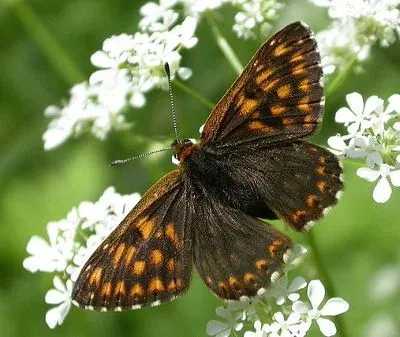
The Duke of Burgundy (Hamearis lucina) is a small, distinctively marked butterfly belonging to the Riodinidae family. It is easily recognized by its vibrant orange-brown wings featuring a series of dark brown checkered patterns and white spots.
With a wingspan ranging from 28 to 35 mm, the butterfly appears small yet robust. Its wings are densely covered in scales that create a velvet-like texture, providing it with excellent camouflage against tree bark and leaf litter.
The larvae are small and slug-like in appearance, typically light green or brown with dark stripes running along their backs. They are covered in fine, short hairs, which help them blend into the foliage of their host plants.
Pupation takes place in a compact, rounded chrysalis that is usually attached to the underside of leaves or nearby stems. The pupa's coloring provides effective protection, often mimicking the appearance of dried plant material.
While the Duke of Burgundy is considered a protected species in many parts of Europe, it may occasionally feed on garden Primula varieties, warranting careful monitoring in specialized horticultural settings.
What it damages
The primary host plants for Hamearis lucina larvae are members of the Primula genus, particularly Primula veris. The caterpillars feed exclusively on the leaves, starting from the central parts.
Feeding damage begins as small holes within the leaf blade. As the larvae grow, their consumption increases, leading to significant skeletonization of the foliage if the population density is high enough.
Damage to ornamental Primulas is mostly aesthetic, as the butterfly larvae reduce the plant's leaf area, leading to stunted growth and loss of decorative appeal in garden displays.
Stressed plants with severe leaf damage are more susceptible to secondary fungal infections, which may eventually weaken the entire root system of the Primula plant.
In a standard garden environment, damage is usually localized and rarely severe enough to cause total plant mortality, provided the overall health of the garden is maintained.
When it appears
The Duke of Burgundy butterfly typically follows a single-brood cycle per year, with adult butterflies emerging in late spring, mainly during May and June.
Following mating, eggs are laid singly or in small clusters on the undersides of leaves. The egg stage lasts approximately two weeks before the larvae hatch and begin feeding.
The larval stage is active throughout the mid-summer months, from June to August, during which time the caterpillars undergo several growth stages (instars) while feeding.
By the end of the summer, the fully grown caterpillars pupate and enter a state of diapause. The chrysalis remains in the soil or under debris throughout the winter months.
Emergence in the following spring is highly temperature-dependent, usually timed to coincide with the early blooms of their preferred Primula host plants.
Signs of infestation
The first indicator of the Duke of Burgundy's presence is the emergence of uneven holes and irregular notches on the edges of Primula leaves throughout the summer.
Because the larvae are nocturnal or secretive feeders, they are rarely seen during the day. Inspecting the undersides of the leaves during the early morning hours is the best way to spot them.
Frass (larval droppings) appearing as small, dark pellets near the base of the plant or on the soil surface is a clear sign that caterpillars are active and feeding nearby.
A noticeable loss of foliage vigor and premature wilting, especially in potted Primula plants, can often be traced back to the hidden feeding activity of these larvae.
Observing adult butterflies in the vicinity of host plants in late spring is a strong indicator that potential egg-laying activity is occurring in the garden area.
Control measures
Effective management requires a balance between protecting the garden and respecting the status of this butterfly as a vulnerable species.
- Manual removal of caterpillars from affected plants, relocating them to nearby wild areas if possible.
- Thorough autumn cleanup, including the removal of dead leaves and organic debris, to eliminate wintering pupae sites.
- Using biological control agents such as B.t. (Bacillus thuringiensis) if the damage to ornamental plants becomes intolerable.
- Encouraging natural predators such as wasps and birds, which naturally help to control larval populations.
- Applying physical barriers, such as lightweight netting, during the egg-laying season to protect highly valued Primula collections.
Taxonomy
- Latin name
- Hemearis lucina
- Order
- Lepidoptera (butterflies)
- Family
- Riodinidae
- EPPO code
- HMERLU
Discussion
No discussions yet — be the first.