
Avocado seed weevil
Heilipus lauri
Description
How to identify
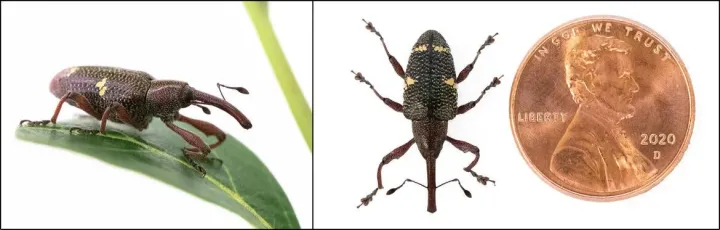
The avocado seed weevil Heilipus lauri belongs to the order Coleoptera and the family Curculionidae. This insect is a significant pest known for its elongated snout and dark, hardened exoskeleton.
Adult weevils typically measure between 10 and 15 mm in length. Their robust build and dark brown to black coloration allow them to blend into the bark of avocado trees, making them difficult to spot during routine inspections.
The larvae are legless, creamy-white grubs with a distinct brown head capsule. They are exclusively internal feeders, spending their entire larval stage protected inside the avocado fruit or seed.
The life cycle involves complete metamorphosis, consisting of the egg, larval, pupal, and adult stages. Each stage is perfectly adapted to survive within the avocado tree environment.
Adults are primarily nocturnal, which is a critical behavioral trait for growers to understand when planning monitoring activities, as they remain hidden during daylight hours.
What it damages
The primary host for Heilipus lauri is the avocado tree (Persea americana). The pest causes extensive damage to both the fruits and the tree structure.
Adults feed on young shoots, petioles, and flower buds. This feeding activity can lead to flower drop, significantly reducing the potential yield of the orchard.
The larvae cause the most severe economic damage by boring directly into the fruit and devouring the seed. This renders the fruit completely unsalable and unsuitable for consumption.
Damaged seeds are often destroyed, leading to a loss of reproductive potential for the tree. Furthermore, the tunnels created by larvae facilitate the entry of secondary pathogens, such as fungi.
Secondary infections often lead to rapid fruit rot, which can spread to healthy fruits on the same branch, resulting in substantial post-harvest or pre-harvest losses.
When it appears
The activity of the avocado seed weevil is closely tied to the phenological development of the avocado tree. Peak activity typically coincides with the period of fruit set and development.
Adults emerge from hibernation sites as temperatures rise and favorable moisture levels are achieved, often correlating with the onset of the rainy season in tropical regions.
The reproduction cycle can continue throughout the year in regions without significant winter cold, creating a constant pressure on avocado plantations.
Optimal temperatures for rapid larval development fall between 20°C and 28°C, which accelerates the infestation rate within the fruit.
Overwintering adults find refuge in deep crevices of the bark or under leaf litter, making the orchard's general hygiene an essential factor in long-term population management.
Signs of infestation
The first indicator of an infestation is the appearance of small, needle-like punctures on the surface of young fruits, which are created by females during oviposition.
Dark fluid or dry frass (larval excrement) is often visible around these entry points, marking the spots where larvae have bored into the flesh.
Premature fruit drop is a common symptom. When fallen fruits are inspected, tunnels made by the larvae are usually visible, confirming the cause of the drop.
If a damaged fruit is cut open, the interior will reveal a hollowed-out area or a seed that has been partially or fully consumed by the larvae.
Visible signs of wilting in apical shoots, even in the absence of obvious disease, may indicate adult weevil feeding damage on the tender plant tissues.
Control measures
The foundation of control is strict orchard sanitation: collecting and destroying all fallen fruit immediately to prevent larvae from completing their life cycle in the soil.
Integrated Pest Management (IPM) programs utilize pheromone traps to monitor adult populations, allowing for targeted insecticide applications only when threshold levels are reached.
Chemical control is effective when timed with the adult emergence phase, but it must be executed carefully to avoid harming beneficial pollinators and natural predators.
Biological control methods, including the use of entomopathogenic nematodes or fungi, have shown promise in reducing larval populations in localized areas.
- Pruning trees to improve light penetration and airflow in the canopy.
- Removing weeds and debris from the orchard floor to eliminate hiding spots.
- Selecting avocado varieties that may show natural resistance or physical toughness.
- Implementing quarantine measures for the movement of fruit between infested and non-infested zones.
Taxonomy
- Latin name
- Heilipus lauri
- Order
- Coleoptera (beetles)
- Family
- Curculionidae
- EPPO code
- HEILLA
Discussion
No discussions yet — be the first.