
Avocado weevil
Heilipus bonelli
Description
How to identify
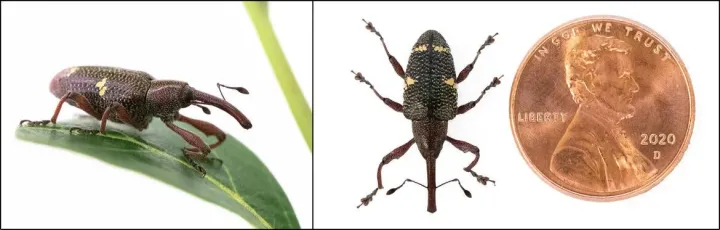
The avocado weevil (Heilipus bonelli) belongs to the order Coleoptera and the family Curculionidae. It is a specialized pest of tropical fruits, recognizable by its elongated rostrum typical of the weevil family.
Adult insects usually feature a dark coloration, often with distinct spots on the elytra, which helps them camouflage effectively on tree bark. The body length of the adults typically ranges from 10 to 15 millimeters.
The larvae are cream-white, legless, and have a curved body shape, common to most weevil larvae. They undergo several developmental stages within the fruits or shoots.
The development of this species is highly dependent on climatic conditions; high temperatures and humidity levels accelerate their life cycle and increase reproductive potential.
Identification in the field can be challenging due to the secretive behavior of the adults, which are primarily active during twilight hours or at night.
What it damages
The main crop affected by this pest is avocado. The insect can cause significant economic losses in plantations by compromising both the quantity and the commercial quality of the fruit.
Adult weevils feed on young shoots, floral buds, and the surface of fruits, leaving small pits. This feeding activity can cause organ deformation and inhibit the overall growth of the tree.
The most severe damage is caused by the larvae, which bore into the fruit and tunnel through the pulp. This leads to premature fruit drop and renders the produce unmarketable.
Damaged fruits become susceptible to secondary fungal and bacterial infections, which rapidly accelerate rotting and destroy remaining yields on the tree.
In cases of heavy infestation, yield losses can be substantial, necessitating urgent intervention by growers and farm managers.
Signs of infestation
The first sign of the pest's presence is the appearance of small punctures on the skin of young fruits, created by females during the egg-laying process.
A characteristic symptom is the presence of fine frass (excrement) on the surface of the fruit or near the points where the stems attach to the branches.
During tree inspection, one may notice wilting or drying of young shoots that have been damaged by adult weevils during their feeding activity.
Premature yellowing and abscission of avocado ovaries are often indicators of hidden larval infestation within the plant tissues.
Cutting open affected fruits reveals tunnels bored by larvae and the presence of the insects themselves, confirming the infestation status of the orchard.
Control measures
Effective management of Heilipus bonelli requires an integrated approach that combines agrotechnical, mechanical, and chemical control measures.
Sanitary orchard management is crucial, including the regular collection and destruction of fallen or infested fruits to break the life cycle and prevent the emergence of new generations.
Biological control strategies, such as the deployment of natural predators or entomopathogenic fungi, can help reduce population densities in an environmentally friendly manner.
Chemical control involves the application of systemic or contact insecticides during critical periods of fruit development, strictly adhering to safety guidelines and pre-harvest intervals.
- Regular orchard monitoring using pheromone traps.
- Timely pruning and destruction of dead or infested branches.
- Stringent quarantine procedures for the movement of nursery stock.
Taxonomy
- Latin name
- Heilipus bonelli
- Order
- Coleoptera (beetles)
- Family
- Curculionidae
- EPPO code
- HEILBO
Discussion
No discussions yet — be the first.