
Casuarina weevil
Haplonyx casuarinae
Description
How to identify
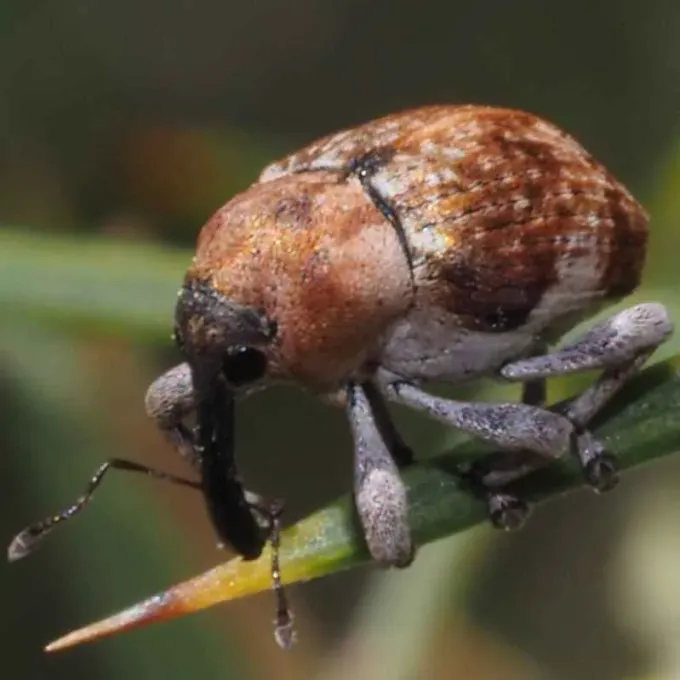
The Casuarina weevil (lat. Haplonyx casuarinae) is a specialized insect species belonging to the Curculionidae family. It appears as a small beetle with the characteristic elongated snout common to weevils, enabling it to feed on plant tissues effectively.
The coloration is generally camouflaging, ranging from brown to dark shades, which helps the beetles remain hidden on tree bark. The body is compact and covered with tiny scales that may form unique patterns.
A distinctive feature of this species is its narrow host specialization targeting the Casuarina genus. The life cycle is closely linked to the phenological stages of these plants, making them the primary host for the species.
The larvae of the weevil are legless, cream-colored, and develop deep within the plant tissues. Because their development is concealed, it is often difficult to detect the infestation in the early stages.
Adult beetles are primarily nocturnal, which explains their secretive behavior during daylight hours. Identification is often achieved by observing secondary indicators of their life activity.
What it damages
The primary hosts for this pest are trees and shrubs of the genus Casuarina (Casuarina). These plants are frequently used in landscaping and forest restoration in regions with suitable climates.
The pest primarily attacks the reproductive organs of the plants. The larvae develop inside the cone-like fruits of the Casuarina, feeding on internal tissues and seeds, which leads to significant losses of reproductive material.
Damage to the seed capsules inhibits the natural regeneration of forest stands. In commercial nurseries, this can significantly reduce the yield of high-quality planting material.
Adult beetles may additionally damage soft shoots and the bark of young trees. High population densities result in the weakening of saplings and stunted growth.
Mass outbreaks of the weevil on plantations can cause economic losses, necessitating population monitoring to prevent the degradation of forest stands.
When it appears
The life cycle of the Casuarina weevil is synchronized with the fruiting periods of Casuarina trees. Adult beetles typically appear during the development of young fruits.
Optimal conditions for insect development occur during warmer seasons when temperatures support rapid larval development. In regions with mild climates, activity may persist almost year-round.
Mating and egg-laying occur directly on the surface of the fruit. Females use their mouthparts to prepare an oviposition site before the larva bores into the interior.
Pupation occurs either within the damaged fruit or in the topsoil layers under the tree. The duration of the generation depends on the climatic factors of the specific region.
Monitoring seasonal activity is crucial for planning protective measures. Identifying peak flight periods allows for interventions during the most vulnerable stages of the pest's life cycle.
Signs of infestation
The primary sign of infestation is the presence of exit holes in the Casuarina cones, created by adults after completing their development cycle.
When damaged fruits are dissected, internal cavities filled with larval frass and plant tissue remnants are found. The interior of the fruit is often entirely consumed.
Deformations or premature fruit drop can also indicate a high level of infestation by the pest.
Visual inspection of the bark at night using flashlights allows for the detection of active adults feeding on the branches.
Young shoots may exhibit necrotic spots or ulcers caused by supplemental feeding by the adult beetles.
Control measures
The foundation of control is an agrotechnical approach, specifically the timely collection and destruction of fallen fruits that may contain larvae and pupae.
The application of chemical insecticides is effective during the active adult flight period. Treatments should involve systemic products that penetrate plant tissues to target the beetles during feeding.
- Utilizing pheromone traps for population monitoring.
- Biological control methods employing entomopathogenic fungi or specific parasitoids.
- Strict adherence to quarantine protocols when transporting Casuarina nursery stock.
Ensuring optimal growing conditions for the trees increases their natural resilience to pest damage. Healthy plants are better able to recover from infestations.
In cases of critical pest density, repeat insecticide applications must be conducted according to label instructions to break the insect's reproductive cycle.
Taxonomy
- Latin name
- Haplonyx casuarinae
- Order
- Coleoptera (beetles)
- Family
- Curculionidae
- EPPO code
- SIGACA
Discussion
No discussions yet — be the first.