
Haliclystus auricula
Haliclystus auricula
Description
How to identify
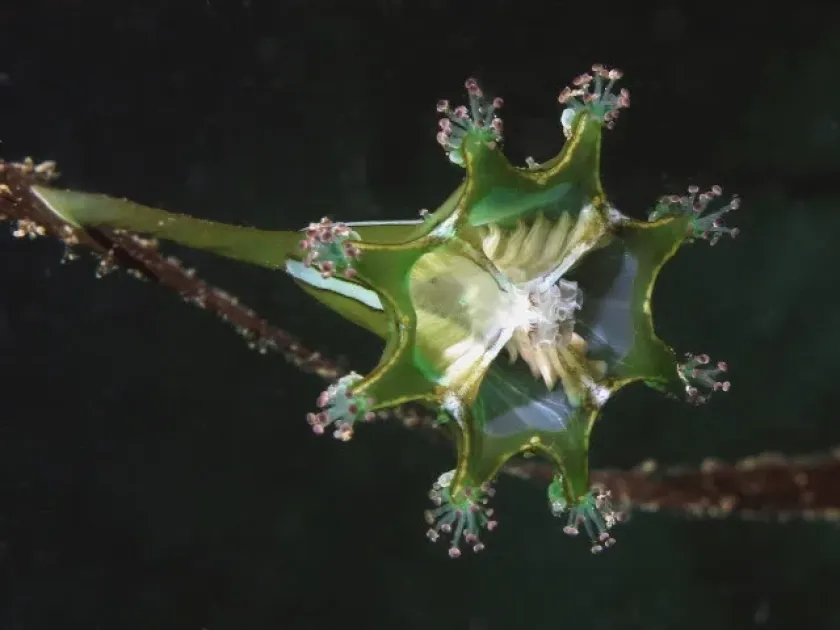
Haliclystus auricula is a species of stalked jellyfish belonging to the class Staurozoa. Unlike typical medusae, these animals spend their adult lives permanently attached to rocky substrates or seaweed using a specialized stalk.
The body is shaped like a trumpet or a goblet, with eight arms arranged around the margin of the umbrella. Each arm terminates in a cluster of tiny tentacles used to trap small planktonic prey.
These organisms exhibit various color patterns, including shades of green, brown, and yellow, which help them blend seamlessly into their marine environment.
Taxonomically, they fall under the order Stauromedusae. Their development involves a sessile planula larva that eventually settles and metamorphoses into the adult form.
They are primarily found in temperate coastal waters, where they can thrive in intertidal zones due to their ability to anchor themselves firmly against water movement.
What it damages
It is important to clarify that Haliclystus auricula is not a plant pest. It is a strictly marine organism and poses no threat to terrestrial crops, greenhouse plants, or agricultural production.
The species feeds exclusively on small aquatic invertebrates and zooplankton within the marine ecosystem, lacking any biological mechanism to feed on land-based vegetation.
Because it does not interact with agricultural plants, there are no documented cases of it acting as a pest in any part of the world.
No agricultural control measures, pesticides, or monitoring protocols exist for this species as it holds no economic or agricultural significance in the context of crop protection.
Labeling this marine organism as a plant pest is inaccurate, as its ecological niche is entirely restricted to underwater habitats within the ocean.
Taxonomy
- Latin name
- Haliclystus auricula
- Family
- Eleutherocarpidae
- EPPO code
- HLLYAU
Discussion
No discussions yet — be the first.