
Haliclystus
Haliclystus
Description
How to identify
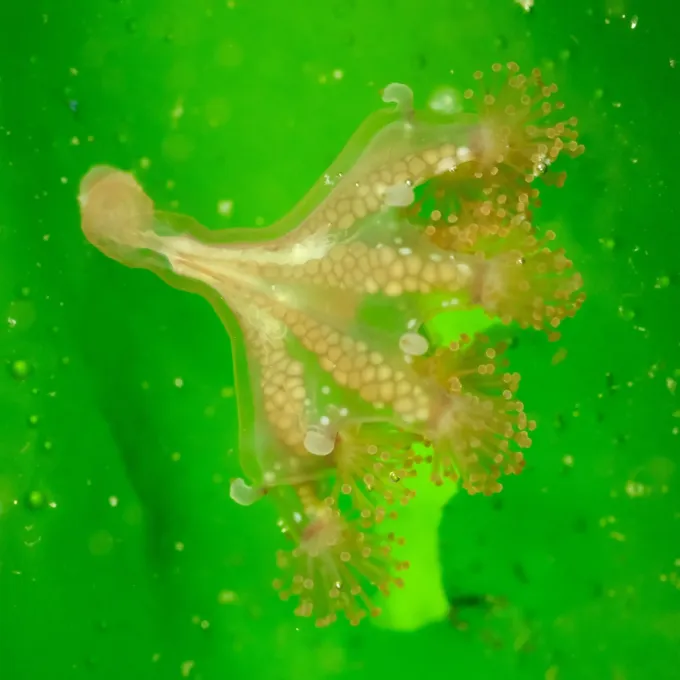
Haliclystus is a genus of stalked jellyfish belonging to the class Staurozoa, family Lucernariidae. Unlike common jellyfish, these organisms are sessile and attach themselves to substrates like seaweed or rocks.
Their body structure consists of a cup-shaped bell on a stalk (peduncle), with eight bundles of tentacles radiating from the rim. They rely on these tentacles to capture tiny planktonic prey.
They are not terrestrial plant pests. Their presence is significant only in marine environments, specifically in coastal areas where they play a role in the local food web.
These organisms are typically small, reaching only a few centimeters in diameter. Their color palette, ranging from green to brown, provides effective camouflage in their natural habitat.
The life cycle involves a creeping planula larva that settles on a firm surface, eventually developing into the iconic cup-shaped form that remains attached for the remainder of its life.
What it damages
Haliclystus does not cause damage to land-based crops or garden plants. It is purely a marine organism and poses no threat to agriculture or soil health.
In aquaculture, specifically seaweed farming, Haliclystus is categorized as a biofouling organism. Excessive colonization on crops can compete for space and nutrients.
The physical presence of these organisms on seaweed thalli can inhibit photosynthesis and potentially lower the commercial quality of the harvested seaweed.
They do not consume plant tissues; rather, they use the plants as physical anchors in high-flow coastal environments, which makes them a structural nuisance.
Managing them is only necessary in high-density aquaculture operations where preventing biofouling is crucial for optimizing production efficiency.
When it appears
The activity and development of Haliclystus are strictly linked to water temperature and seasonal nutrient availability. They thrive in spring and summer.
During warmer months, their metabolic rate increases, leading to rapid colonization of suitable substrates in shallow coastal waters.
As water temperatures drop during autumn, populations naturally decline, and many individuals complete their life cycle and die off after releasing larvae.
The timing of their appearance can vary based on local climatic conditions and the specific environmental parameters of the estuary or bay.
Farmers monitor these seasonal patterns to time their maintenance activities and ensure that the colonization does not peak during critical harvest periods.
Signs of infestation
Identification is primarily visual; one can see small, funnel-shaped organisms attached to seaweed blades or cage structures in the water.
When removed from their watery environment, they collapse into an amorphous gelatinous lump, making them difficult to recognize without prior field experience.
Signs of heavy infestation include dense clusters of small, flower-like bodies covering submerged surfaces and potentially reducing water flow through nets.
One might notice slight discolorations on the surface of seaweed blades where the stalked jellyfish have been attached for an extended period.
In large numbers, they may create a slimy residue on industrial infrastructure, indicating a need for cleaning operations to maintain equipment functionality.
Control measures
Chemical control is generally avoided due to the potential ecological impact on marine biodiversity. Sustainable and mechanical methods are preferred.
Mechanical cleaning is the standard approach. Periodic rinsing of aquaculture nets and structures with high-pressure water effectively removes the sessile individuals.
Modifying the depth at which the crops are suspended can often discourage settling, as these jellyfish have specific preferences for light levels and flow.
Maintaining the cleanliness of the surrounding environment by removing old, decaying debris reduces the available settlement area for new larvae.
- High-pressure water washing.
- Manual removal from nets.
- Adjusting farm depth.
Taxonomy
- Latin name
- Haliclystus
- Family
- Eleutherocarpidae
- EPPO code
- HLLYSP
Discussion
No discussions yet — be the first.