
Thistle weevil
Hadroplontus litura
Description
How to identify
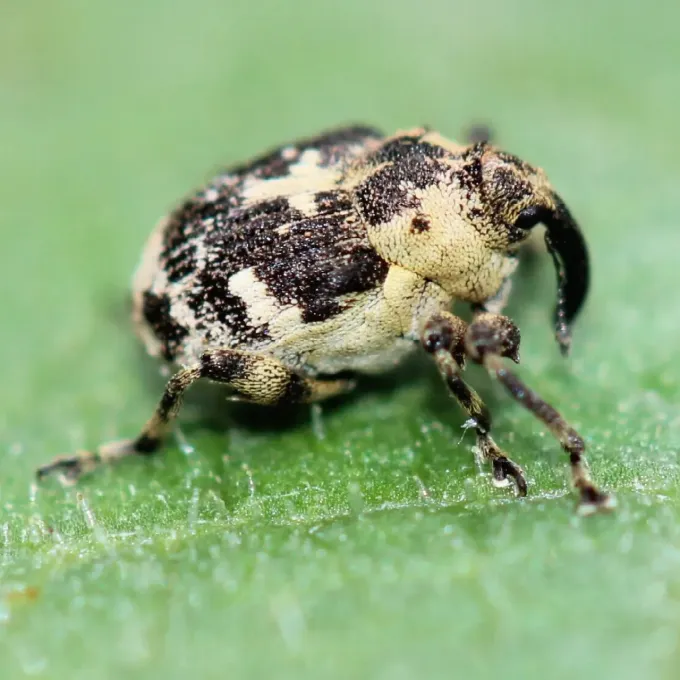
The thistle weevil, Hadroplontus litura, belongs to the Curculionidae family of beetles. It is a small insect characterized by its distinct, elongated snout used for both feeding and egg-laying.
The adult beetle typically measures between 3 and 4 mm in length. Its body is covered in small, dark scales, providing a protective, camouflaging appearance against soil and plant surfaces.
Larvae of this species are legless, ivory-white in color, and possess a well-defined, brownish head capsule. They are specially adapted to thrive within the internal tissues of their host plants.
The species is highly specialized, focusing its life cycle on members of the Asteraceae family. Adults are secretive and often remain hidden within the basal leaf rosettes of plants.
Understanding their morphology and preference for specific host plants is crucial for accurate field identification and effective management of the pest population.
What it damages
The thistle weevil primarily targets thistles (Cirsium and Carduus species). Both adults and larvae contribute to the damage, causing significant stress to the host plants.
Adults feed on foliage, creating small, circular holes. While this does not always kill the plant, it significantly reduces the leaf surface area available for photosynthesis.
The most severe damage is caused by larvae that burrow into stems and root necks. This activity creates tunnels inside the plant, disrupting the transport of water and nutrients.
Stem tunneling weakens the structural integrity of the plant and creates entry points for various secondary fungal pathogens, which often lead to rot and plant death.
In high-density infestations, the cumulative damage can significantly inhibit plant growth and flowering, effectively serving as a natural control agent for weeds.
When it appears
Adult weevils emerge from their winter hibernation sites in early spring, once soil and air temperatures reach a threshold that triggers their metabolic activity.
Spring is marked by mating and egg-laying. Females deposit eggs directly into the tissues of stems or leaf petioles, ensuring that larvae have immediate access to food upon hatching.
Larval development occurs throughout the summer months. During this phase, larvae feed extensively inside the plant, often causing visible deformation of stems and shoots.
The emergence of the next adult generation occurs in late summer. These adults feed for a short period before seeking out protected sites for overwintering.
Overwintering takes place in the soil or beneath leaf litter, where the beetles enter a state of diapause to survive the harsh winter conditions.
Signs of infestation
The presence of Hadroplontus litura is often first detected by observing small, characteristic "shot-holes" on the leaves of host plants.
Close inspection of stems may reveal small entry holes, often surrounded by darkened, necrotic tissue or traces of larval frass (excrement) around the opening.
Severely infested plants often display symptoms of wilting, stunted height, and general yellowing of the leaves, particularly during dry weather spells.
- Circular holes in leaves.
- Stem deformation or twisting.
- Presence of larvae inside stem cross-sections.
- Premature wilting of the plant's apical portions.
Secondary signs include an increased presence of predatory insects or birds that actively hunt for weevils in infested weed patches.
Control measures
Cultural practices are the first line of defense. Proper weed management significantly reduces the available habitat for the weevil population to thrive.
Deep autumn plowing of fields disrupts the overwintering cycle of the beetles, exposing them to environmental extremes and reducing their survival rates.
Crop rotation helps break the life cycle by ensuring that the host plants are not consistently available, which limits the build-up of the pest population.
If necessary, systemic insecticides can be used to target adults during their spring emergence, before they have a chance to lay eggs in the stems.
Integrated Pest Management (IPM) programs often combine monitoring with the preservation of natural enemies, such as parasitic wasps, to suppress the weevil numbers.
Taxonomy
- Latin name
- Hadroplontus litura
- Order
- Coleoptera (beetles)
- Family
- Curculionidae
- EPPO code
- CEUTLI
Discussion
No discussions yet — be the first.