
Poplar shoot moth
Gypsonoma sociana
Description
How to identify
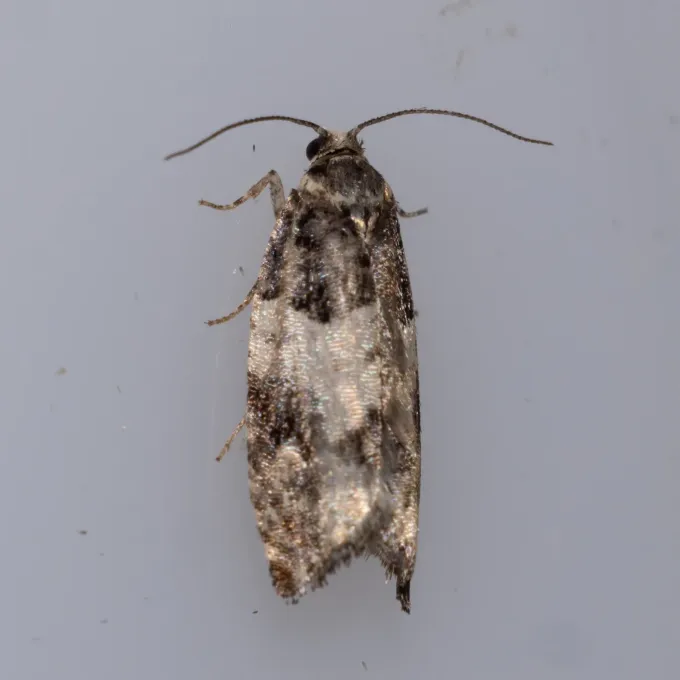
The poplar shoot moth (Gypsonoma sociana) belongs to the order Lepidoptera and the family Tortricidae. The adult moth typically has a wingspan of 12–16 mm, with forewings featuring mottled greyish-brown patterns that provide excellent camouflage against bark.
The larvae, which are the main damaging stage, grow to about 10–12 mm in length. They are characterized by a dirty-white to brownish body and a dark brown or black head capsule, making them identifiable during tree inspections.
These moths undergo one generation per year. They overwinter as larvae of the second or third instar, hidden inside silk-lined cocoons within crevices of the tree bark or near the base of buds.
Development in the spring is synchronized with the phenology of the host plant. Once temperatures rise and buds begin to swell, the larvae emerge to feed on the tender tissues, initiating their life cycle for the new season.
Pupation occurs in June or July within the folded leaves or twisted shoots. The pupal stage lasts approximately two to three weeks before the adult moth emerges to mate and lay eggs for the next overwintering generation.
What it damages
The primary hosts of Gypsonoma sociana are species of the genus Populus, including aspen and various poplars used in urban forestry, timber production, and ornamental landscaping.
Damage begins in early spring when emerging larvae burrow into the swelling buds, destroying the embryonic foliage and potential flowers, which prevents the development of new leaves.
As the season progresses, the larvae bind leaves together with silk to create protective shelters. Inside these "nests," they feed on the leaf tissue, often causing the leaves to wither, turn brown, and drop prematurely.
Heavy infestations lead to widespread defoliation, which severely stresses the tree. This reduced vigor makes the host plant more susceptible to secondary pathogens and wood-boring insects, potentially leading to tree decline.
In nurseries and young plantations, the damage to terminal buds is particularly critical as it causes the loss of apical dominance, leading to distorted stems and stunted overall growth of the seedlings.
Control measures
Pheromone traps are essential for monitoring the flight activity of adult moths, helping arborists and foresters time their intervention strategies effectively to maximize success.
Biological control involves the application of Bacillus thuringiensis formulations, which are highly specific to lepidopteran larvae and offer a reduced impact on beneficial non-target insects.
Chemical control, if necessary, should be applied during the early bud-burst stage. At this point, the larvae are most active and exposed, making contact insecticides more effective before they build protective leaf nests.
Good silvicultural practices, including the removal of heavily infested shoots and keeping nursery stock healthy, are crucial for long-term management and population reduction.
Encouraging biodiversity by providing habitats for parasitic wasps and insectivorous birds can create natural checks on the moth population, effectively minimizing the need for large-scale chemical applications.
Taxonomy
- Latin name
- Gypsonoma sociana
- Order
- Lepidoptera (butterflies)
- Family
- Tortricidae
- EPPO code
- EPINNE
Discussion
No discussions yet — be the first.