
Poplar bud gall moth
Gypsonoma aceriana
Description
How to identify
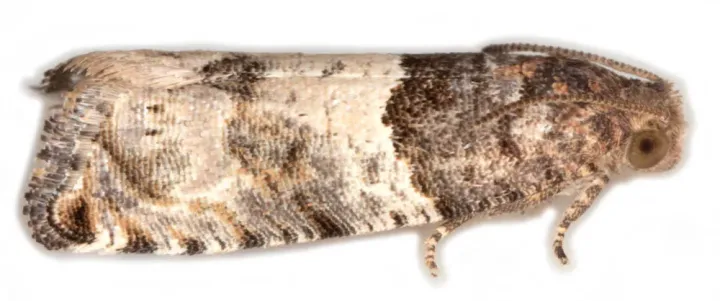
The Poplar bud gall moth (Gypsonoma aceriana) is a member of the Tortricidae family. Adult moths have a wingspan of approximately 14–17 mm, with greyish-brown forewings featuring dark, intricate markings.
The larvae, which reach up to 12 mm in length, have a greyish-pink or brownish body with a dark head capsule. Their sparse hairs make them well-adapted for hiding within plant tissues.
The eggs are small, translucent, and oval-shaped. They are usually laid singly or in small clusters on the surface of leaves, near the leaf veins or at the base of the buds.
The pupa is brownish and develops inside the damaged shoots or within curled leaves, providing a shielded environment during its transformation into a moth.
Larvae of the second or third instar hibernate in dense silken cocoons hidden within bark crevices or near the base of buds, ensuring survival through harsh winters.
What it damages
The primary hosts of this pest include various poplar species, such as the black poplar, pyramidal poplar, and Canadian poplar. In some instances, it may also infest willow trees.
Damage is primarily caused by young larvae that feed on terminal buds immediately after hatching, leading to the destruction of the apical meristem and growth inhibition.
Destroying the terminal buds forces the tree to compensate by developing secondary shoots, which leads to structural deformities and crooked stems in young saplings.
Heavy infestations significantly reduce biomass production and negatively impact the aesthetic value of urban and forest poplar plantings.
Weakened trees are more susceptible to secondary fungal infections and environmental stressors due to the structural damage caused by the larvae feeding inside the stems.
When it appears
Adult moth emergence typically occurs in late spring or early summer, corresponding with the period of bud burst and initial leaf development in poplar trees.
Depending on the geographical location and local climatic conditions, the moth can complete one or two generations per growing season.
Larval feeding activity begins in early spring as they bore into the swelling buds, causing immediate and visible damage to the growth points.
The second generation occurs during summer, where larvae target mature shoots and foliage in preparation for overwintering as they reach maturity.
As temperatures drop in autumn, larvae move to protected sites and spin protective hibernacula to survive until the following spring.
Signs of infestation
The most prominent sign is the withering and browning of terminal buds in early spring, which often appear scorched or malformed due to larval feeding.
Frass (larval waste) held together by silken webbing around the damaged buds or shoots is a definitive indicator of Gypsonoma aceriana activity.
Small entry holes at the base of the shoots reveal where larvae have bored into the pith of the stem, causing the shoot to eventually break or die.
Leaf damage often involves the rolling of leaf blades into protective tubes, where the larva feeds and shelters from predators.
Persistent infestation leads to stunted vertical growth and an abnormal, bushy crown architecture as the tree attempts to regenerate from lateral buds.
Control measures
Cultural control measures involve the pruning and destruction of infested shoots during the early stages of the season to remove larvae before they mature.
Biological control using Bacillus thuringiensis-based products is highly effective when applied to young larvae before they bore into the buds.
Chemical control options include the application of systemic or contact insecticides during the peak flight period of moths or during the egg-hatching phase.
Integrated Pest Management (IPM) strategies, including the use of pheromone traps, are recommended to time applications accurately and minimize chemical use.
Promoting local biodiversity by protecting natural predators such as parasitic wasps and predatory beetles helps to naturally regulate moth populations.
Taxonomy
- Latin name
- Gypsonoma aceriana
- Order
- Lepidoptera (butterflies)
- Family
- Tortricidae
- EPPO code
- GYPSAC
Discussion
No discussions yet — be the first.