
Nut fruit moth
Gymnandrosoma punctidiscanum
Description
How to identify
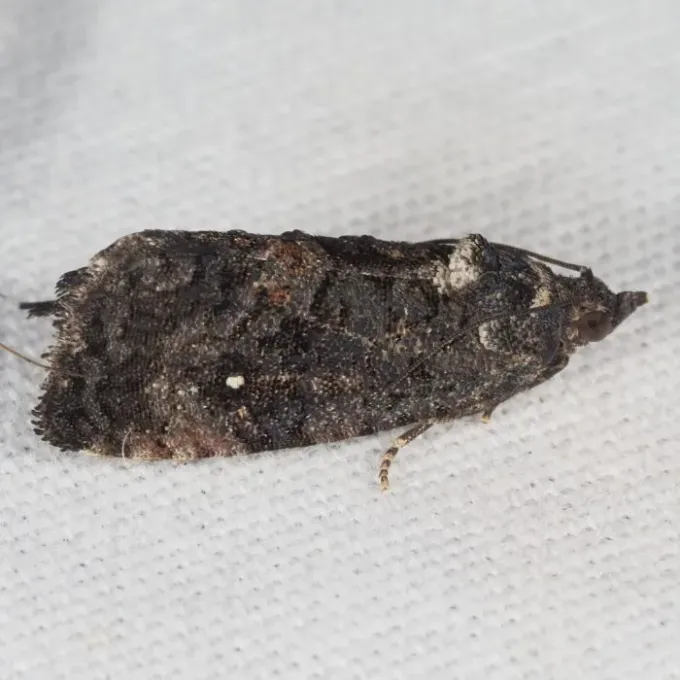
The nut fruit moth (Gymnandrosoma punctidiscanum) is a member of the Tortricidae family. It is a significant pest primarily affecting various nut-bearing trees, including pecans and walnuts, across its natural range.
The adult moth has a distinct wing pattern that allows it to camouflage effectively against tree bark during daylight hours. Its behavior is primarily nocturnal, making visual detection in the orchard difficult without specialized equipment.
The life cycle consists of four distinct stages: egg, larva, pupa, and adult. The moth lays its eggs strategically near the developing fruit, ensuring that the neonate larvae have immediate access to their primary food source upon hatching.
The larvae are highly mobile and possess strong mandibles adapted for boring through the tough outer shells of developing nuts. This stage is responsible for the majority of the economic impact associated with this species.
Environmental factors, particularly temperature and relative humidity, play a critical role in determining the number of generations produced per growing season. In warmer climates, this pest can complete multiple cycles, significantly increasing the pressure on orchards.
What it damages
The primary damage is caused by larvae boring into the developing nut. By consuming the kernel, the larvae destroy the marketable value of the crop, rendering the nuts unfit for human consumption or commercial distribution.
Infested nuts often exhibit premature drop, which is a major symptom of a widespread infestation. Such dropped fruit is usually unrecoverable and serves as a reservoir for further insect development if not managed correctly.
The entry points created by the larvae also serve as infection sites for various fungal and bacterial pathogens. This secondary infection often leads to rotting of the nut kernel while the fruit is still hanging on the tree.
Large-scale infestations can cause substantial yield loss, sometimes exceeding 50% of the harvest in untreated orchards. The hidden nature of the larvae within the nut shell makes them exceptionally difficult to control once they have burrowed inside.
Trees affected by high populations of Gymnandrosoma punctidiscanum suffer not only from direct crop loss but also from the cumulative stress of fighting off secondary infections and managing damaged reproductive tissues.
Control measures
Effective management relies on an integrated pest management (IPM) approach that combines cultural practices, biological controls, and judicious chemical applications. Cultural control remains the most sustainable starting point.
Sanitation is paramount; the prompt collection and destruction of fallen nuts (drop fruit) significantly reduce the overwintering population. This practice prevents the next generation of moths from emerging within the orchard.
Pheromone trapping is widely used for monitoring population peaks. By tracking the flight patterns of adult moths, growers can determine the exact timing for insecticide applications, focusing on the susceptible larval hatch window.
Biological control agents, such as specific entomopathogenic bacteria or naturally occurring predators, should be utilized to maintain a balanced ecosystem, reducing the reliance on broad-spectrum chemical sprays.
- Regular orchard sanitation and nut removal.
- Use of pheromone traps for population monitoring.
- Targeted insecticide applications during larval hatching.
- Promotion of natural predatory insect populations.
Taxonomy
- Latin name
- Gymnandrosoma punctidiscanum
- Order
- Lepidoptera (butterflies)
- Family
- Tortricidae
- EPPO code
- ECDYPU
Discussion
No discussions yet — be the first.