
Grylloblatta campodeiformis
Grylloblatta campodeiformis
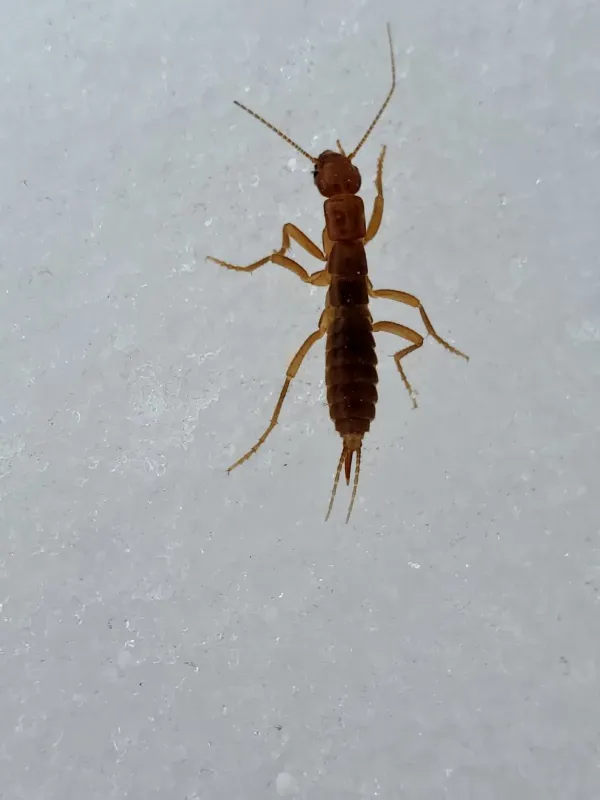
Description
How to identify
Grylloblatta campodeiformis, commonly known as the ice crawler or glacier bug, is a primitive insect belonging to the order Grylloblattodea. It is a flightless, nocturnal creature that lives in high-altitude environments.
The insect has an elongated, cylindrical body typically measuring 20 to 30 millimeters in length. It possesses a pale brown or yellowish exoskeleton and long, slender antennae used for sensory perception in the dark.
They are completely wingless, having evolved to move through narrow cracks, rocky crevices, and glacial debris where flight is unnecessary and energetically expensive.
The family Grylloblattidae is renowned for its extreme cold tolerance. These insects cannot survive in environments with temperatures above their narrow, freezing-point threshold.
Their morphological structure reflects an ancient evolutionary lineage, maintaining features that are highly specialized for life in periglacial habitats.
What it damages
Grylloblatta campodeiformis is not an agricultural pest. It does not feed on crops, vegetables, or any cultivated plants found in farming environments.
Its diet consists of small arthropods, insect fragments, and organic detritus scavenged from the icy ground in mountain regions.
Because these insects are obligate cold-dwellers, they cannot inhabit or damage crops in temperate agricultural landscapes, as they would perish long before reaching such areas.
There is no economic damage associated with this species. It has no interaction with human agriculture or food supply systems.
Concerns about this species damaging crops are unfounded, as it lacks the physiological capacity to function in agricultural ecosystems.
When it appears
These insects are active throughout the year in their natural habitat, as their environment remains thermally stable due to constant low temperatures.
The life cycle of the ice crawler is exceptionally slow, often taking several years to complete its development from egg to adult.
They do not hibernate in the traditional sense, but their metabolic rates remain low and constant throughout the seasons to match their cold surroundings.
Adults are typically observed at night when the ground temperature drops to levels that suit their thermal preferences.
Reproductive patterns are tied to stable cold conditions, which ensure the survival of their larvae in the harsh mountain wilderness.
Control measures
No pest control measures are required for Grylloblatta campodeiformis, as it poses no threat to crops, pastures, or stored produce.
The use of chemical pesticides in their natural mountain habitats is unnecessary and potentially harmful to the delicate alpine biodiversity.
Agricultural management practices do not need to account for this species, as it is geographically and ecologically isolated from human farmland.
Monitoring for this species in agricultural settings is not required, and any rare sightings should be considered as part of natural mountain fauna.
Conservation efforts for such specialized and rare insects are encouraged, as they represent a unique evolutionary legacy in mountain ecosystems.
Taxonomy
- Latin name
- Grylloblatta campodeiformis
- Family
- Grylloblattidae
- EPPO code
- GRYBCA
Discussion
No discussions yet — be the first.