
Grylloblattids
Grylloblatta
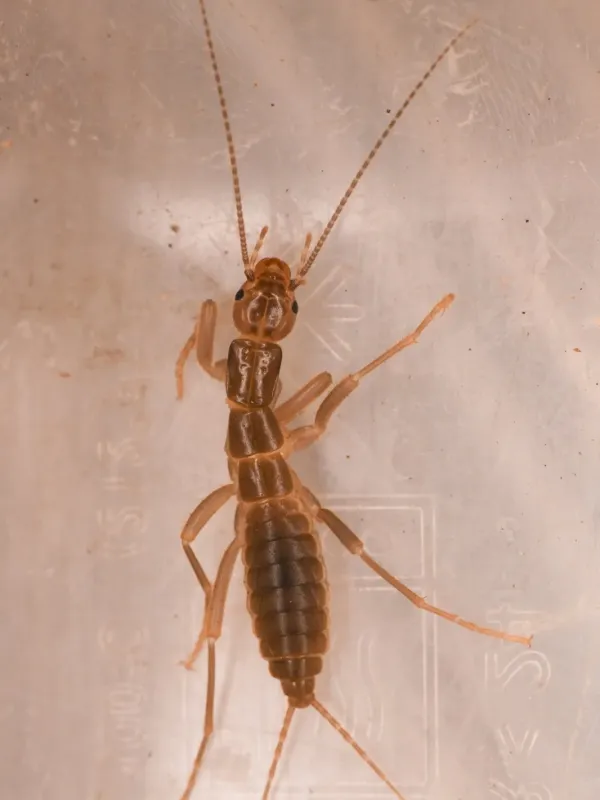
Description
How to identify
Grylloblattids, commonly known as rock crawlers, belong to the order Grylloblattodea. These insects are famous for their primitive characteristics and unique evolutionary history.
They are wingless, with an elongated body, long antennae, and long cerci. Typically, their size ranges from 15 to 30 millimeters, and their color is usually a brownish-grey shade.
Their most striking feature is their strict requirement for cold temperatures. They are stenothermic organisms that perish quickly when exposed to heat, limiting their range to cold high-altitude environments.
In terms of taxonomy, they are a distinct order of insects. They are rarely encountered by humans, especially in areas subjected to intensive agricultural activity.
Their morphology is adapted to crawling in crevices, under rocks, or in glacial debris, which makes them highly specialized organisms rather than generalist pests.
What it damages
Grylloblattids are not considered agricultural pests. They do not feed on crops, and there is no record of them causing damage to plants or harvests.
They function primarily as predators or scavengers in their natural cold habitats, feeding on small arthropods or decaying organic matter found in nature.
Their digestive systems and mouthparts are not adapted to consuming vascular plant tissues. Consequently, they pose zero threat to field crops, orchards, or vegetable gardens.
Agricultural ecosystems provide conditions that are hostile to grylloblattids, such as high summer temperatures and soil disturbance, which prevent their survival.
Any perceived damage attributed to these insects is almost certainly caused by other common pests like crickets or beetle larvae that share a superficial resemblance.
When it appears
These insects are active in cold conditions, often near the freezing point of water. They avoid sunlight and are usually nocturnal in their activity patterns.
Their development is remarkably slow compared to common agricultural pests. It takes years for them to mature, preventing them from establishing large populations in agricultural environments.
They prefer regions with persistent cold, such as mountain ranges or high-latitude forests. Agricultural lands typically fail to provide the climate necessary for their life cycle.
Seasonal changes that allow for crop growth are generally too warm for grylloblattids to remain active or reproduce effectively.
Due to these factors, their presence in agricultural areas is statistically improbable and biologically impossible for sustainable populations.
Control measures
There are no control measures for grylloblattids because they are not pests. They do not require management or intervention in an agricultural context.
Farmers should not apply pesticides specifically for these insects. Standard integrated pest management (IPM) practices are more than sufficient to keep any insect population under control.
In the rare event that an individual is spotted, it should be recognized as a non-threatening insect. Researching or preserving such species may be of interest to entomologists.
General farming practices such as field cultivation and rotation naturally deter the survival of such cold-specialized species in crop production zones.
No agricultural economic threshold exists for grylloblattids, as their impact on crop yields is non-existent throughout their global range.
Taxonomy
- Latin name
- Grylloblatta
- Family
- Grylloblattidae
- EPPO code
- GRYBSP
Discussion
No discussions yet — be the first.