
Pecan bud moth
Gretchena bolliana
Description
How to identify
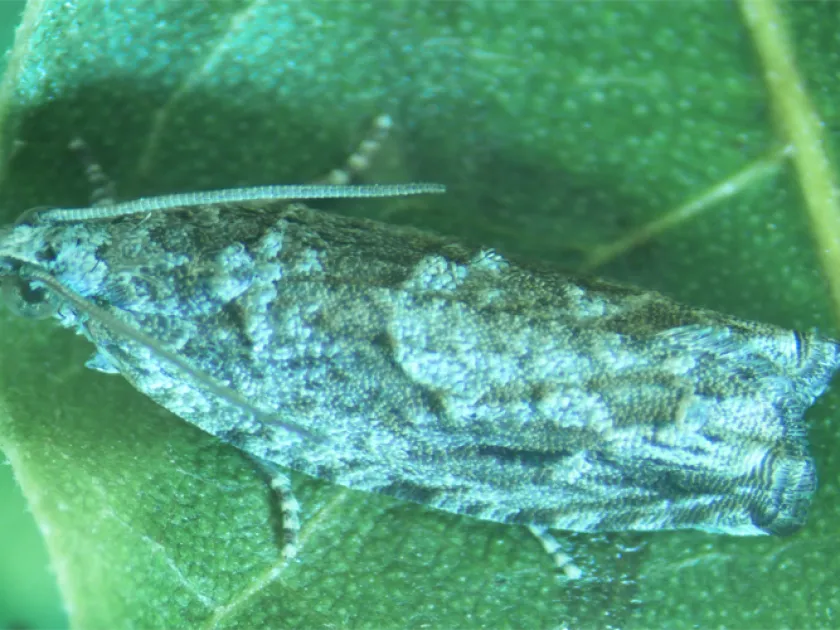
The pecan bud moth (Gretchena bolliana) belongs to the order Lepidoptera and the family Tortricidae. The adult is a small, grayish-brown moth with cryptic coloration that allows it to blend into tree bark effectively.
The larvae are small caterpillars with a characteristic dark head capsule. They go through several instars, with their color ranging from translucent pale yellow to greenish-brown depending on their age and food source.
What it damages
The primary host for this pest is the pecan tree (Carya illinoinensis). It is considered a significant pest in nurseries and young orchards where structural growth is crucial for the tree's future development.
Feeding larvae target the terminal buds and tender shoots of the pecan tree. By consuming the apical bud, they inhibit vertical growth, forcing the tree to produce excessive side branches, resulting in a stunted or deformed canopy.
When it appears
The pecan bud moth typically overwinters as a pupa in protected areas such as crevices in the bark of the host tree or in leaf litter accumulated at the base of the trunk.
Emergence in the spring coincides with the bud break of pecan trees. Throughout the growing season, multiple overlapping generations can occur, meaning the trees are at risk from early spring until the late summer months.
Signs of infestation
Visible signs of infestation include wilted, dead terminal shoots that often break off easily. Webbing, which the larvae use to bind leaves and secure their feeding tunnels, is a clear indicator of their presence.
Inspectors can find excrement (frass) near the entrance holes of the buds or shoots. The resulting "witches' broom" appearance of the branch tips is a common long-term sign of heavy infestations in previous seasons.
Control measures
Monitoring using pheromone-baited traps is essential for timing insecticide applications accurately. Treatments should be targeted at newly hatched larvae before they bore into the plant tissue.
Cultural practices include the removal and destruction of infested prunings and fallen leaves to reduce the overwintering population. Keeping the orchard clean helps prevent the re-establishment of the pest.
Systemic insecticides are generally effective as they translocate into the new growth where the larvae feed. Applications should be performed according to regional pest management guidelines and economic thresholds.
Taxonomy
- Latin name
- Gretchena bolliana
- Order
- Lepidoptera (butterflies)
- Family
- Tortricidae
- EPPO code
- GRETBO
Discussion
No discussions yet — be the first.