
Lesser appleworm
Grapholita prunivora
Description
How to identify
The Lesser appleworm (Grapholita prunivora) is a member of the Tortricidae family. Adult moths are small, with a wingspan ranging from 9 to 13 mm, characterized by dark brown forewings featuring metallic highlights and light markings.
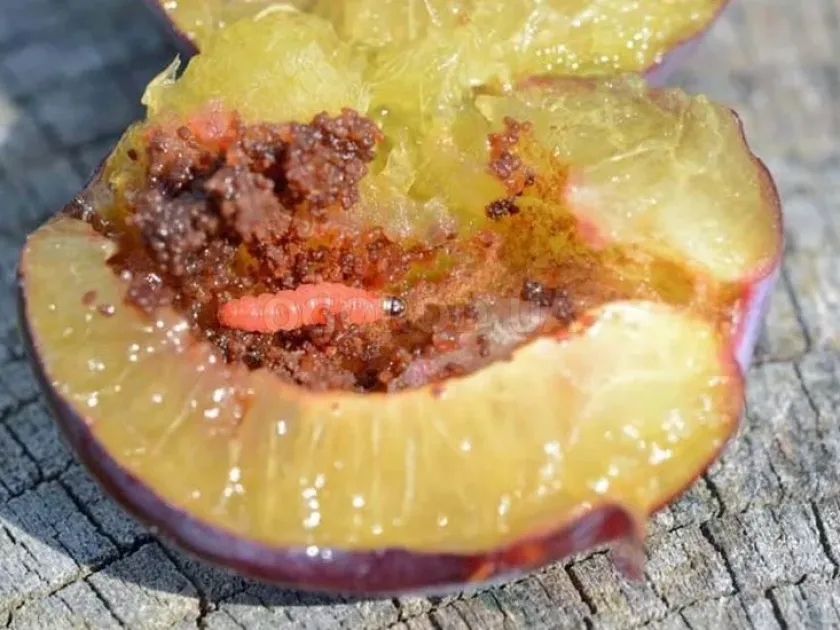
Larvae are typically small, reaching about 10 mm in length. They are identified by their reddish or pinkish bodies and dark brown heads. These larvae undergo several instars before reaching maturity and spinning their cocoons.
What it damages
This pest primary targets stone fruits. Plum trees are the most common hosts, although the pest is also known to infest peaches, apricots, and cherries in various regions.
The larvae feed on the internal tissues of the fruit, often boring toward the pit. This feeding behavior ruins the fruit quality and often triggers early fruit drop in infested trees.
When it appears
The insect typically overwinters as a mature larva inside a silk cocoon. These cocoons are hidden under the bark of host trees, in pruning scars, or in debris on the ground.
Adult emergence usually occurs in late spring, aligning with the flowering period of fruit trees. Depending on the local climate, the species can complete multiple generations within a single growing season.
Signs of infestation
Infested fruits display small entry holes often surrounded by larval frass and webbing. Sometimes, a localized discoloration on the fruit skin indicates internal feeding activity.
Interior damage is characterized by tunnels bored into the pulp. In many cases, the affected areas become entry points for secondary fungal infections, leading to rot.
Control measures
Integrated pest management starts with sanitation, including the regular removal and destruction of fallen or infested fruit to break the life cycle. Clearing debris from the orchard floor is essential.
Chemical control is applied during the egg-hatching phase to prevent larval penetration. Pheromone traps are highly effective for monitoring flight patterns and timing the application of insecticides precisely.
Taxonomy
- Latin name
- Grapholita prunivora
- Order
- Lepidoptera (butterflies)
- Family
- Tortricidae
- EPPO code
- LASPPR
Discussion
No discussions yet — be the first.