
Pea moth
Grapholita nebritana
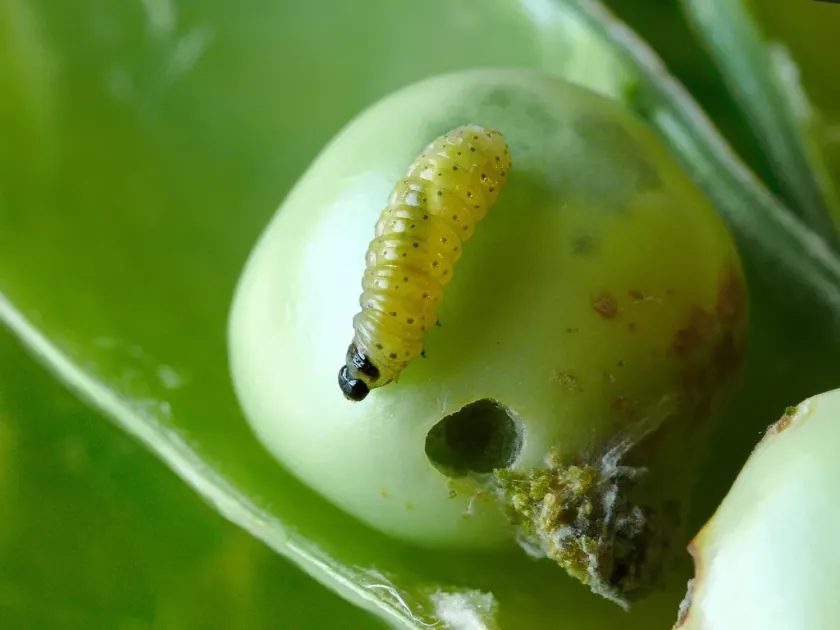
Description
How to identify
The pea moth Grapholita nebritana (often referred to as Cydia nigricana) is a small moth belonging to the Tortricidae family. The adult has a wingspan of approximately 15 mm and features dark grey forewings with distinct light markings and a metallic mirror-like spot.
The larva, or caterpillar, is the stage responsible for crop damage. It grows to about 10–12 mm in length and is typically creamy-white when young, turning a characteristic pinkish-red as it matures. The head capsule is dark brown, providing a key identification feature.
This species undergoes complete metamorphosis. It overwinters in the soil as a mature larva inside a silk-lined cocoon. In late spring, the pupation process occurs, and adults emerge, with their peak activity timing usually coinciding with the flowering period of pea crops.
Female moths lay their eggs singly or in small clusters on the leaves, stipules, and pods of host plants. A single female can produce up to 200 eggs, making the population potential quite high under favorable summer weather conditions.
Agronomists often use pheromone traps to monitor adult flight activity. This is essential for timing chemical or biological interventions to maximize efficacy against the pest population during the critical egg-laying window.
What it damages
The primary host for the pea moth is the garden pea Pisum sativum. However, it can also infest other pulses, including lentils and vetches. The damage is primarily caused by the larval stage feeding within the developing pods.
Upon hatching, larvae bore through the pod wall and feed directly on the developing seeds. This destruction leads to significant yield losses, as the larva consumes the interior of the seeds, often leaving frass behind, which triggers rotting and quality degradation.
Damaged seeds are significantly lighter and have poor germination energy. Such infestation renders the grain unfit for high-value food markets and reduces its viability as sowing material for the following season.
In high-pressure years, if left unmanaged, the pea moth can destroy a significant portion of the crop, with damage levels reaching 40-50%. The larvae may move between pods, increasing the total number of damaged seeds per plant.
Beyond direct yield reduction, the physical presence of larvae and their excrement within the grain creates severe logistical challenges during processing, requiring intensive sorting and cleaning to meet food safety standards.
When it appears
Adult flight activity typically begins in late May or June, depending on local climate conditions. The timing of this activity is highly synchronized with the pea crop's flowering phase, which is when the plants are most susceptible to egg deposition.
One generation is produced per year in most temperate regions. However, warm and dry weather during the summer accelerates development and increases the success rate of larval penetration into the pods.
The feeding period of the larva inside the pod lasts for approximately 3 to 4 weeks. Once the larva reaches maturity, it bores an exit hole, drops to the soil, and prepares to enter the pupal stage for winter survival.
Temperature serves as the primary driver for both pupal emergence and egg development. Monitoring growing degree days can help predict the precise timing of peak emergence, allowing for more precise management actions.
Due to shifting climate patterns, some regions have reported minor shifts in seasonal activity, requiring growers to stay vigilant and rely on localized field scouting and trap monitoring data rather than calendar dates alone.
Signs of infestation
The most reliable sign of an active infestation is the presence of tiny, circular entry holes in the pod walls. Often, these holes are accompanied by fine dust or "frass" visible on the surface of the pod.
When pods are opened, one can observe larval damage, including hollowed-out seeds and silky webbing produced by the caterpillar. The pinkish color of the mature larva is a diagnostic feature when found inside the pod.
Field scouting often reveals the moths themselves, which are easily disturbed during the early morning or evening hours. They fly in short, irregular bursts just above the canopy of the pea plants.
Stored grain inspections might reveal exit holes in the seeds or the presence of mature larvae, particularly if the harvest was processed without prior pest control measures in the field.
- Small entry holes in the outer pod wall.
- Frass and debris visible on pods.
- Hollow or distorted seeds upon shelling.
- Presence of pink-colored larvae within the pod.
- Reduced seed weight and quality during post-harvest assessment.
Control measures
Cultural control is the first line of defense. Rotating crops to move peas away from previous years' sites and maintaining spatial isolation from older fields are highly effective in limiting early-season colonization.
Deep autumn plowing of infested fields is crucial. This practice exposes overwintering pupae and larvae in the soil to harsh weather and surface predators, significantly reducing the survival rate for the next season.
Early-maturing pea varieties are a proven strategy for escaping the peak egg-laying activity of the moth, as the pods harden and become less attractive to the newly hatched larvae by the time the flight period hits its peak.
Chemical control focuses on applying insecticides during the peak of adult flight, ensuring the residue is present to prevent larvae from successfully boring into the pods. Timing is critical, as once inside, they are protected.
Biological control methods include the mass release of egg parasitoids like Trichogramma. These tiny wasps parasitize the moth eggs, preventing larval development and offering a sustainable alternative to conventional pesticides.
Taxonomy
- Latin name
- Grapholita nebritana
- Order
- Lepidoptera (butterflies)
- Family
- Tortricidae
- EPPO code
- LASPNE
Discussion
No discussions yet — be the first.