
Hawthorn moth
Grapholita janthinana
Description
How to identify
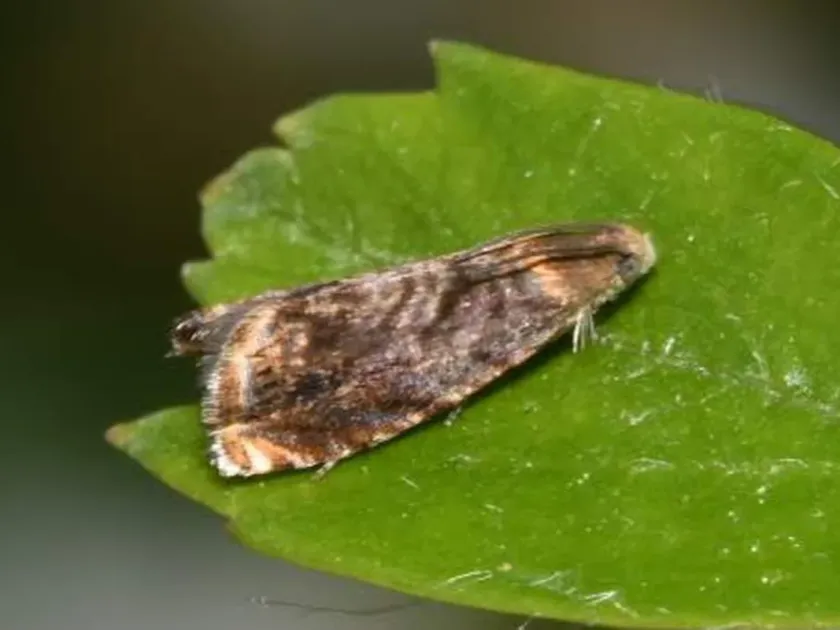
The hawthorn moth (Grapholita janthinana) belongs to the order Lepidoptera and the family Tortricidae. These small moths typically feature a wingspan of 10–13 mm with dark, often metallic-toned forewings that provide excellent camouflage against tree bark.
The larvae are typically whitish to pale pink with a distinct brown head capsule. They grow up to 10 mm in length and spend their entire developmental cycle inside the fruit of their host plants, making them difficult to spot during routine inspections.
Eggs are laid singly on the surface of developing fruits or their stalks. The incubation period is relatively short and highly dependent on ambient temperatures, which dictate the synchronization of the moth's life cycle with its host.
Overwintering occurs at the final larval stage. The caterpillars spin silken cocoons in protected sites such as bark crevices, under lichen, or in cracks in the woody parts of the host trees.
Adult moths are primarily crepuscular, meaning they are most active during twilight hours when mating and oviposition take place. Their behavior can be monitored using specialized pheromone lures.
What it damages
The primary hosts of this species include hawthorn (Crataegus), but it also poses a significant threat to other Rosaceae species, including apple, pear, and rowan trees. It is a common pest in hedges and traditional orchards.
Damage is caused by the larvae, which bore into the fruit to feed on the pulp and seeds. This activity leaves a visible entry hole and hollows out the inside of the fruit, causing significant structural damage.
Infested fruits frequently drop prematurely, causing measurable crop losses. The internal tunnels created by the larva are often prone to colonization by fungal pathogens, leading to rot and complete fruit decay.
Large-scale infestations can affect a high percentage of the harvest, especially in years when weather conditions favor the rapid development of the larvae.
Because the larvae are concealed within the fruit, the damage is often discovered only when the fruit begins to wither, change color, or show premature signs of softening.
When it appears
The flight period for the first generation of adults typically begins in late spring, generally coinciding with the flowering and early fruit set stages of hawthorn and related species.
Larval development occurs throughout the summer months. Depending on the geographical location and regional climate, the hawthorn moth may complete one or two generations per year.
Peak larval activity is observed during mid-to-late summer, corresponding with the period when fruit growth is most rapid. This is a critical time for monitoring potential outbreaks.
As autumn approaches, the mature larvae exit the fruit and seek out suitable locations for overwintering. By the onset of cold weather, they have usually constructed their cocoons.
Monitoring using pheromone traps is essential from late May onwards to determine the precise timing of adult emergence and to assess the threat level to the orchard.
Signs of infestation
The most reliable sign of an infestation is the presence of small, inconspicuous entrance holes on the fruit surface, often surrounded by small amounts of larval frass.
Premature ripening and the unexpected drop of seemingly healthy fruits are common indicators. Upon cutting open such fruits, one can usually find the larval tunnels and the larvae themselves.
In some cases, the larva may connect multiple adjacent fruits using silk, which provides a protected environment for feeding and eventual exit for pupation.
Visible changes in fruit morphology, such as localized softening or brownish discolorations, often mark the site of larval penetration and subsequent tissue destruction.
Observing rowan or hawthorn trees near fruit orchards is crucial, as they often serve as primary reservoirs from which the pest spreads to commercial fruit crops.
Control measures
Cultural control practices are the first line of defense. Regularly collecting and disposing of fallen fruit helps eliminate larvae before they reach the stage of pupation.
Applying sticky bands or cardboard traps to tree trunks can help catch larvae as they migrate from the fruits to their overwintering sites, significantly reducing the next year's population.
Biological control methods involve enhancing the presence of natural enemies, including parasitic wasps and predatory insects, which help keep the moth population in balance.
- Implement sanitation measures to remove infested fruit.
- Use pheromone traps for monitoring and mass trapping.
- Apply targeted biological insecticides if the population exceeds threshold levels.
For chemical control, timing is everything. Applications should be performed based on the emergence patterns detected by traps rather than on a calendar schedule to ensure maximum efficacy.
Maintaining a clean orchard environment and reducing the number of untreated hawthorn hedges in the immediate vicinity can greatly reduce the pressure of this pest on fruit crops.
Taxonomy
- Latin name
- Grapholita janthinana
- Order
- Lepidoptera (butterflies)
- Family
- Tortricidae
- EPPO code
- CYDIJA
Discussion
No discussions yet — be the first.